Listen to this essay
25 minute listen
Late one night in February 2022, a Chinese man recovering in a Cambodian hospital explained how a group of online scammers had held him against his will, tortured him, and drained his blood. His name is Li Yayuanlun. From his bed, he said he had sought work as a security guard in China, but was tricked and apparently kidnapped, transported to Cambodia, and then sold into one of the country’s many fortified ‘scam compounds’ – facilities where workers labour around the clock to extract money from people online. When he resisted, Li was beaten and tortured, then passed from one scam operator to another. He claimed his captors finally began to drain large quantities of his blood: seven times in half a year. In the hospital, he pointed weakly at an infusion bag above his head. That was the size of each extraction, he said. In online articles, journalists began to describe his case as that of the ‘blood slave’.
Li’s tale had all the elements of a nightmare: human trafficking, captivity, physical abuse, and an unexpected macabre twist. In response, Chinese social media lit up with outrage and sympathy. Even government officials in China and Cambodia took notice. For a moment, Li seemed to embody the darkest truths about the criminal scam compounds spreading across parts of Southeast Asia.
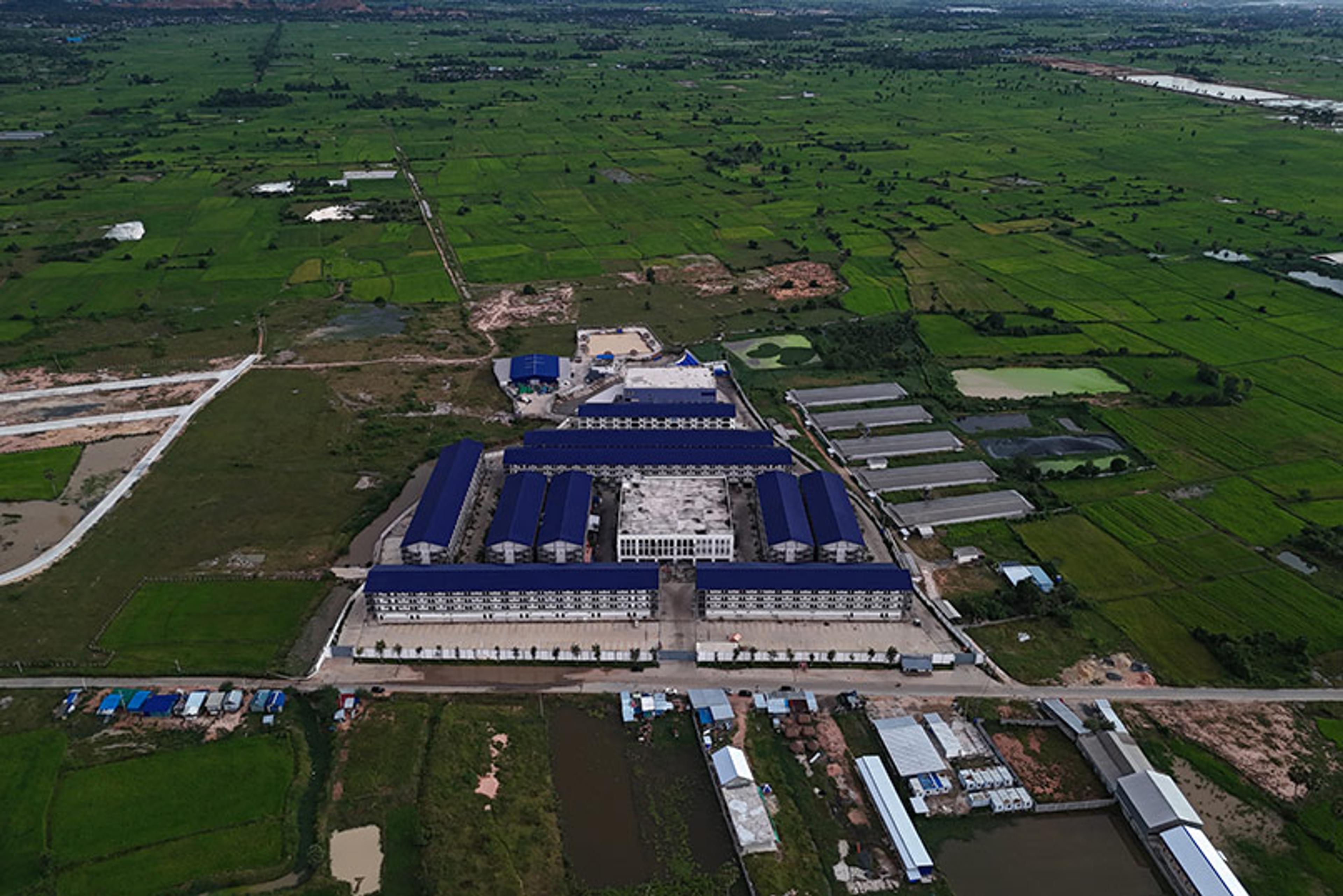
Drone view of the scam compound
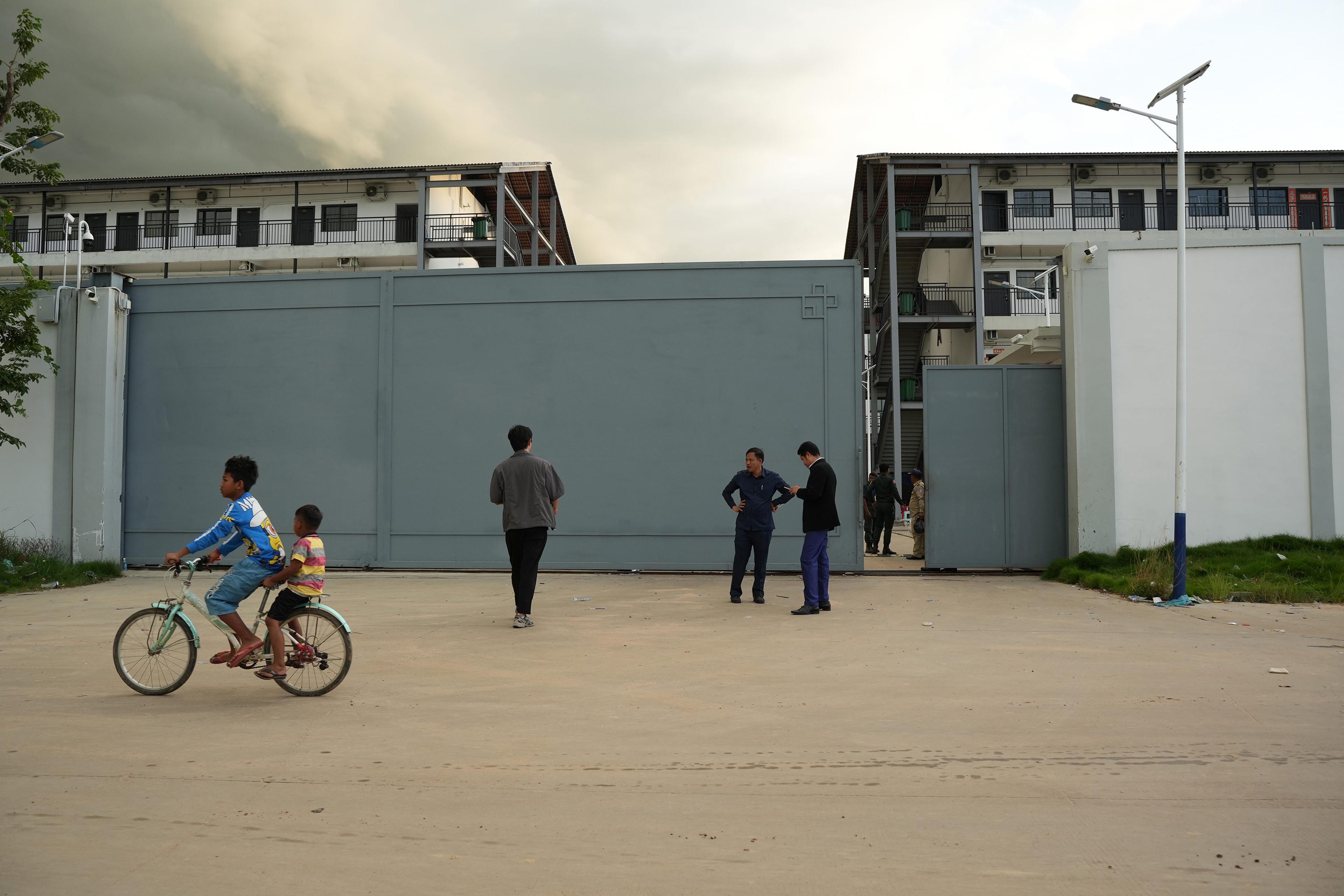
In the past decade, these walled enclaves have popped up in Cambodia, Laos, Myanmar, the Philippines and other nations. What began as a collection of small-time fraud operations run from apartments, villas, hotel rooms and back offices, often by ethnic-Chinese criminal groups, has expanded into a massive industry. There are now hundreds of fortified scam compounds in all shapes and sizes, bristling with guards, surveillance cameras and barbed wire. Behind the gates, thousands of workers run constantly evolving online schemes that target victims across the globe. They groom individuals through romance or investment schemes to strip them of their savings. They trick older people into giving up access to their bank accounts by offering fake ‘tech support’. They coerce migrants into laundering money. They pretend to be government or law-enforcement officials and exploit international students. These are just some of the many criminal operations currently being run from scam facilities in Southeast Asia.
Alongside the problem of regulating scam compounds and policing their operators, there is another issue: how should we understand the people working inside them? On the surface, they may appear as victims of modern slavery, like Li, or as hardened criminals targeting people online. But inside the murky underworld of scam compounds, familiar ideas about crime, scamming and slavery begin to unravel. In such a context, stories become tangled and uncertain as the boundary between truth and fabrication blurs. In the process, victimhood becomes a very slippery category.
Cracks soon appeared in Li’s account. Medical experts doubted him. The Chinese platform where he claimed to have seen the job ad that had led to his abduction found no evidence of the post. On social media, people started wondering why criminals would want to sell cheap human blood. The very details that made his testimony unforgettable – the stolen blood, the image of a man being milked like livestock – also made it seem doubtful. It was clear that he had been trapped in scam compounds and had emerged broken and ill. Less certain was how much else of his story was true. Was he really a victim of what the media described as ‘cyber slavery’?
Cambodian authorities jumped at the opportunity to claim that tales of forced labour in their country’s scam compounds were largely fabrications by hostile foreign forces or by workers dissatisfied with their bosses. Li’s case, however, reminds us of something more unsettling. Because survivors of scam compounds – of modern slavery – are often doubted or dismissed, they may sometimes feel the need to embellish or dramatise their stories simply to be heard. The urge to exaggerate is not necessarily evidence that they are inventing fictions to exculpate themselves. Instead, it can reflect the constant demands to prove their status as a victim – demands that become heightened in the context of the scam industry.
Each worker in the scam compounds of Southeast Asia sits along a spectrum of victimhood. At one end are the ‘pure’ perpetrators who knowingly profit from the misery of others. At the other end are the ‘pure’ victims who are trafficked, beaten, and held against their will. Between these poles lie the most troubling categories: perpetrators who later become victims, and victims who are compelled to become perpetrators. Even those who enter the industry willingly may do so due to limited opportunities and financial desperation. It is in this grey zone that the boundaries of suffering and responsibility blur, and it is here that modern slavery is being redefined.
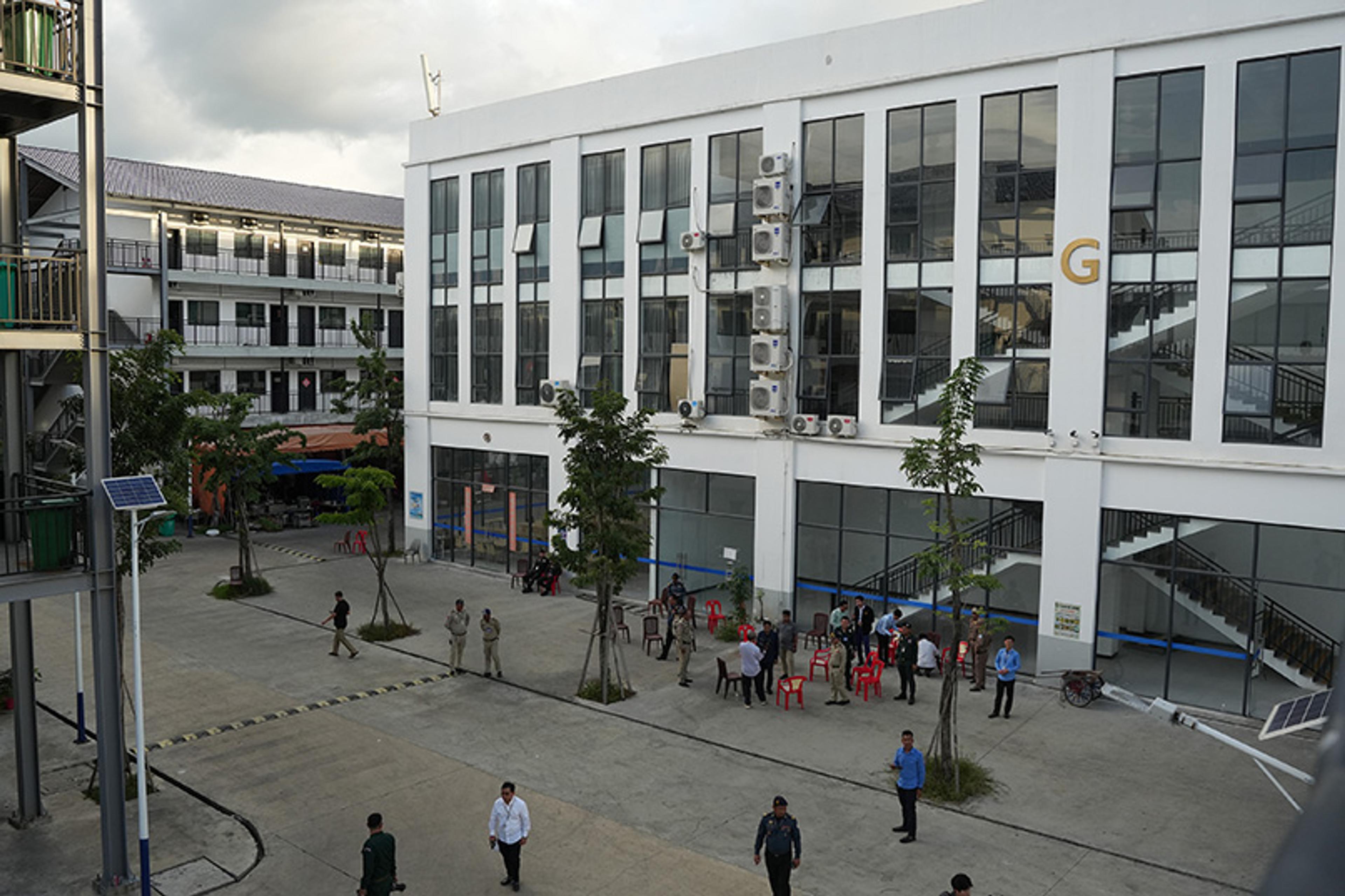
Cambodian officials inspecting the compound
How, then, should one respond to stories like Li’s that are so entangled in suffering, coercion and doubt? One place to start is simply by listening and taking testimonies seriously, even when they are messy or incomplete. That is the work we began doing in 2022, after Ling Li, one of the two authors of this essay, first encountered people trying to escape the compounds.
Ling is now a graduate student studying modern slavery, but around 2022, she was living in Cambodia for a research project on bride trafficking. While in Phnom Penh, she began hearing alarming accounts of people trapped inside scam compounds, and soon found herself assisting Chinese charity groups and other civil society actors working to rescue them. As she became increasingly involved in this world, Ling engaged with hundreds of people who had escaped these facilities. She interviewed dozens about their experiences. The other author of this essay is Ivan Franceschini, who, before studying the world of scamming, had spent nearly a decade researching labour issues linked to Chinese investment in Cambodia, including in Sihanoukville, a coastal town that morphed into one of the world’s major scamming hubs during the COVID-19 pandemic. As Franceschini watched the city transform – some of the sites where he had conducted fieldwork turned into fortified scam compounds – he felt compelled to understand what was unfolding. To dig further, we also teamed up with Mark Bo, a researcher with a background in corporate and financial mapping who had long been based in Cambodia. Mark helped to trace the intricate criminal networks involved in the industry. For the past few years, we have together attempted to unravel the complex social worlds emerging in and around scam compounds.
Many of the accounts Ling gathered through her interviews were harrowing. So were many of the stories we heard from people at the frontline of rescue efforts. Sometimes we even witnessed disturbing events unfolding in the field.
The two girls and Bao had never scammed anyone, never had a chance to refuse or consent
Consider, for instance, the case of a teenage boy from Jiangxi province whom Ling encountered while she was assisting a Chinese charity group in Cambodia that was arranging his repatriation to China. We will call him Bao. He was just 15 when, in July 2024, he set out to earn money for his family during the summer holidays. His parents were heavily in debt, and Bao hoped to ease their burden by taking a short-term job he found online: two months packing goods at a factory in Nanning, a city near China’s border with Vietnam. He was promised a wage of 10,000 yuan (around $1,400 USD), but he never reached the factory. Instead, traffickers took him across the border into Vietnam and then into Cambodia, where he was sold to a scam compound in the town of Bavet. For two weeks, he was trained to type faster so he could run online scams, but his skills were too limited. He was reassigned to a restaurant inside the compound where he served as a waiter and delivery boy. His ordeal ended only when his family scraped together a ransom of $12,000 USD to buy his freedom, an expense that pushed them further into debt.
Bao is not the only minor whom Ling came across while she assisted Chinese charity groups in Cambodia. She later learned of two 14-year-old girls from Jiangxi who were trafficked to Cambodia in August 2024 after a classmate’s boyfriend told them about a temporary work opportunity. Their families paid more than $10,000 USD to secure the girls’ release, in one case diverting money that had been set aside for an elderly grandfather’s medical care. Even after making this sacrifice, their ordeal did not end outside the compound. Chinese police issued documents certifying that the girls had been trafficked, but Cambodian immigration officers refused to let them leave without receiving an additional fine, along with payments for shelter and repatriation.
The two girls and Bao had never scammed anyone, never earned the money they were promised, and never had a chance to refuse or consent. These stories underline the farthest and bleakest pole of the spectrum of victimhood: children trapped in a system where their youth and powerlessness leave no room for complicity. And yet, even after escape, their suffering is compounded by ransom demands and bureaucratic cruelty.
Another young woman Ling spoke with, whom we will call Alice, also shows what this end of the spectrum can look like. In June 2022, Alice was lured to start a new office job in Cambodia by a trusted friend in the Philippines, who even paid for her visa and ticket to Phnom Penh. After arriving, Alice learned she had been sold into a compound to conduct online scams and would not be allowed to leave until she had earned enough for the company. When she resisted, her supervisor threatened her with a stun gun and warned that he would let men rape her if she did not comply. Sadly, that is exactly what happened.
‘It is not a matter of being greedy or stupid. It can really happen to anyone’
In an interview with Ling, Alice described how she was first pushed into doing scams: ‘I knew it was illegal, so I played dumb and said that I didn’t know how to type,’ she said. ‘[T]hey assigned me to do cleaning and paperwork. Then they sold me again and again. I was repeatedly raped and almost forced to work in a brothel-like clubhouse in the last company.’
Alice eventually managed to send a desperate call for help on Instagram, which led to her rescue before she was sold for a fifth time. But her ordeal did not end there. That cry for help revealed her story to those in her social circles, and instead of receiving support she faced public shaming. Now back home, she struggles to reintegrate. ‘I want you to write about me,’ she told Ling. ‘I am a victim of modern slavery, but no organisation is helping me. I also want to say it is not a matter of being greedy or stupid. It can really happen to anyone.’
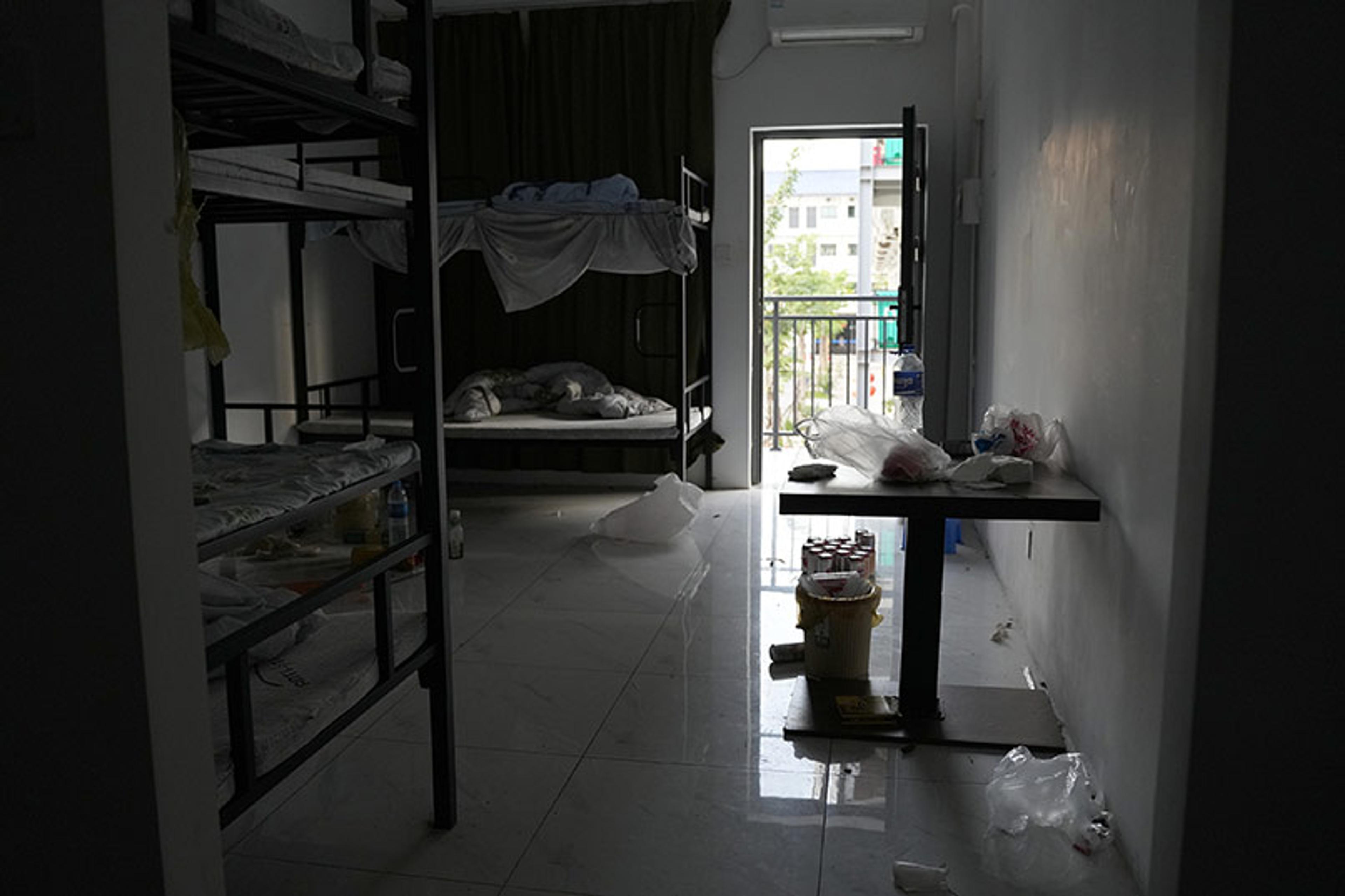
A dorm room inside the scam compound
Alice’s testimony shows what it means to stand at the far end of the spectrum of victimhood where there is no choice or complicity, only violence and humiliation. It also reminds us that the harm of the scam compounds does not end at the compound gates, but lingers in the silence, stigma and abandonment that survivors face once they return home. Taken together, these stories offer a portrait of victimhood that aligns with familiar understandings of modern slavery: innocent minors and a vulnerable young woman pulled into a predatory world dominated by ruthless men.
But the compound workforce is far more complex than these examples suggest. Not everyone arrives due to coercion or deception.
To run smoothly, scam compounds rely on a complex criminal ecosystem in which recruiters, brokers, enforcers and managers work together. This is a fluid system, which can absorb new labour when it needs. It is also structured and stable, thanks to overlapping hierarchies: seasoned scammers and ‘human resource’ officers recruit newcomers; brokers sell people across borders; armed guards and ‘team leaders’ enforce discipline; and scam bosses extract profits from the shadows. Some of the people we spoke with had moved through these different layers during their time in the compounds. This helped show us how the same individuals helping to sustain the system can also be consumed by it.
Take the case of a 29-year-old from Guangdong who had ties to the scam industry and was actively seeking new opportunities within it. We will call him Ming. His trajectory changed abruptly after a falling-out with one of his bosses, a case of what those in the Chinese underworld call ‘hēi chī hēi’ (‘black eats black’) – an expression for criminals preying on one another.
His story captures the paradox of the perpetrator who becomes a victim, only to re-emerge as a perpetrator
In June 2024, Ming was kidnapped and forced into a compound, where he fell victim to the violence he had once helped perpetuate. For three months, he endured daily beatings as others around him succumbed to despair. In the compound, he witnessed workers take their own lives rather than continue. Convinced that he might die, he managed to contact allies on the outside who eventually secured his release.
The ordeal left him traumatised but unreformed. Once free, Ming drifted back into the scam industry. His story captures the paradox of the perpetrator who becomes a victim, only to re-emerge as a perpetrator again. In the world of scam compounds, victimhood does not always erase culpability, and criminality does not protect against becoming a victim.
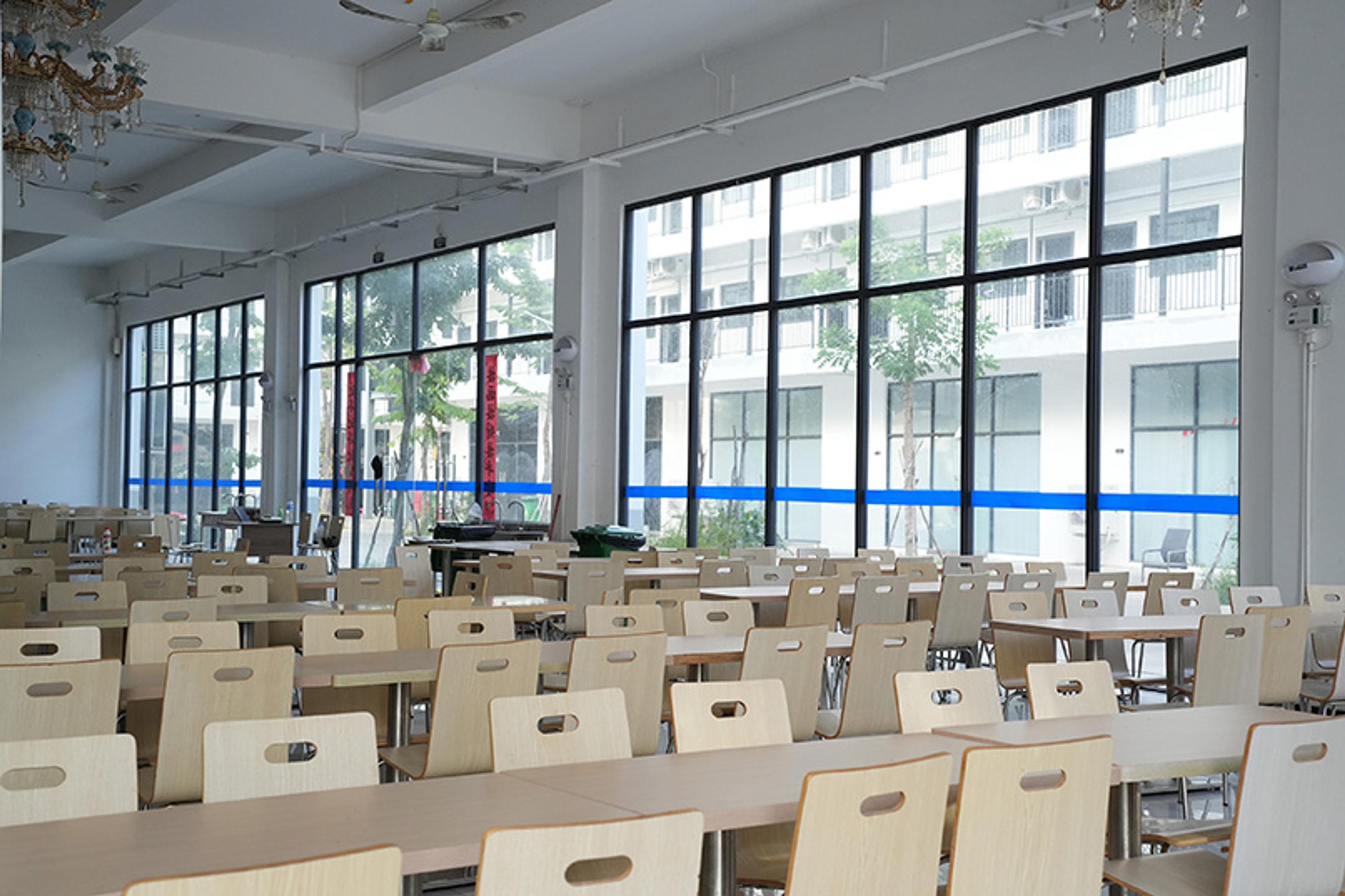
The scam compound canteen
Perpetrators who turn into victims are the hardest category to recognise. People who willingly engage in criminal activity have little incentive to admit their past once they become victims. In addition to the stigma that accompanies victimhood, they might have to face legal consequences for the suffering they inflicted on the people they scammed. For law enforcement, this translates into an acute dilemma: how should those who were genuinely coerced be distinguished from those who remain active criminals, without letting offenders slip away under the guise of being victims? Humanitarian organisations, already dealing with resource constraints, face a similar challenge. NGOs cannot easily draw clear lines between the ‘deserving’ and ‘undeserving’, yet they must decide who to rescue, shelter or support – decisions that are scrutinised by donors and authorities.
The people trafficked into compounds often have no choice but to engage in criminal activities, due to the consequences of resisting. During our fieldwork, we encountered many such cases of victims who were forced to participate in scams.
In September 2023, a woman whom we will call Tavares travelled to Cambodia for what she believed was the start of a promising new career. She had been recruited online for a job as a customer service manager. But when she landed in Phnom Penh, she was taken to a scam compound in Kandal province. Her passport was seized on the pretext of arranging a visa and, for the next 15 months, she lived in captivity. She was beaten, threatened and forced to work under brutal conditions. However, because of her educational background and financial literacy she was soon tasked with refining the scams themselves. She edited scripts and recordings, polished websites, and helped invent some of the fictional identities that scammers would use to lure targets into fake investment schemes. In some of these scams, she posed as an American assistant in her 30s, working with others playing different roles in elaborate dramas designed to defraud strangers in the United States, the United Kingdom, India and the Netherlands. Under duress, she found herself compelled to make the scenarios more convincing, inflicting more suffering on those who were scammed.
Their slide from victim to perpetrator was shaped by incentives, debts and the absence of alternatives
This blurring of victim and perpetrator becomes particularly stark when survivors are forced to recruit others into the compound workforce. In one case reported online in 2022, a Vietnamese woman who had experienced what she described as the ‘hell’ of being sold from compound to compound eventually became a recruiter herself. She made peace with her new role, even as she continued to lure people into a business that had traumatised her. In another case, reported online in 2023, a Vietnamese man trafficked to Cambodia confessed that he tricked three of his friends into joining after his captors promised to pay him for each recruit. ‘In order to have money and not be starved and be beaten, I tricked three of my friends into coming here,’ he told journalists, adding that he never received the money in the end. In Myanmar, some survivors reported being told that their only way out was to find replacements, sometimes five or more people. These stories expose the industry’s dehumanising logic: survival often hinges on inflicting suffering on others, and people who began as victims are turned into vectors of the very harm they once endured.
Other cases we came across were even more complex and surprising. Sometimes, victims who gained their freedom from scam compounds returned to the industry as willing perpetrators without direct coercion. Their slide from victim to perpetrator was shaped by incentives, debts and the absence of alternatives. Research by the Vietnamese NGO Blue Dragon Children’s Foundation found that 10 of the 43 traffickers they studied had once been victims themselves. Some were still held inside the compounds when they were told they could earn commissions – between $40 and $1,400 dollars – for every person they brought in. Others were released only after paying ransoms, but then pressured to recoup their losses by recruiting. In some cases, workers who had left the compound and returned home found themselves surrounded by scam networks. Unable to find legitimate work, they drifted back into recruitment out of desperation rather than malice.
These trajectories complicate any simple distinction between coercion and choice. Even when not under the immediate threat of violence, survivors’ decisions were shaped by fear, debt and poverty. The scam compounds create and feed on conditions in which the line between victim and perpetrator is being continually redrawn. Even after people leave, these conditions can follow them.
Many of the stories we heard illustrate what criminologists call the ‘victim-offender overlap’. This is the observation that victimised people are disproportionately likely to offend, and vice versa. Since 1948, when the criminal psychologist Hans von Hentig first proposed the concept, criminologists have examined how the roles of victim and offender are neither mutually exclusive nor stable. These roles can intersect within the same person, relationship and moment. Fangzhou Wang, one of the few researchers who has studied the overlap in the context of cybercrime, shows that those trafficked into compounds are subject to a range of pressures, ‘including isolation, financial coercion, physical abuse, drug influence and brainwashing that are designed to forcibly transform the trafficked victims into scammers’. Occupying this in-between category can cause some people to have difficulty deciding ‘whether escape and surrendering to law enforcement is a viable option,’ Wang writes.
In the broader public imagination, victims and offenders remain sharply separated into moral opposites: one deserves sympathy, the other punishment. In the scam compounds, the overlap is structural, forcing us to confront the ways that categories can collapse. The modern scammer and so-called cyber slaves unsettle the way we usually think about crime. A woman like Tavares may have been trafficked into the compounds but is made to use her skills to polish fraudulent investment schemes. A man like Ming may have once profited from scams, only to be kidnapped and beaten into submission. In light of the overlap, the scam compounds are not just sites of individual criminal acts but factories of moral degradation. They reveal a political economy of exploitation that produces victims and perpetrators, collapsing the distinction between the two, and leaving survivors stigmatised and distrusted even when their suffering is real.
Some were forced to participate in scams, recruit new arrivals, or police their peers as the price of survival
To understand why some stories resonate and others do not, we need to look at the idea of the ‘ideal victim’. Criminologists use this term to describe those who most easily win recognition as legitimate victims: the weak, the innocent, the respectable, and others who could not possibly be blamed for their fate.
Most people working in the scam compounds, however, do not fit this ideal type. Many are young men from poor families, physically able-bodied, and therefore seen as less vulnerable and more responsible for their fate. Some answered job ads that seemed too good to be true. Others entered the industry knowingly, hoping for quick earnings, before discovering they could not leave. Still others were forced to participate in scams, recruit new arrivals, or police their peers as the price of survival. Women can fall outside the frame of recognition, too, especially when their ordeals involve sexual violence, which is often met with shame and suspicion rather than compassion. Alice is an example: despite the horrors she endured, she was stigmatised after her rescue.
These morally complicated individuals with messy stories rarely elicit sympathy. Authorities dismiss them as criminals. Communities don’t trust them. Even NGOs sometimes hesitate to work with them, wary of cases where the line between victim and perpetrator is too blurred.
The story of Li Yayuanlun, the so-called ‘blood slave’, captures the unease at the heart of the scam crisis. His ordeal was real and his suffering undeniable. Yet the embellishments in his account made his story hard to believe and gave cynical authorities ammunition to question the testimony of others who had escaped the industry. His case forced the public to confront a difficult truth: in this world of captivity and coercion, victimhood is rarely pure.
This creates urgent dilemmas for those who must respond to the suffering caused by scam compounds. A trafficked woman may have helped polish scam scripts; a man beaten daily may have later recruited others. To governments, police and donors, these ambiguities may look like evidence of fraud or failure. To survivors, they mean fewer chances of assistance or reintegration – fewer chances of being recognised as victims.
The Nazi concentration camps produced a ‘grey zone’ of moral ambiguity, at times turning Jewish victims into kapos
Those of us who are the targets of scams, or simply bystanders, need to resist the instinct to view every scammer as a calculating villain. Such reactions are understandable. After all, scams cause appalling financial and emotional harm. But responding in this way flattens the complex trajectories that bring people into the industry. Recognising that some perpetrators are also victims does not excuse the damage they inflict. It challenges us to imagine solutions that go beyond punishment. This is how we might begin addressing the structural forces that sustain the scam economy in the first place: to see the scam compounds clearly is to recognise that victimhood is a shifting condition, not a fixed status.
In The Drowned and the Saved (1986), the Italian Holocaust survivor Primo Levi reflects on a comparable form of moral complexity forged in a radically different setting: the Nazi concentration camps. He shows how the camps produced a ‘grey zone’ of moral ambiguity, at times turning Jewish victims into kapos – privileged prisoners compelled to collaborate and exercise power over others. From this zone emerged figures who were neither simply monstrous nor merely pitiable, but often both at once: ‘obscene and pathetic’, as Levi puts it. We have an obligation to confront such figures, he insists, because understanding them is essential ‘if we want to know the human species, if we want to know how to defend our souls when a similar test should once more loom before us, or even if we only want to understand what takes place in a big industrial factory’ – that is, within any large, hierarchical system capable of redistributing responsibility and coercion.
It is exactly in this ‘grey zone’, as Levi calls it, that most survivors of Southeast Asia’s scam compounds today exist. Caught in a limbo between victimhood and complicity, their plight compels us to rethink what justice, responsibility and blame mean.