Listen to this essay
31 minute listen
If you think about recent podcasts you listened to and articles you shared, how many of them stressed the importance of community? Grappling with the loneliness epidemic, the damaging role of social media on face-to-face socialising, and young people’s struggles to interact with peers in the post-pandemic era, psychotherapists look for an explanation in the lack of ‘community’. Sociologists talk about community as a solution for childcare shortages and the best way to support nuclear families. Anthropologists remind us about the power of collective rituals, and bring up examples of culturally diverse models of communal life. Climate experts emphasise that the fight against the climate crisis entails the economy of sharing and a myriad of communal efforts. In short, whether it is about fixing the economy, healing individual traumas or saving a generation, ‘community’ appears to be the panacea.
If it sounds like I am sceptical about this ‘community hype’, it is not because I do not share the conviction about the importance of cooperation, support and solidarity – all that we tend to associate with ‘community’. Being a parent, a university professor, a citizen, an inhabitant of a rapidly warming planet, it’s hard not to recognise the damage that the undermining of communal ties has brought about at both individual and societal levels in the past decades, in which the spread and the normalisation of the neoliberal order has remade political, economic and social life. Yet, the diversity of problems that tend to be associated with the (presumed) lack or weakness of community should give us pause and make us ask not only if it is ‘the community’ that is seemingly universally needed and desired, but what kind of community, and also – what is meant by ‘community’? Further, these questions push us to consider: what was the reason behind the ‘escape from community’ in the first place, and what continues to push individuals away from it?
I write these words also as an ethnographer who has spent the past 10 years with a group of people – ‘a community’, as they would have it – who decline and conjugate the notion of community in all possible ways, rendering it nearly sacred. Since 2015, I have been following youth far-Right militants active in several European countries, collecting their life stories, observing them in action, and striving to understand what motivates them to embrace this radical nationalist ideology. The movements they belong to share a set of key characteristics: they are all ultranationalist, express attachment to Christian heritage, adhere to a conservative gender ideology, and consider interwar fascism to be a source of inspiration. Their reading of history and culture is filled with racist and xenophobic claims, and a deeply anti-pluralist and anti-egalitarian agenda. Members are active in a variety of domains, from historical politics through social assistance projects to promotion of sport activities and a healthy lifestyle. They see themselves as part of movements, not as political parties, and strongly emphasise their educational mission, with ‘education’ meaning a cultural and ethical upbringing. Numbering between dozens to a few hundred members, they are active locally and form tight groupings, often socialising on an everyday basis.
These similarities notwithstanding, the young people I met in Italy, Poland and Hungary differ in their approach to religion, their views on marriage and their concrete economic solutions. Young people active in one country and belonging to the same movement may disagree when it comes to intellectual figures they claim to find inspiring, and they may come from quite different backgrounds. Some are the rebellious kids of rebellious 1968ers – while others are the pious offspring of deeply religious Catholics. The diversity of pathways and personal stories struck me most when I embarked on this project and was striving to understand how this heterogeneity can coexist within movements that give the appearance of being rather homogeneous. A common denominator I identified in their accounts was the ‘search for community’ – when they explained what motivated them to join the movement – and the ‘power of community’ – when they explained what motivated them to stay. ‘We are like the Fellowship of the Ring,’ Alberto, an Italian activist, once told me, his eyes sparkling. ‘What attracted me to this community is that I realised that here we can have relationships like in The Lord of the Rings – friendship, closeness.’ His Polish peer Miron would say: ‘You know what attracts people to [this group]? A communitarian spirit.’
Throughout the years, my ethnographic engagements with far-Right activists made me realise both why ‘community’ is so appealing and ends up being considered the ultimate value, as well as why it is a trap. While the radical movements I studied may undoubtedly appear as marginal, idiosyncratic and having little to do with the aspirations, strivings and maladies of mainstream society, examining them closely demonstrates that ethnography, and anthropology more broadly, is about studying large issues in small places. But if a study of the far Right may tell us more about community writ large, what is community in the first place?
In discussing ‘community’ as one of his ‘keywords’ in 1976, the writer Raymond Williams noted that it can be ‘the warmly persuasive word to describe an existing set of relationships, or the warmly persuasive word to describe an alternative set of relationships.’ Either way, ‘it seems never to be used unfavourably, and never to be given any positive opposing or distinguishing term.’ The ‘warm’ connotations of the term date back to the social-scientific reflections on modernity and modernisation, wherein (traditional) ‘communities’ and (modern) ‘societies’ were seen as sets of, respectively, emotional relations and rational bonds. As such, communities were often idealised as cosy, less formal groupings, and contrasted with the cold, formalised relations that were supposedly to become dominant in modern times.
In the readings of Ferdinand Tönnies and of Émile Durkheim, ‘community’ vis-à-vis ‘society’ was about closeness vis-à-vis detachment, and about natural, organic relations vis-à-vis artificially established rapports. This transformation was not necessarily seen as negative. In adopting an evolutionary view, modern theorists posited that the disappearance of community would be tantamount to hierarchy and religious charisma giving way to equality and rational, scientific criteria. Such a view of social change also posits community against market forces. Therefore, in the Marxist reading for instance, the discourse on community may be ultimately ambiguous, with community representing, negatively, both the backward village life and, positively, the weapon against alienation.
Against the teleological reading of human history, which saw the transformation of communities into societies, the notion of community not only persisted but arguably expanded. And, whether we talk about a ‘neighbourhood community’, a ‘religious community’, a ‘European community’ or a ‘global community’, it is obvious that the term is being used because of its positive connotations – and because it’s vague enough to cover the variety of ways in which people relate and connect. Community thus appears to be a paradoxical term. Its ubiquitous use has nearly stripped it of meaning, but, at the same time, given how often it is invoked and applied, it must mean something.
First and foremost they see in community a response to liberalism and its ‘extreme individualism’
Community’s ‘affective potency’, to quote the anthropologist Ann Grodzins Gold, does not seem to weaken, even though numerous scholars have refuted the myth of community as a sphere of cooperation and harmony, showing it to be the locus of conflict, difference and inequality. As a matter of fact, even if the experience of community does not correspond to its romanticised image, the idealised view of community continues to persist and to evoke certain aspirations.
Far-Right activists likewise subscribe to such a romantic view of community: in talking about their movements, they reach for the notions of ‘brotherhood’, ‘comradeship’, ‘home’, ‘shelter’, yet first and foremost they see themselves as ‘ethical communities’ glued together by a shared ethics and a ‘communitarian spirit’. In embracing ultranationalist and ultrareligious rhetoric, they consider it a response to a globalised world in which distinct cultural communities and congregational religious life disappear. However, first and foremost they see in community a response to liberalism and its ‘extreme individualism’. In the activists’ understanding, liberalism is a system that destroys communitarian life and communitarian values at every level: political, economic, cultural, moral. ‘Liberalism is a suicidal system,’ Leonardo, an Italian activist told me once, shaking his head. ‘How can one believe in nothing?’ Far-Right militants’ embrace of the discourse of community is tantamount to a rejection of liberal modernity, and the wish to – in Leonardo’s words – ‘re-enchant the world’. The way they construe liberalism and liberals as opponents may sound like caricature, yet in fact is a key to understanding the appeal of far-Right visions of community – and, in the second step, of the appeal of community at large.
Since the outset of my research with far-Right youth, I have been asked a similar question: is it the promise of violence that attracts young people to the far Right, and is it the opportunity to engage in violence that bonds them with the group and makes them continue participating in the movement? Images of violence occurring globally – from the mosque shooting in Christchurch, New Zealand in 2019 and the assault on the US Capitol in 2021 to constant attacks on racialised migrants in Europe and anti-Muslim riots in India – make evident the high participation of young people. While I have never witnessed any episode of violence against outsiders, I was aware of the clashes at football stadiums and the hateful, violence-inciting rhetoric that some movements’ members were even sentenced for. However, in answering the question about pull-factors and motivations, I always point to what the far Right offers beyond violence.
A young man does not need to be a member of movement to break the window of a grocery store run by migrants or to engage in a fight at the stadium. Granted: a community, a community of believers faithful to a cause, may no doubt inspire such actions, and the connection between symbolic and physical violence is unquestioned. However, if we consider the cost that belonging to a far-Right community entails, it becomes clear that members draw from it benefits that may escape our attention, if all we look for are violent encounters. The same is true for the benefits drawn from membership, and which range from economic to emotional support. Miron, one of the Polish movement’s leaders and a deeply religious person, would often recount stories of personal transformation. Telling me about a man his comrades ‘saved’, Miron said: ‘He abandoned drugs; today he has a good job and soon he will move to his own flat. Without us he might not be alive now. And today, if someone else has a problem with drugs, we call [him], and he helps those people.’ And then of a different man: ‘Before joining [us] he had never held a book in his hand. And now he will sometimes surprise me by quoting some details I myself overlooked. Before, he was only interested in picking fights.’
A promise of, or hope for, transformation, via community, is crucial when considering pull-factors. In the words of one of the leaders, people who join far-Right movements are ‘either people with problems’ or people who ‘recognise that reality is not colourful, that something needs to be changed, something needs to be done.’ (Although he would not necessarily grant it, this appears to be true for movements more generally.) Let us look at two quite common trajectories of movement members.
A young woman goes to a hard rock concert with a schoolmate and finds out that it was organised by a group of people who share her musical taste; later, after a conversation, they invite her to go with them to a pub. There, she learns that the group organises a mountain hike on Sundays and decides to join them. She also learns about the work in the animal shelter the group performs on a regular basis. She begins attending Friday gatherings at the pub and volunteering at the shelter. She is a bit surprised when one of the gatherings turns out to include a talk by a far-Right politician who talks about ‘natural gender roles’ and defends the ‘traditional family’. She is disturbed by his patriarchal tirade. And yet, the more time she spends with the movement, the more her position on the matter transforms and crystalises: she claims she can be a female activist while not transgressing traditional gender hierarchies. She feels encouraged to perform various roles – simply within the limits set by the movement. Time spent with the group is her favourite escape from her tedious and poorly remunerated work in a call centre.
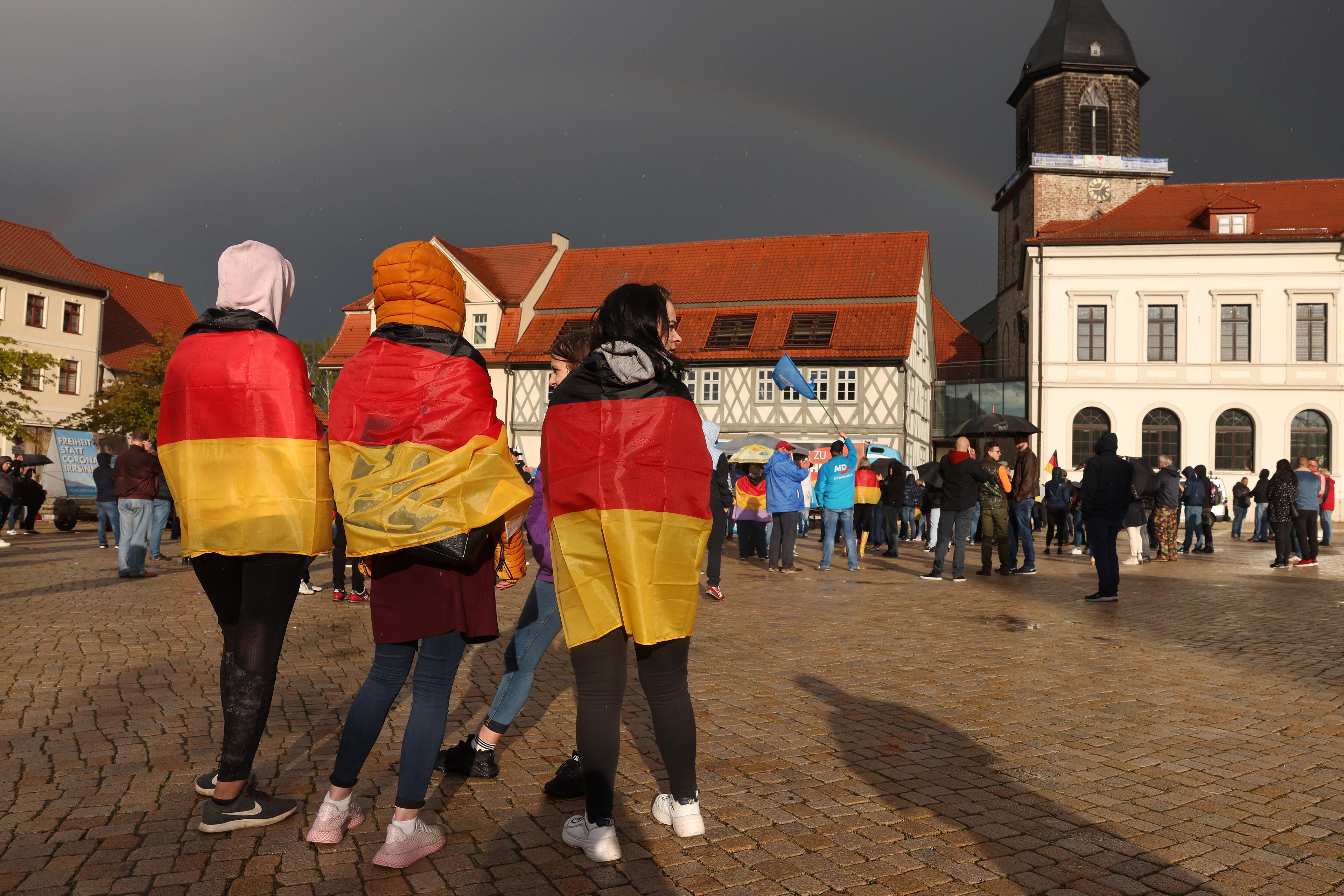
Photo by Florian Wiegand/Getty Images
While shopping at an outdoor market, a young man notices a group of young people collecting food for co-nationals in need. He donates some food, takes an information leaflet and enquires about the possibility of volunteering during food collections. He has recently finished high school where he interacted with many peers from migrant backgrounds. And, while he maintains he has nothing against migrants, he realises that people in his own country now need to compete for scarce resources: welfare services, jobs, access to healthcare. Having participated in several food collections, he learns more about the movement they represent. After one of the food collections, he follows the activists and visits the movement’s headquarters, where he combs through its little library. He finds books that provide him with vocabulary and interpretations: ‘great replacement’, ‘cultural incommensurability’, ‘anti-white racism’. During an anti-migrant demonstration the movement organises, he is the one to invent slogans and paint the banners.
Before becoming ‘full members’, both these young people will have to prove that ‘they are ready’: by participating as frequently as possible in the movement’s activities and by proving their familiarity with the ‘staple literature’. Once they are officially designated members during a highly emotional ‘community’ ceremony, they will continue socialising and organising a variety of things with their brothers-comrades while fulfilling clearly defined roles and unconditionally respecting the movement’s hierarchies: taking commands from their units’ leaders, being on time (and accepting punishment for lateness), and taking the floor only when asked to do so.
He depicts a transnational community of likeminded people united in their fight ‘against the modern world’
In the course of 10 years researching the far Right, I took part in a variety of group events; whether formal or informal, they always highlighted all the contradictions and paradoxes of ‘community’. Take the ceremonial event in Poland, a celebration of the movement’s founding anniversary, which also serves as an official introduction of new members and is attended by activists from all over the country.
Imagine an elegant conference centre, rented by the movement for this occasion in a mid-size town. Filled with stylish wooden furniture, the centre likely tends to host delegations of bankers and corporations rather than dozens of young people dressed in dark, military-style clothing. The organisers covered the bare walls of the room with flags and banners, featuring slogans such as ‘Not numerous but fanatical.’
The gathered activists occupy a few rows of chairs and listen in silence to the speeches. Several people take the floor, reporting on the movement’s operations and discussing plans for the future. One militant talks about the network of social support that the movement developed during the COVID-19 pandemic and about everything that this period taught them: ‘We realise the extent of social problems … I will never forget the smiles of kids from the orphanages … the importance of saying the rosary together.’ Another male activist talks about the vast networks of collaborations abroad, depicting a transnational community of likeminded people united in their fight ‘against the modern world’. A female activist, Alina, picks up on this issue and describes a new supranational initiative – a web platform where different nationalist movements publish essays on various subjects. A graduate in literature, she talks in a very engaged and eloquent way about what being an activist means to her: ‘It is the people that I meet in this movement that give me such a motivation to act.’ If you were sitting there, you’d be likely struck by the attention every speaker gets; by rows of youth listening in absolute silence, without scrolling on phones or even whispering.
A few other militants talk about political-economic issues, emphasising the strength of the national radical alternative as neither Left nor Right: the necessity to fight against both neoliberalism and the legacies of Soviet communism. One man makes it clear that at stake is also the economic domination of the ‘nation with curved noses’. The primitive antisemitic trope he reaches for is at odds with the rest of his speech in which he offers a well-grounded critique of the system of taxation favouring big international corporations at the expense of local entrepreneurs and employers. Finally, Miron, the movement’s leader, takes the floor. He describes his 10 years with the movement as the best time of his life. He sees the movement’s strength in the solidarity and koleżeństwo among the members. The Polish expression ‘koleżeństwo’ blends the idea of camaraderie, generosity and mutual support, and evokes the bond between the people united due to common passions or interests. Another member speaks not only to praise but also to criticise, accusing many activists of a lack of engagement and laziness. ‘It is time to move your ass!’ he exclaims.
The meeting has it all: connection with the past, emphasis on addressing present-day problems, the promise of a better future, all described in a language that mixes data-backed economic analyses with racist tropes, lofty vocabulary and swearwords. It is filled with excitement, expressions of solidarity and genuine friendship. A short movie prepared for one of the activists to celebrate his long service follows the speeches. The roughly five-minute video features a diversity of communal moments and activities: mountain hikes and evenings at the campfire, trail runs and martial-arts training, laughter during a meal and joint readings. The video evokes the spirit of koleżeństwo emphasised by Miron. Although made for an internal audience only (and thus, without a need to worry about potentially subversive political content or use of forbidden symbols), the sole reminders of the video’s protagonists are a picture of a Right-wing leader in the background and the movement’s logo on T-shirts.
Now imagine what a ceremonial oath may look like in such a milieu. When the person in charge announces that it’s time for this, a young man due to take the ceremonial oath closes his eyes, his veins pulsing. He bows his head, wrapping his hands around it. He looks like he is praying in silence, waiting to be called on stage. But the ceremony is interrupted. An activist takes the microphone and says: ‘I want you to think once again if you are truly ready. I don’t want you to call me in two months and say that you have changed your mind.’ He speaks firmly, yet in a slightly irritated voice. ‘Please, take it to your hearts. Leaving [the movement] means a betrayal. [The young man who is about to take the oath tightens when hearing the word ‘betrayal’.] In other words… be careful not to piss me off,’ he finishes on a less solemn note.
After he gives the microphone back, the new members’ names are read, and they are invited to come to the front. A dozen people repeat the pledge in front of a crucifix, promising faithfulness to the movement and service to the nation, and repeating: ‘So help me God.’ Afterwards, they are congratulated profusely. Other activists jump up to hug them and express their excitement at having them ‘fully on board’. The announcer shouts out: ‘This is not the end, this is just a beginning!’
Even though I was wary of how problematic it is to judge something ‘authentic’ or ‘genuine’, throughout my fieldwork I could not escape this kind of vocabulary when registering in my notes the indisputable joy the members seemed to draw from being together, the weight they assigned the membership, and the strength of community bonds (simultaneously realising the amount of preconceptions I had, and my expectations regarding the very instrumental nature of bonds). Observing the activists greeting each other, sitting together at the fire, standing arm in arm at a concert, or ardently debating an issue, I was struck by the degree of affection, closeness and mutual support – all that is ‘ideally’ associated with community. Crucially, the fact that the caring, horizontal bonds between ‘comrades’ and ‘brothers’ coexist within these movements with clear and strongly accentuated hierarchies does not seem to weaken those experiences – which is not surprising if we consider what I said above about the myth of community.
My conversations with people who had left the movement confirm these observations. While some former activists would tell me they realised how poisonous the movement’s discriminatory rhetoric was, or that the course the movement took was wrong, they hardly questioned their bonds of friendships, the support they’d received, what they’d learnt from others, and how the activism changed them.
A statement shared with me by Ula, one of my Polish research participants, helps to shed light on this issue. In explaining what the ‘far-Right community’ means, she emphasised that it merges three other forms of community: a religious renewal movement, a scout association, and a martial-arts group. All three put emphasis on order, hierarchy and discipline. Renewal movements bring to the fore the importance of spirituality and the possibility of transformation; scout movements – cooperation and responsibility for others; and martial arts – diligence and work on the self. Years of observation of youth far-Right movements made me keenly aware of the ways in which these different faces of community are indeed perceptible. When participating in a summer festival that merged camping in a forest with lectures on Christian Orthodox spirituality and a martial-arts training, or when observing a commemorative event in the course of which rows of militants marched and listened in silence to a solemn speech about their patriotic ancestors and the necessity for national rebirth, I was also becoming aware of how the tight community of militants is being (at times) extended to include other co-nationals, dead and alive.
Members believe they are different from a bunch of indifferent youth poisoned by the ideology of liberalism
This capacity to extend community in time and space, simultaneously emphasising its unique character is, in my view, the key to understanding the success of the far Right. Put differently, far-Right movements provide their members with a platform for being active on different levels. On the one hand, they invite them to participate in a ‘cause’ and belong to something that is presented as greater (and eternal). They emphasise the importance of ‘roots’ and ‘tradition’ and the ‘partnership of the dead, the living and the unborn’. Celebrations of the past and historical events are an integral part of a broader agenda: supporting the poor, activities in education and sport, campaigns targeting the defence of the ‘traditional family’ and Christian heritage; and also, recently, environmental issues and challenges brought by AI. ‘Past’, ‘present’ and ‘future’ are thus carefully linked. Through such a carefully constructed image of national community, linking questions of economy, culture and heritage, the movements’ leaders offer a view of the nation as a powerful panacea for current malaises and the only true source of social cohesion, and therefore one worth working for.
On the other hand, the movement’s self-image is that of the community of the chosen: people capable of and willing to sacrifice, to devote time to militancy and volunteerism, to work on themselves, and to pursue a mission. Members believe and support the view that they are different from their peers, from a bunch of indifferent youth poisoned by the ideology of liberalism. (As my interlocutor Leonardo would say, radical Left-wing activists might be considered their opponents but at least they’re people who believe ‘in something’ and in community.) The movements are also avenues of social mobility, sometimes in the material sense, and sometimes in terms of sociocultural capital.
In this way, by promoting the membership of tight, clearly delineated, quite exclusivist communities, they at once foster an emotional attachment to a larger community, cherishing the connection between the living and the dead and, through that, the idea of the nation. While it may sound backward-oriented, they understand it as a project for the future. Unsurprisingly, then, in discussing alternative economic scenarios or challenges brought about by the climate crisis, activists frequently reach for the notion of utopia, and claim that utopian language is the way to ‘re-enchant’ the rational modern world.
The centrality of community in far-Right activist practices has important implications for understanding the community question writ large. What I mean here more specifically is that it pushes us to enquire into the needs and desires that any young people may express. Although young people attracted by feminist, anti-racist or environmental activism might end up pursuing quite different goals, it may well be that what brought them to that activism, and what they find it offers them, would be interpreted by them in a way akin to far-Right youth’s motivations. Put differently, young people who become members of an evangelical church, a squatters’ movement or a student association may all be driven by similar needs, among which the wish to belong to a community and a critique of liberalism are central. And the reason why, increasingly, the far-Right offer is chosen from many other community options is what I call the capacity to link the tight community ‘here and now’ to a bigger ‘cause’.
By the same token, then, the centrality of community provokes the question not only about the appeal of ‘far-Right communities’ but of the present-day appeal of ‘communities’ more broadly. The conservative sociologist Robert Nisbet wrote in The Quest for Community (1953) that ‘The theme of the individual uprooted, without status, struggling for revelations of meaning, seeking fellowship in some kind of moral community, is … recurrent in our age …’ Questions of meaning, fellowship and belonging are prevalent features of our age too, and behind a contemporary ‘resurgence of community’. Arguably, they characterise any period of change. It is especially during periods of instability – and we are certainly living through such a time – that ideas about alternative ways of living are created and imagined. Utopian projects have usually involved some sort of vision of community.
At the same time, each community seems to be built on the grave of another. Once it turns out that the dream-community ends up intolerant, discriminatory towards some people or economically insufficient, it tends to be first abandoned and then replaced by another community that promises to be more inclusive, more equal, more just.
The idea of community as something we ought to desire and aspire to turns it into a sort of commodity
In her highly inspiring book Everyday Utopia (2024), the anthropologist Kristen Ghodsee criticises the nuclear family as patriarchal and capitalist. Wouldn’t we argue the same thing about, say, the multigenerational family living together 100 years ago in the countryside, a family likely reigned by a patriarch and operating as a small enterprise? And isn’t it fair to say that the move from such a model to the nuclear one was often liberatory, especially for the women whom Ghodsee is most concerned with? Granted, making up for the nuclear family’s shortcomings does not necessarily mean re-establishing the multigenerational ones but rather envisioning different forms of communal living: within patchwork families, with neighbours, friends and members of housing cooperatives. The key is that these new models are continuously invoked as communities, and with a hope that it will work this time.
Observations of far-Right communities remind us also that, while the discourse on communities tends to emphasise similarities and unity, it is as much about the difference – the opposition of a given community towards other groups and models of life. As the anthropologists Akhil Gupta and James Ferguson note in Culture, Power, Place (1997), community is built on various forms of exclusion and construction of otherness. The wish to belong and relate can thus be said to coexist with the wish to distinguish oneself, and the act of distinguishing – with discrimination and rejection.
This is precisely what should give us pause when we consider today’s ‘community hype’: it is easy, if not tempting, to point to the irrationalism of national identities and loyalties, to view performative patriotism as something outdated, and the discourse of roots and homeland as backward. The communities that the critics of the far Right aspire to build seem so different – they are diverse, egalitarian, tolerant, cosmopolitan, LGBTQ+ friendly – that it might be hard to see any affinity between them, nor is it easy to entertain the idea that the drivers behind the community quest are similar. And yet, being frank about what they have in common is necessary for understanding what drives youth to embrace the often radical visions of community.
What is further overlooked when we consider the ubiquity of the community discourse is that the idea of community as something we ought to desire and aspire to turns it into a sort of commodity. As social isolation is becoming a public health issue and seen as a cause of societal polarisation, community is called upon by politicians, doctors and educators. Manuals on how to successfully build a community become bestsellers, and workshops in community-building become obligatory at workplaces. Ironically, then, the ideal community seen as an alternative to market-logic and rampant individualism becomes yet another product to purchase and to increase individual success. Perhaps, then, the main puzzle of the ‘craving community’ question is: what is it that we actually crave?