Listen to this essay
35 minute listen
Describing the political map in terms of Left and Right is an accepted convention all over the world, almost to the point of cliché. Yet it is surprisingly complicated to explain whose interests lie on each side of this spectrum. For example, if the Left supports the interests of workers over the interests of employers, why are Left-leaning regions of the United States and elsewhere in the world among the richest? When Japan and South Korea sought to become economic powerhouses in the later 20th century, they adopted Leftist policies such as strong public education, universal healthcare and increased gender equality – if countries seeking to compete in capitalist arenas adopt broadly Leftist policies, then how do we explain why Leftists are always talking about overthrowing capitalism? And if the Left is somehow both the party of workers’ rights and the party of material wealth, then whose interests are supported by the Right? Given such contradictions, how did these terms become so central to modern politics?
The terms ‘left’ and ‘right’ come from the seating arrangements in the National Assembly during the French Revolution, where the combatants used the medieval estate groupings to define their battle lines. According to their writings, land-owning aristocrats (the Second Estate) were the party of the Right, while the interests of nearly everyone else (the Third Estate) belonged to the Left. This Third Estate included peasants working for the landowners but also every other kind of business owner and worker. Decades later, Karl Marx offered a different analysis of capitalism: he put owners of both land and businesses together on one side (the bourgeoisie), while grouping workers from fields and factories on the other side (the proletariat) in a single, world-wide class struggle. The trouble with both these ways of parsing Left and Right is that voting patterns never seem to line up with class. Both historic analyses leave us with questions about the contemporary world – and not just the paradox of why so many Left-leaning places are so rich. Why, for example, do working-class conservatives appear to vote against their material interests, year in and year out, across generations?
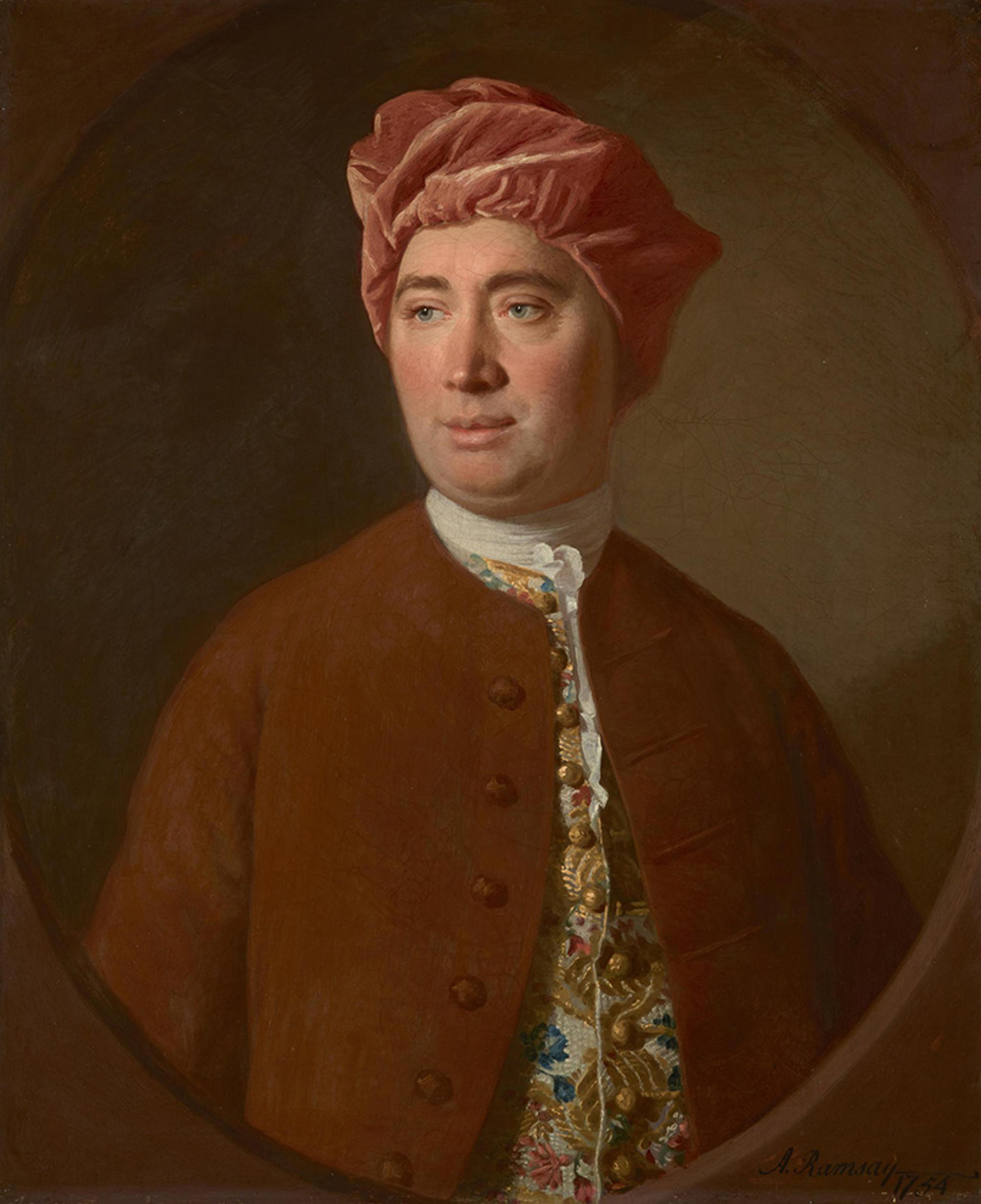
David Hume (1754) by Allan Ramsay. Courtesy the National Galleries of Scotland
The 18th-century philosopher and political theorist David Hume had answers to these questions, though he was writing decades before the French Revolution. While his essay ‘Of Public Credit’ (1752) was a warning about the dangers of Britain’s increasing reliance on debt financing, his apocalyptic vision of the future turned out to describe some features of our current political map surprisingly well. Hume was writing because he believed that debt financing had the power to upend Europe’s traditional power structure and culture by creating a new source of money divorced from tradition or responsibility: stocks and bonds. Unlike land, anyone with some cash could buy war bonds and get an immediate passive income in the form of interest. This was the thin end of the wedge caused by the debt financing that Hume believed was destroying every part of society. The governments of antiquity, Hume argued, saved money to use in battle and then waged wars in self-defence, or else to expand their territory. But the British had invented a new form of warfare that Hume saw no precedent for, even in the merchant states of Nicollò Machiavelli’s Italy: war for trade, funded with money borrowed from private stockholders.
Hume acknowledged the potential for riches in securing trade routes overseas, but the debts worried him. Of the many downsides to the practice of borrowing money in pursuit of empire, possibly the most interesting is that Hume foresaw what the historian Richard Whatmore in The End of Enlightenment (2023) describes as ‘an addiction to the idea of liberty among the populace and politicians’. Once Hume realised the connection between liberty and debt financing, he lost his taste for the philosophical concept entirely.
The connection between liberty and debt financing isn’t obvious at first – it could easily seem like a coincidence that the concept of liberty became so popular among Enlightenment thinkers during the same period that their governments began habitually borrowing money. To see the connection as Hume saw it, we need to understand the contrast between these new economic practices and what had come before.
Through the centuries leading up to Hume’s time, the majority of British people undertook the same kinds of work as their parents, and the primary source of wealth was land. Most landowners had inherited the land from their fathers, passing down responsibility and identity through the generations. Other classes had similarly unchanging patterns of life; peasants and tradespeople lived as their parents had lived, or with slight variations depending on the education or marriages that parents were able to secure for their children. There was little social mobility, and most forms of wealth were concentrated in the oldest generation of each family, giving them power over younger generations. Hume pointed out that the occasional merchant might get rich enough to buy land, but the necessity of caring for the land and its inhabitants would soon transform even a risk-loving merchant into the same boring, responsible personality as his land-holding neighbours. All of British society was structured around landholding, and the shapes of life and character that were most compatible with it.
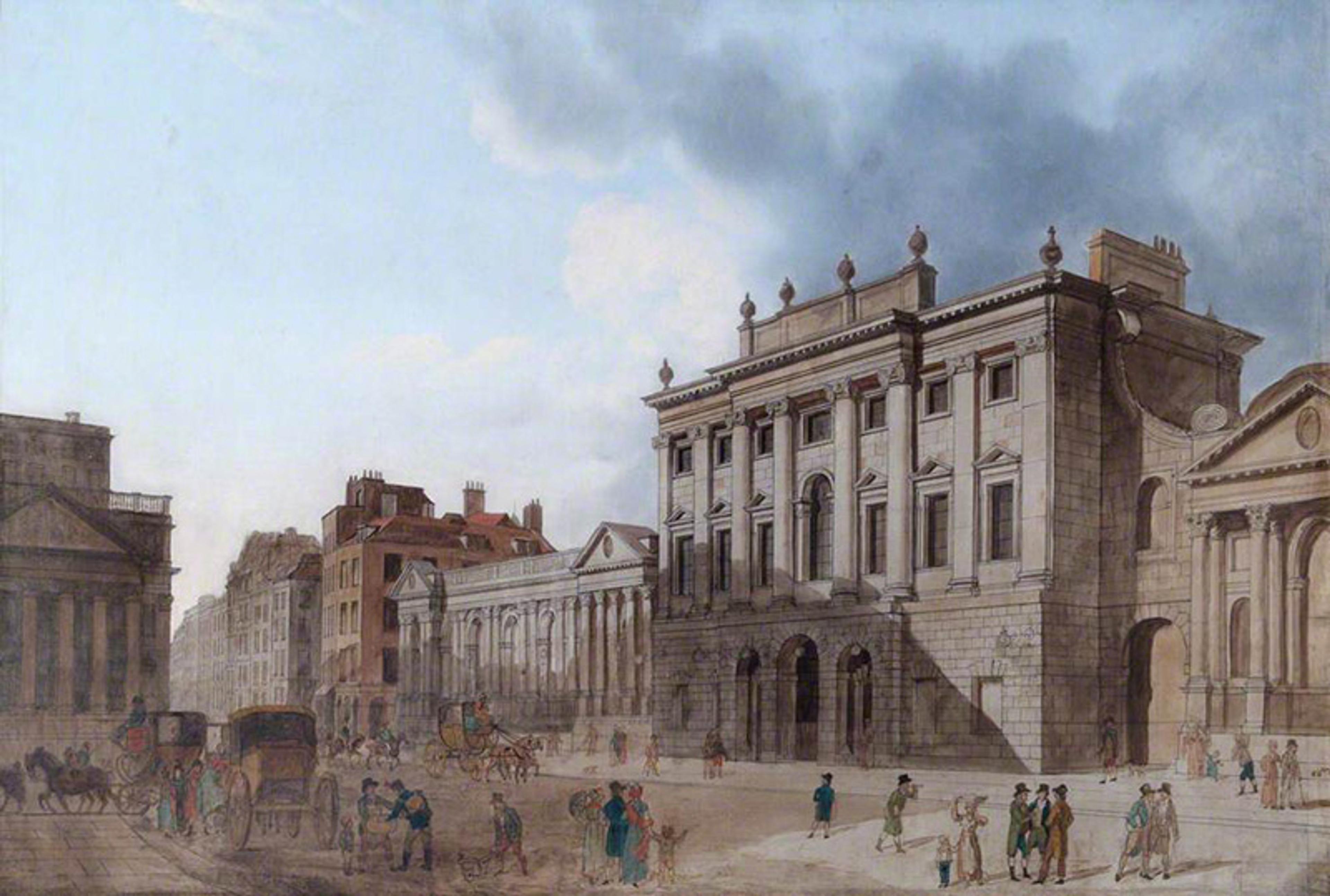
A View of the Old Bank of England, London (c1800) by Thomas Hosmer Shepherd. Courtesy the Bank of England Museum
Hume viewed the sale of government debt to private citizens in the form of bonds as a profound threat to this social structure, because the passive income it generated them offered a means of opting out of social responsibility. Young aristocrats who didn’t want to wait to inherit, and anyone else who wanted to live differently from their parents – for the first time, these people had access to another source of income, disconnected from tradition, lineage or obligation. For Hume, this threatened to spell the end of ‘all ideas of nobility, gentry, and family’. The change was not just political, it would be felt in personal relationships at every scale: every tie that composed a stable society was at risk.
Hume clearly described certain dynamics that still drive global politics to this day
While Hume was aware of the commercial stock market growing up alongside the government debt market, he was more concerned with government debt because the interest that accrued on government bonds came from taxes. Effectively, taxpayers all over the country were paying the interest going into the pockets of these stockholders, who could then enjoy themselves living in London or any other great city in the world without concern for anyone’s needs but their own. There was nothing to prevent a British stockholder from deciding his money would be better invested in the French government, say, even if the two countries were at war. Everything that tied a landholder to a particular place and a lifelong role in their community was reversed among stockholders, who could increase their profits by buying and selling rapidly and investing internationally.
Hume was not the only person to notice the vertiginous rise in public debt and its potential to disrupt social order – just over 40 years earlier, Jonathan Swift, writing about the new system of public finance in The Examiner, said that ‘power, which … was used to follow land, is now gone over to money’. Yet Hume’s fears for the future of Britain are especially interesting in our current times because of how clearly he described certain dynamics that still drive global politics to this day. Hume identified three threats that seem particularly prescient, and were also tied to the growing mania for liberty. First, there was the disconnection between money and traditional responsibilities, whereby older generations would lose their power over younger ones, and individualism would prosper over generational fealty. Second, while the economy of London might not suffer, rural populations would get no benefit from the taxes they paid into these interest payments. The wealth of landholders had always been tied up with the wellbeing of rural people, but that wasn’t so with stockholders who could spend their money as they pleased. The interest involved was not a small proportion of the tax income, either: by the end of the 18th century, debt service would reach as high as two-thirds of the total British tax revenue.
The third threat arose because the indebted government depended on the good will of stockholders, and so even a monarchy was no longer truly ruled by the monarch. As long as the borrowed money could be withdrawn at any time, stockholders essentially had the power to send British troops wherever they wanted to enrich their own companies. At the time Hume was writing, British troops had been sent to Bengal to defend British trade interests, and we know that the expansion of the British Empire would only increase this kind of military engagement. Hume feared the loss of control among the establishment, the impoverishment of rural areas, and the loss of power a king had to defend or expand his territory. Each of these objections connects stockholding to the concept of liberty: to the freedom to enjoy a passive income in any café in Europe; the freedom from paternalist authority; and from a king’s absolute rule. Each increase in one person’s liberty equated to the loss of another’s power.
With the benefit of hindsight, we can see that Hume was right: an entire economy was forming around stockholders invested in both commercial and government debts. The new economy wasn’t limited to the stockholders themselves, but also to the businesses they founded and financed. As the economic historians Jaume Ventura and Hans-Joachim Voth have shown, the factories and railways of the Industrial Revolution grew from the new debt-financed economy. Eric Hobsbawm likewise noted that many of the railroads in England were first built because there was a high demand for investment opportunities, rather than a direct demand for transit or shipping. While modern people often make strong distinctions between government and commercial entities, in this case it’s not necessary. Both government and commercial debt financing contributed to the new economy.
Much of this industrial development still lay in the future when Hume was writing, but he anticipated a lot of it. He saw there was wealth to be made in this new economy, and that the power of landholders would diminish in concrete ways, meaning they would lose control of the government that had traditionally served their interests above all others. Although he was writing to warn his contemporaries about the dangers of financing debt, Hume ended up describing the early stages and trajectory of our modern global economy and political structure.
Beyond greed, there was another cause for the rise of debt financing that Hume would not have been able to see: namely, inflation. Evidence of a significant stretch of monetary inflation across Europe during the premodern period was first identified by the German historian Georg Wiebe in 1895, and later picked up by the American historian Earl J Hamilton, who theorised that its cause was the influx of silver that Spain brought over from the Americas. More recently, David Hackett Fischer in The Great Wave (1996) revises the date used by Hamilton and Wiebe to argue that there were roughly 180 years of inflation during the ‘price revolution’ of approximately 1470 to 1650, which raised the cost of living many times over all over Europe. Nothing like it had happened before in recorded history. In the 1750s, when Hume was writing ‘Of Public Credit’, inflation was on the rise again. Though there have been periods of stability since the price revolution of the 18th century, modern life has been characterised by at least some degree of monetary inflation in a way that premodern life was not.
Inflation rewards certain activities and makes others more expensive. To take an easy example: in a stable currency, if you buried coins in your yard, they’d have the same value when you went back for them years later. During times of inflation, this would become an expensive habit because the coins would lose value every day that they remained underground. So we could expect that buried treasures would become rarer over those years. Another change: if you spent your coins on supplies to make consumer goods, then sold the goods when prices rose later, you would make a bigger profit during inflation than you would with a stable currency. If those goods were sold abroad, the value coming back to your own pocket would not only make you richer, it would make your entire national economy stronger. Inflation thereby gives both individuals and nations new incentives to produce more consumer goods than they need to survive, and to trade the excess abroad.
In The Protestant Ethic and the Spirit of Capitalism (1905), Max Weber wrote about the changing role of labour in the religious lives of northern Europeans during the Reformation. He argued that Protestants laid the groundwork for modern capitalism by considering diligence at work a spiritual virtue and – importantly – by using money to create more money through investments and entrepreneurship. Weber’s theory and Adam Smith’s description of the division of labour and the advent of commercial society are two of the most famous and influential explanations for the rise of capitalism between the 16th and 18th centuries, and neither of them mentions inflation. Still, knowing that these sea changes in labour and commerce happened at the same time as a price revolution, we can see that they were more profitable with the inflation than they would have been without it. Further, these changes are versions of the same things we do now, though very much consciously, to protect our savings from sinking in value, so we can conclude that these early capitalist developments were not only profitable, they operated as adaptations to the new threats that came along with prolonged inflation.
Saving coins in a war chest was as bad as burying them in the yard
Many cultures traditionally put excess resources into building palaces, temples and tombs – or going to war to expand their borders. It was very unusual in antiquity, as Hume wrote, to focus on manufacturing consumer goods and securing trade routes, as the English and the Dutch did in the early modern era. Contrast this with 16th-century Spain, which had everything that the emperors of antiquity could have wished for – land all over the world, enormous expansion of the Spanish language and the Catholic religion, untold riches, spectacular churches and palaces; and, with the Inquisition, they had obedient, religious citizens while suppressing dissent. And yet the Spanish government went bankrupt 13 times between the 16th and 19th centuries, and four of those bankruptcies came swiftly at the height of Spanish empire under Philip II. The traditional markers of strength had become economic liabilities, or at least they failed to protect even powerful kings against inflation. In a sense, all of Europe became a laboratory for experimenting with methods to protect against the effects of inflation.
Hume approved of the early waves of these changes in Great Britain because, as he wrote in ‘Of Commerce’ (1752), it was easy to see and understand the virtue of people working harder than they had before. The increases in productivity and in international trade seemed like a benefit to all. The changes didn’t stop there, though. Funding wars with national savings no longer worked the way it had for the nations of antiquity for many reasons, but significantly: the value of coins disappeared too quickly. Saving coins in a war chest was as bad as burying them in the yard.
It’s hard to convey the level of experimentation involved in developing modern finance as a tool to manage inflation. Part of the story is illustrated by the number of years that lapsed between the Swedish and British governments establishing national banks (1668 and 1694, respectively, with the French following in 1718) and the Spanish, in 1782. To show how far from obvious it was that countries would need some form of finance industry to stay solvent through the 18th century, consider Frederick the Great of Prussia, who tried to fund his involvement in the Seven Years War by debasing coins, even though producing these coins left him in parlous debt to the Dutch.
In modern times, we keep our money as cash briefly, and save using interest-bearing accounts to stay ahead of inflation. Banks raise money to service these savings by granting loans, and the interest rates on these loans is tightly controlled by national banks to protect their currencies and economies. Without people financing their endeavours with debt, we would have no way of protecting our savings from inflation, on any scale – personal, commercial or national. This is a version of the situation Hume thought would destroy the stability of British society. He wasn’t wrong. The system does require a constant level of debt finance rather than direct saving throughout society: and that system did upend the power structure of Great Britain and beyond.
While Hume wanted to make a clean distinction between the hard-working manufacturers and the pampered stockholders, the brisk trade in consumer goods was central to the profit of both groups, and also to their ability to protect currency from inflation. He was hardly the only one to try to make this distinction. In Capitalism (2022), the historian Michael Sonenscher wrote that efforts to find alternatives to capitalism often focus on systems of ownership, but few people have developed utopian alternatives to the division of labour. In most ways, Sonenscher points out, the connection between the division of labour and the 18th-century French word capitaliste – meaning ‘stockholder’ – seems incidental. From the perspective of defending against inflation, however, the division of labour was an important step toward protecting currency by virtue of increasing the output of consumer goods to sell; but the national banks and finance markets were even more effective at protecting the value of money by giving everyone access to the inflation-fighting power of business ownership, whatever their jobs. The optics were bad, though. Stock traders were always in coffee houses and what they did was a form of gambling, beset by scammers and bubbles. Since we know how the 19th century went, we know how much the spread of industry would go on to be funded by debt financing, and we can see, as Hume could not, that industry and finance were connected all along, two sides of a new economy. But from Hume’s perspective, the one group was hard-working, and the other was lazy and immoral.
By the 1750s, Hume could see a future in which stockholders could have as much, or more, power than the landholders who defined the old political and economic order. Smith voiced a similar fear in The Wealth of Nations (1776) but went into less detail about what might happen if it should come to pass. With the benefit of hindsight, it’s pretty clear when the stockholder economy reached parity – at least – with the landholder economy, for in 1783 Great Britain’s government divided permanently into two parties, spurred by a fight over the terms of a bailout for the East India Company.
In the US, the 1796 presidential election was the first with two parties – one representing the agricultural south, and one representing finance and the industrialised north, again spurred by a fight over national debt. Of course, the French Revolution had many complicated causes, but one of them was the 1788 crisis over national debt, with the interests of landholders conflicting with the interests of stockholders, which ended with parties representing a political Right and Left. In other words, within a single decade, all these countries’ governments split into two parties along the lines Hume had foreseen in the 1750s. On the Right, in each case, there was a traditional land-based agricultural economy and a political party representing its interests. On the Left, a party representing the stockholder economy, composed of the hodgepodge of practices and beliefs that had become profitable during inflation: manufacturing, finance, international trade, and liberty.
If we take Hume’s analysis from the 1750s and apply it to current US politics, we see two overlapping economies – the landholders’ and the stockholders’ – with some common ground and some points of enduring conflict. Each economy has a full class structure with owners, bosses and various kinds of workers, so class alone can’t determine our political alignment, as Marx would have it, for example. Furthermore, the two economies are not always in conflict. As Thomas Piketty argues in Capital in the Twenty-First Century (2013), inherited money blends well with the stockholder economy, growing even more significantly than wages. This is hardly the only way the two economies combine with mutual benefit. Land proximate to financial centres will command high rents, while taxes paid by industrial businesses can be used for farm subsidies. The overlap between the two economies is what we call ‘capitalism’. But it’s a mistake to elide the ways in which the two economies are still distinct and do not create a single, seamless global system.
Modern people have a blend of commitments to the landholding and stockholding economies
For one thing, all the premodern traditional practices concerning property are still with us. People still inherit wealth and marry into it. People still get jobs through family connections. People still ask friends for help when they fall on hard times. Many people still depend on their grown children for care as they age. There are very few ways in which the new stockholder economy has cut off these old traditions. In all economic classes, people are still supporting themselves in premodern, relational ways rather than in the individualistic ways associated with the industrialised side of capitalism. In modern times, these are the modes of property transfer typically defended by the Right. Opposing inheritance taxes and no-fault divorce laws are each political bids to empower this economic structure, but it’s not hard to imagine a social version, also. Many people make their primary financial and emotional investments in their children, and resent how little reciprocal obligation children might feel to live nearby and provide grandchildren. Hume may be comforted to know that the old family power structures are still going strong, even if they are not the only ways by which modern people live.
The other point to note is that people can change their alignments. They can align mostly with one economy and somewhat with the other. Someone who makes a fortune in the stockholder economy, for example, might then find meaning in the relational landholder economy as they age. Or vice versa. Modern people generally have some blend of commitments to the landholding and stockholding economies, with some portion of money or social capital invested in each. And yet, even more than two centuries after the Left and the Right divided, even with countless defections from one side to the other, the differences between these two sides still do not collapse.
Unlike religious or ethnic groups, there is nowhere in the world that the Left and the Right live together peacefully, without political strife. There is something insoluble at stake between the sides, and neither side has extinguished the other or found a lasting compromise. This is more evidence that we’re not living under a single system but two, with enduring differences.
Then, there are the fights. A war like the US Civil War, for example, has a Left (those fighting to abolish slavery) and a Right (those fighting to preserve it). But while Cedric Robinson, in Black Marxism (1983), and other scholars have argued that the transatlantic slave trade was a central feature of early capitalism and the pursuit of empire among Europeans, the people going to war against it later, inside the US, were more industrialised and less agrarian than the ones fighting to keep it. Under these circumstances, there is a dissonance in describing the Right as the party of capitalism or business owners, and the Left as anti-capitalist, since the Left has been fighting on the side of finance and industry all along.
While scholars such as Bruce Levine and Eric Foner might argue that the American north and south had meaningfully distinct economies, and others, including Sven Beckert, counter that they were only components of a single system of war capitalism – these arguments taken together illustrate exactly how two economies can overlap, sometimes to mutual benefit, and still remain distinct enough to cause strife. It’s hard to maintain the idea that we are all living under a seamless unified capitalism when the differences between the landholder and stockholder economies drive US (and other national) politics to this day. Capitalism is, at is has always been, two separate but overlapping systems.
What about class (the primary Marxist lens for analysing material relations)? Inflation gives bosses extra incentive to force workers to produce excess goods. It also makes wages effectively drift downward until workers demand a reset. However, the financialised economy also requires a constant stream of borrowers who want to buy houses, go to college or start businesses: in other words, it requires a pool of people with the ingredients for social mobility – education, opportunity, vigour – who are not already rich, to take out loans and repay them with interest. You could say that the restlessness of modernity is very concretely the way we stay ahead of inflation.
Rather than imposing a new class system, the financialised economy requires more and more previously marginalised people to join the group of potential borrowers, becoming successful, socially mobile people, defined neither by class nor any other narrow social role. Focusing on the myriad harms of class systems can muddy our perception of the economy we are actually inhabiting – one that thrives on our rejection of traditional roles of any kind. Once we add this element to the picture, a simple two-sided class struggle is not sufficient to explain the complexity of a modern economy.
This is how the Left can be both the party of finance, and the party that tries to overthrow capitalism
While agricultural economies can operate with very little social mobility, a financialised economy does better on the back of public education, universal healthcare and elder care: the various social structures that allow people to leave the circumstances of their birth. Fights for the rights of the working class are, of course, hard won and necessary – yet they also benefit the entire stockholder economy, as we see among countries that voluntarily adopt these structures in order to financialise their economies.
The Left isn’t only a moral position concerning the needs of the needy, it is also a series of experiments in living under conditions of relentless inflation. The values of liberty, universal human rights, and experimentation with new social structures – all of these support the stockholder economy, and its conviction that better things are possible. This is how the Left can simultaneously be the party of finance and industry, and also the party that tries to overthrow capitalism. It’s also why Leftism has given us the best recipes humanity has so far developed for growing and consolidating wealth during inflation.
So, to return to the question I posed at the start: are working-class conservatives voting against their interests? Not if we return to Hume’s concerns.
Social mobility, desirable though it may be under the rubric of ‘progress’, carries the risk of unstitching traditional family ties. People of all classes risk losing respect in their old age, or control over where their children settle, or what religion their grandchildren practise – every form of cultural continuity through generations, which many people value far more than money. These imperilled values are generally championed by politicians on the Right who understand that even the richest people in the financialised world can’t make their adult children share their faith or politics, or care for them in old age. The stockholder economy effects a significant and lasting shift in power toward the young, which might explain why conservatives often vote against their apparent material interests. Contrast this with traditional economies, where even people without wealth can exert significant control over their children and grandchildren, and that may legitimately be something more valuable than money to many conservatives.
Finally, the global rise of the Right-wing. If we imagine the two economies as a Venn diagram, we find a significant overlap where finance and industry can be used for the purposes of the Left or the Right. Both the Great Depression and the runaway inflation of the 1970s involved complicated interactions between the Right and Left within the arenas of finance and industry. However, the complexity of these interactions don’t seem to have changed the fundamental polarisation of the two economies, since Left-leaning areas remain richer than Right-leaning ones, and the political divisions seem to only grow. The 2008 market crash illustrates something of the dual nature of the finance industry in contemporary times: on the one hand, individual bankers may take advantage of the system to enrich themselves and benefit their friends and families at the expense of the national economy and individual borrowers. Deregulatory laws that encourage such behaviour are often considered ‘pro-business’. On the other hand, the purpose of a finance industry is to safeguard an economy from uncontrolled inflation and other market shocks – and a narrow, Right-leaning understanding of ‘pro-business’ interests can prevent it from fulfilling that function, as it did spectacularly during the subprime mortgage crisis.
Many people would rather have land and power than money and liberty
There is another face of the Right though: the edge of the landholder economy that Hume feared would be extinguished by the stockholder economy. Hume identified three groups of people who would lose power as the new economy ascended: rural people, ageing parents, and people who want to annex land. When the US president Donald Trump first said that he planned to annex Canada and Greenland, many Americans treated these ideas as absurd, but we don’t have to look far to see modern nations going to war for their neighbours’ land just as they’ve done in the past. Indeed, the first step to waging this kind of war between nations like the US and Canada, for example, would be to attack the international web of economic interdependences of the stockholder economy – as Trump has done with apparently irrational tariffs and restrictions to foreign aid.
With global warming making habitable land ever scarcer, wars over land might once again become more common than wars over trade and influence. Climate change could easily disrupt the balance between the stockholder and landholder economies, making the risks of inflation less frightening than the possibility of running out of habitable land for one’s own family. Disruption of this balance would likely manifest as a global rise of the Right-wing, as more and more countries scramble to control dwindling land resources. In fact, there is a built-in coalition that would welcome the destruction of the stockholder economy. If we look at Hume’s three groups of people disempowered by the rise of debt financing in the modern US, they consistently vote for conservative leaders, even though the economy and job growth fare better under Democratic presidents. First, electoral maps show that people who live in rural areas are more likely to vote for conservatives than people in big cities. It’s the same with ageing parents, and people who want to preserve old power structures, including the family. Again, we see this in voting patterns ‘strongly associated’ (according to the Pew Centre) with age: younger people lean Left and older people lean Right. And finally, there are people who want to go to war for land. Right-leaning leaders are usually the ones to start invasions, and the protests against them are usually led by the Left.
There are many reasons for people aligning Right or Left, which is why analyses of class and material interests fall short of describing the realities of people’s politics. Hume foresaw that these specific groups would resent the economic sea-change of the 18th century – and he was correct. Many people would rather have land and power than money and liberty.
Still, the power of the Right hasn’t doomed the Left – no more than the Spanish Inquisition doomed the rise of the Left in 18th-century England and France. As long as governments want to keep the value of their currencies from falling, someone in their ranks will be using the methods of the Left and inventiveness that brought us everything from our banking system to gay marriage. We don’t need to resurrect communism or focus narrowly on class, following Marx. The experiments are far from over, and we should remember that the Left is generally where money comes from in modern times. We give away too much power when we forget it.