Listen to this essay
24 minute listen
Sometimes, little-known historical characters from long ago can give us a new window both into their times and into our own. In our current era of polycrisis, this may be more important than ever, as shown by the history of a little-known woman from the town of Cacheu in today’s Guinea-Bissau in West Africa. Crispina Peres was the most powerful trader in the town in the 1650s-60s: though readers may know little about her or about this part of the world, either now or in the distant past, it’s often precisely by stepping into a little-known space that we can gain a richer sense of perspective on our own lives.
Peres was a woman of mixed African-European heritage, born some time in the 1610s. In the 1630s, she married a captain-general of the Portuguese colonial port-enclave of Cacheu. By 1665, she was rich, widowed and remarried to a second captain-general. Peres was thus one of the most powerful and dynamic figures of her generation in Cacheu – however, in a sad irony, she’s known instead for the most traumatic and painful phase of her life: her imprisonment. Virtually all we know of Peres comes from her Inquisition trial records: she was arrested in January 1665 after a conspiracy cooked up by her enemies (as was often the case with Inquisition trials).
As usually happened, the inquisitors charged Peres with heresy. Her crime was consorting with healers known as djabakós, whom she had sought to help heal her sick child. And yet, as the papers of her trial show, almost all of her accusers consulted the djabakós. For Portuguese traffickers and officials in Cacheu, Catholicism was not somehow hermetically sealed, as imperial theory demanded: it could be worshipped alongside making offerings at African shrines. Nevertheless, Peres’s integration of African worldviews into Catholic religious practice was enough for the Inquisition. In the slow and bullying manner in which cumbersome bureaucracies tend to grind, it took several years for the papers to be accumulated, the evidence to be weighed, and the (in fact preordained) decision to be taken by the inquisitors to order Peres’s arrest on a charge that most of her accusers could have been found guilty of too.
Already, the details of this case will strike some readers as unusual. The Inquisition is known for its work in late-medieval and early modern Europe, but few people associate it with West Africa. Yet the rise of the Portuguese Empire in the 16th century had gone hand in hand with a rise in the Inquisition’s interest in policing the faith of the distant colonies. Strict adherence to Portugal’s patriarchal religious doctrine was the other side of the coin of its imperial power. In 1560, a tribunal of the Inquisition was established in Goa, which was also responsible for the Portuguese outposts in Mozambique. Thereafter, the Lisbon tribunal was charged with collating evidence of alleged heresies in its other colonies, in Brazil and in its main outposts in Africa: Angola, Cape Verde, and the coast of today’s Guinea-Bissau, where Cacheu is located.
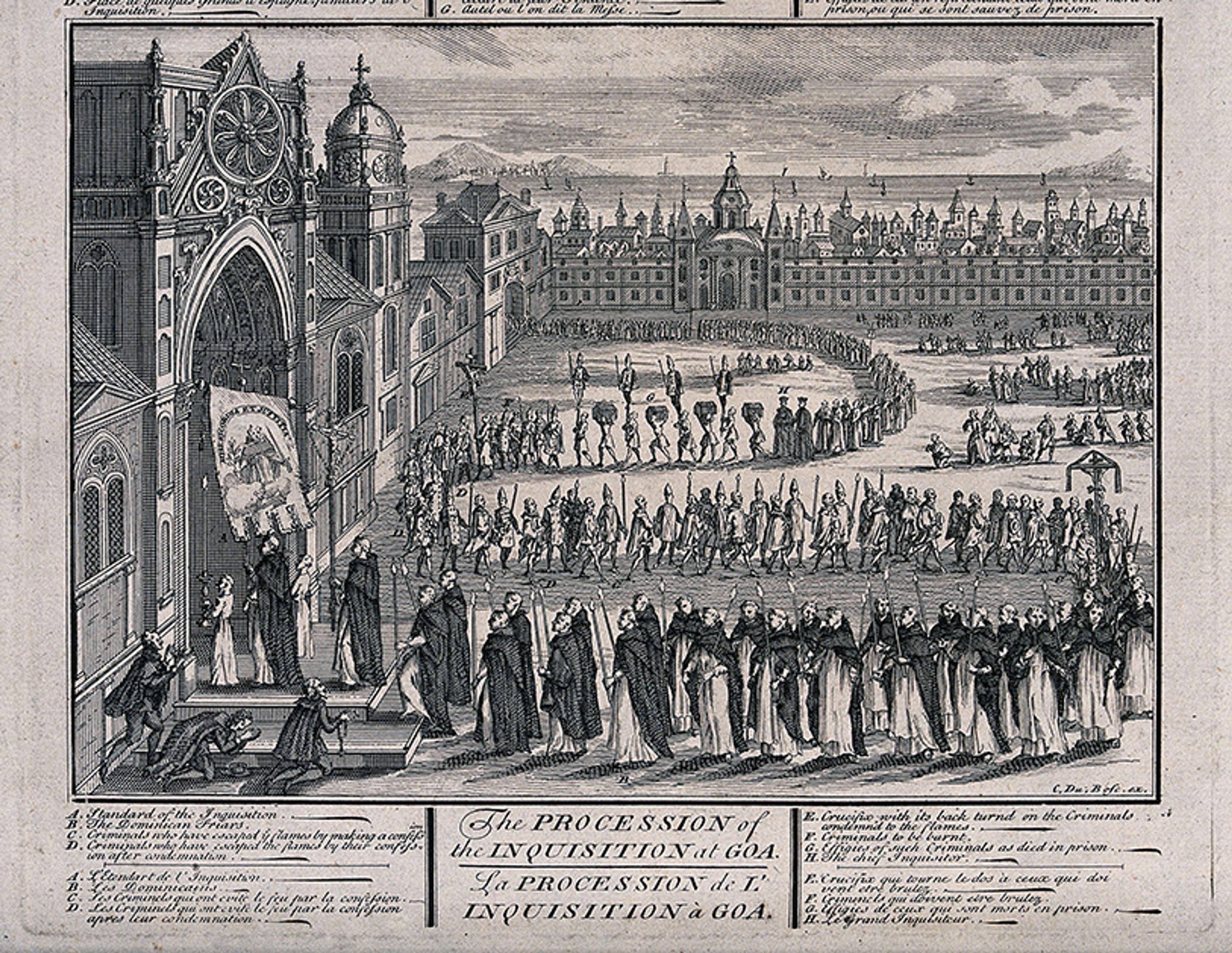
The Procession of the Inquisition at Goa, India. Courtesy the Wellcome Collection
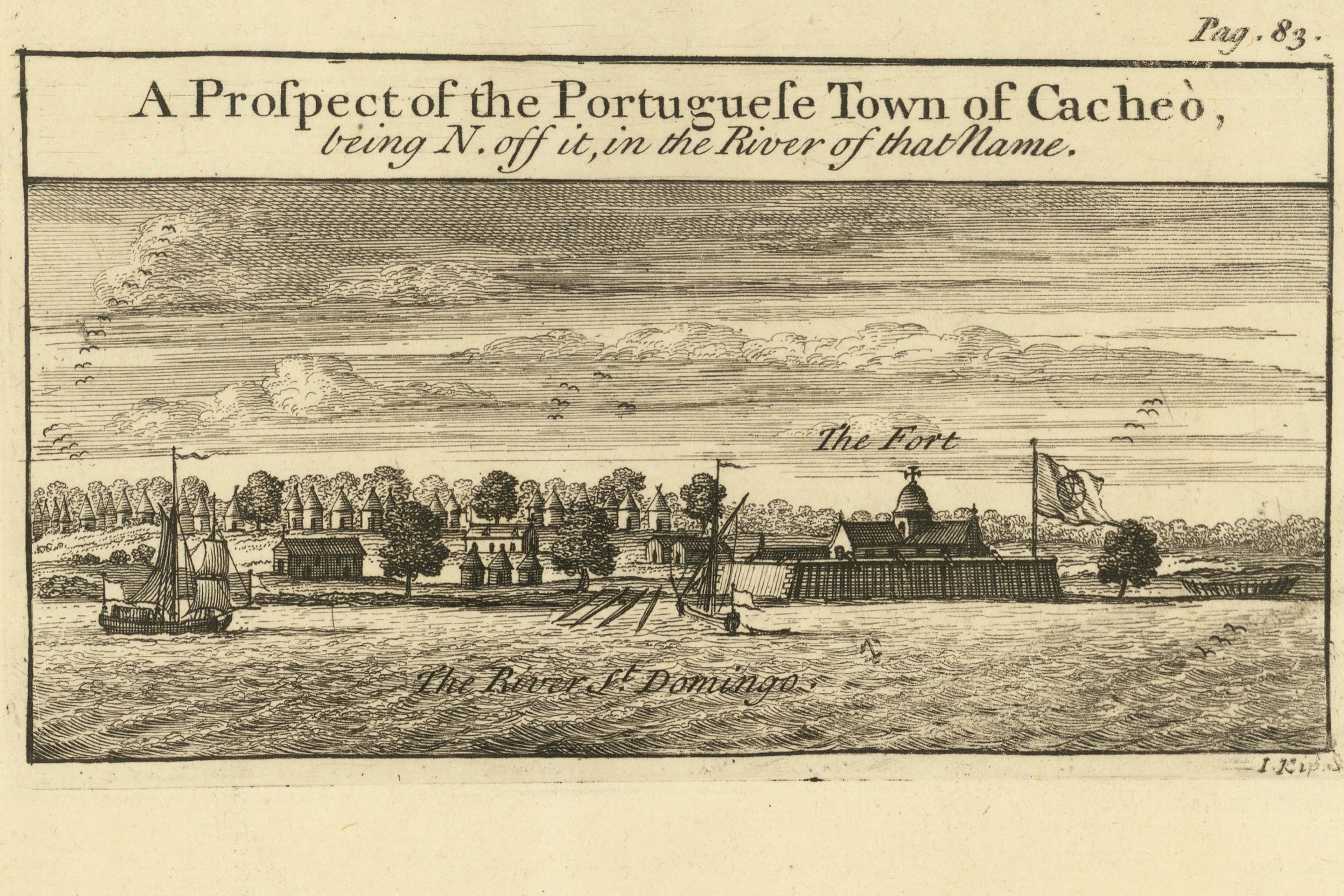
In the 17th century, Cacheu was still a relatively new town. It had been founded by Portuguese imperial officials based on the Cape Verde islands (around 500 km off the coast of Senegal) in 1589. Cacheu was situated on a major river, the São Domingos, not far inland from the estuary. It was a perfect site to consolidate imperial interests, and the settlers came and built fortifications and a church there for two reasons in particular. Firstly, a series of droughts in the Cape Verde islands had forced many of the colonial residents to move to the adjacent West African coast, where they had business associates and family members. And, secondly, there had been a growing number of attacks on these Portuguese settlers as their involvement in the transatlantic trade in enslaved Africans understandably made them the targets of increasing anger from people in West Africa.
In other words, by the time Peres was rising to prominence, many of the factors that now make her trial records such important historical documents were coalescing. As a major centre for the transatlantic slave trade in this part of West Africa, the town was a hub for peoples from different parts of Senegambia, Cape Verde, the Americas, and other parts of the Portuguese and Spanish empires. It was a place that mixed efforts to impose imperial law with the reality that this was an African settlement, based in a Senegambian culture and legal environment.
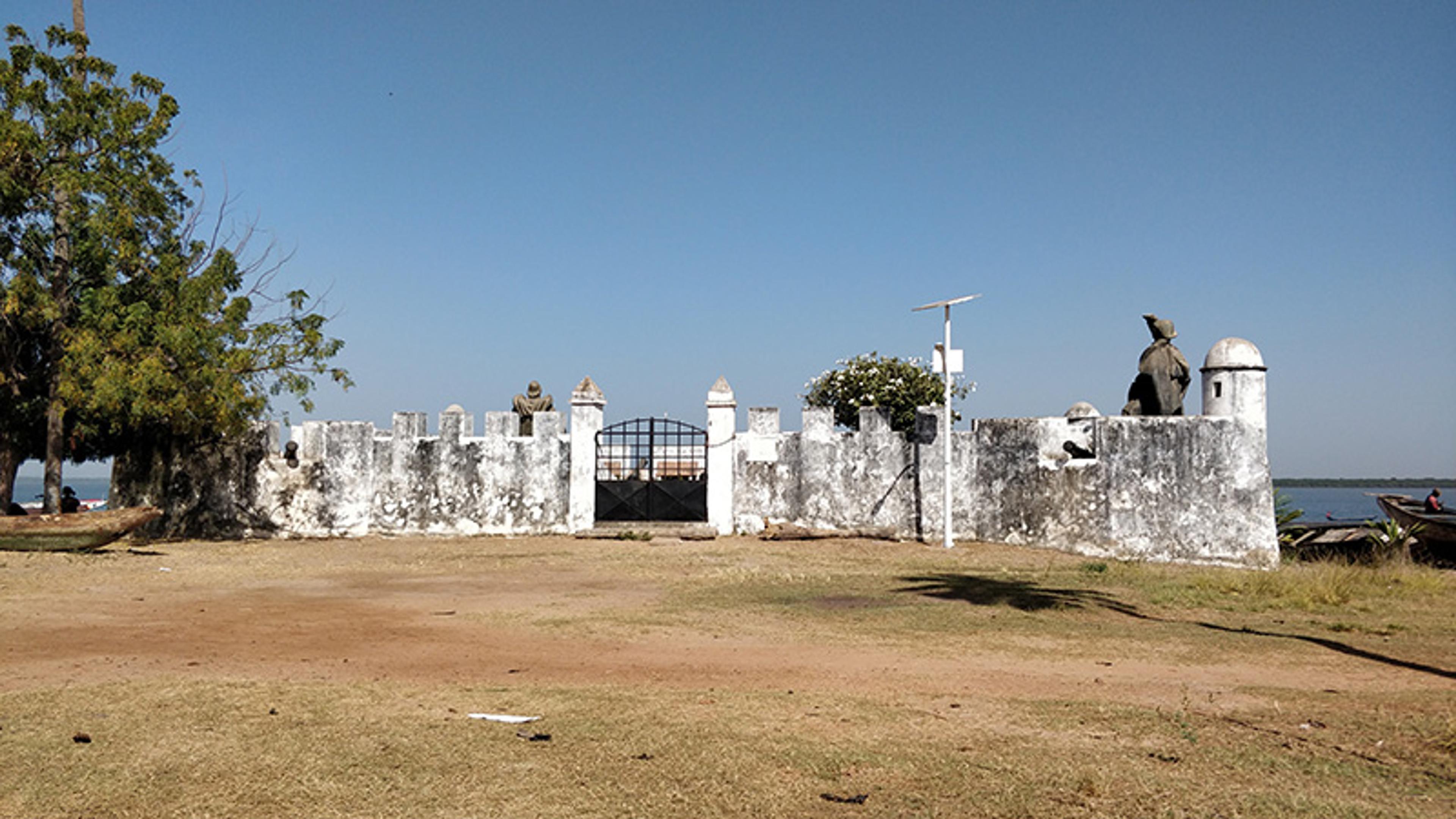
The fort at Cacheu as it is today. Courtesy Wikimedia
Perhaps the final piece of the jigsaw for us today in understanding how the town of Cacheu ‘worked’ is therefore this precious document, the record of Peres’s Inquisition trial – a document that also preserves the trauma of the last years of her life, as she was deported to Lisbon and held isolated in her inquisitorial cell facing judgment for heresy. Historians of early modern Europe have long studied such trials to reveal precious aspects of social history, in books such as Montaillou (1975) by Emmanuel Le Roy Ladurie and The Cheese and the Worms (1976) by Carlo Ginzburg. However, with the exception of James Sweet’s Domingos Álvares, African Healing, and the Intellectual History of the Atlantic World (2011), few such books have looked at the rich social history revealed by trials from the former Portuguese colonies.
I first started studying this document almost 15 years ago, and what has crystallised for me is that 17th-century Cacheu was a plural world in which people shared in one another’s lives, even in an era of unspeakable violence, coexisting in the face of hardship in a way that also marks how much has changed since then.
At times, the Inquisition trial of Peres reads like a modern soap opera, revealing details of the lives of both the woman and her friends and enemies who lived so long ago. The papers that survive offer unparalleled insights into daily life in a West African port town from the distant past, allowing us to reimagine how gender relations, work and worship unfolded alongside the traumatic realities of the transatlantic slave trade. Several aspects of the social world revealed in these pages help us to rethink the possibilities of human relationships in society, and the ways in which people can work together for a common good, despite hailing from very different heritages and traditions.
Like most successful people, Peres embodied the values of the time and place in which she lived – a place where women ran the town. But what was it that allowed her to build her social capital, and how can learning about her life illuminate 17th-century West Africa, when peoples from different backgrounds, faiths and walks of life coexisted in a plural world?
Although the Inquisition is hardly famed as a beacon of interfaith understanding, the trial records reveal a world that was anathema to this intolerant institution – one it wanted to change with the rise of the Portuguese Empire. For Cacheu was a place where Christianity, Islam, Judaism and West African religions all intermingled. Highlighting the ways in which these faiths coexisted both in good and bad times, these documents offer a precious window from our present troubled times into a past multifaith world. The reality is that plural multifaith societies were very much the norm then, which has important implications when we think through the crises we face today.
These details give us a new window into plural settings and the ways in which those who lived there coexisted
Why, then, was Peres arrested, and what insights does her case give us into this distant world? Firstly, there were the political and institutional reasons. By the middle of the 17th century, the Portuguese Empire was in decline. It was faced with the rivalry of ‘upstart’ Protestant trading nations like the Dutch and the English, alongside growing competition posed by Islamic Jahanké preachers and traders who were increasingly found arriving in towns like Cacheu, offering different avenues for both worship and commerce. Some kind of ‘show trial’ was a way of reasserting the significance of the Portuguese Empire and the threat it posed to those who wouldn’t fall in line, or who might consider trading with its rivals.
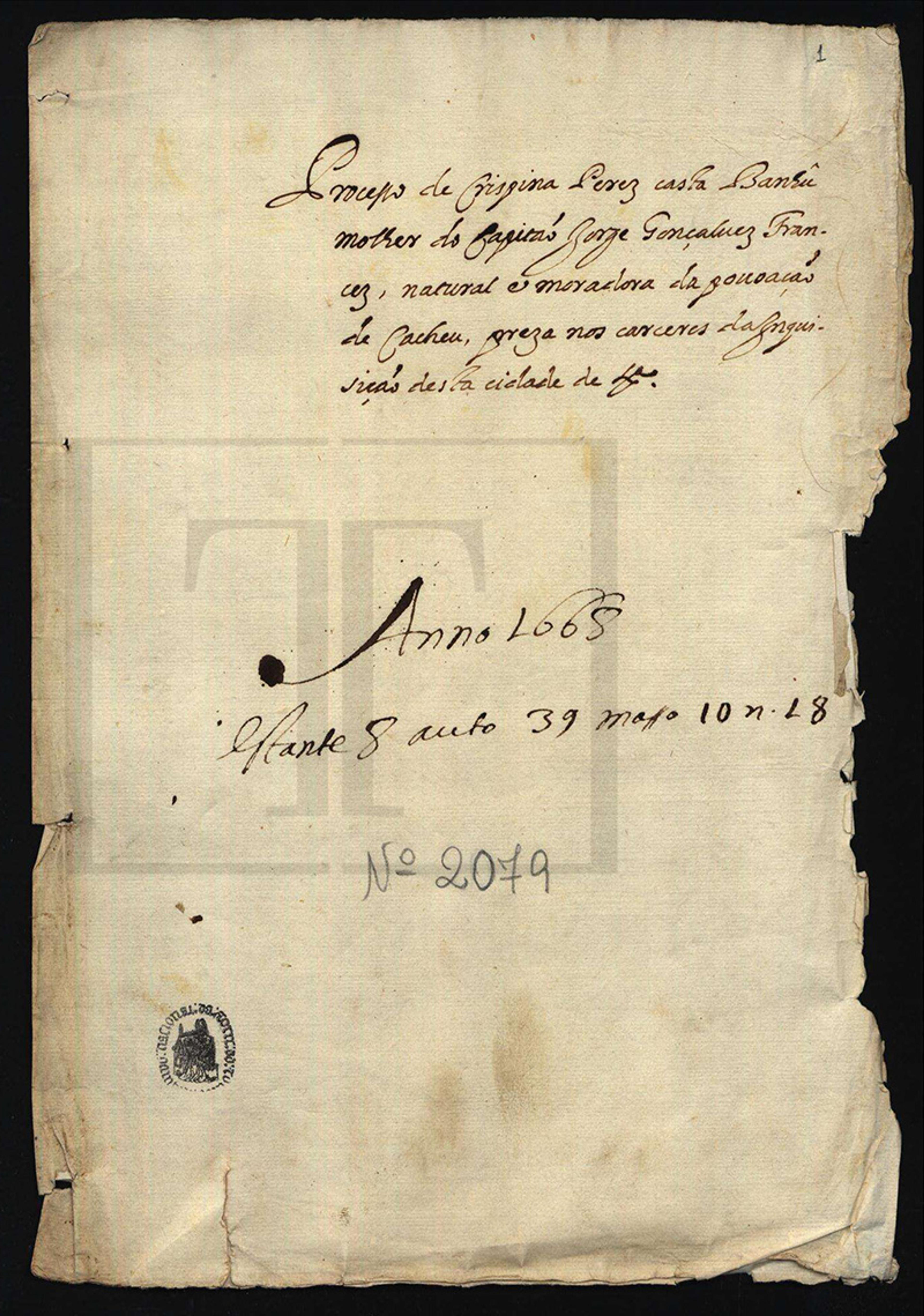
The opening page of the trial of Crispina Peres, Trial 2079 of the Inquisition of Lisbon. Courtesy the Instituto dos Arquivos Nacionais do Torre do Tombo, Lisbon
Historians often focus on these institutional reasons for major historical events, but alongside these, of course, are the human emotions that drive us all. The fact was that, by the early 1660s, Peres’s success was attracting attention. And, like all successful people, this excited envy among her rivals – especially her younger competitors, who wanted to elbow her out of the way and seize control of the trading networks that she had helped to build up. These traders drew on the frameworks of the Inquisition and concocted a plan to denounce her for ‘witchcraft’, for consulting the djabakós – whom they all consulted too.
Peres’s enemies relied on one of her household slaves, a man called Sebastião Rodrigues Barraza, who accused her of consulting the West African shrines called chinas. Very rare for an enslaved person in West Africa, Barraza was literate and thus left his own account of his life, which gives moving and painful insights into the lives of the enslaved. After making his accusations, Barraza later retracted them and claimed that he had been bribed by the town’s governor-general and by Peres’s main commercial rival to denounce her, being given ‘ribbons and shoes and buttons and all that which I most needed’ – and that he had done this because they had promised him freedom:
[F]or there are slaves in Guinea who would throw away their lives for a fishbone or a flask of wine or brandy, and even more so for the manumission they promised me.
The trial records are rich in details like this, which can help us to piece together the origins of Peres’s power in Cacheu, as well as startling and disturbing new details about the enslaved’s daily life in such a port. These details give us a new window into plural settings such as 17th-century Cacheu, and the ways in which those who lived there coexisted, even at times of great stress and potential violence – such as was involved in the transatlantic slave trade.
What was it about Peres that had enabled her to rise to such a position of prominence? After all, the big traders in European port towns such as Lisbon and Seville at the time were exclusively male. Women were certainly involved in smaller-scale economic activities, but to have a figure like Peres shaping the trade of a major economic hub marks Cacheu as an unusual and distinctive place. What was it that enabled her power?
First was her ability to speak many languages – at least five. Peres had been raised by her mother, a member of the Bainunk people. Her mother’s links and connections helped Peres to develop her language skills, meaning that she could negotiate with local kings and seek preferential business arrangements. The Pepel king of the adjacent region of the Mata de Putame seems to have been a particularly strong ally of hers – indeed, when she was arrested in January 1665, this king raised an army of 1,000 people that the colonial authorities struggled to put down. A number of those charged with arranging her arrest wrote that they feared for their lives during those days, demonstrating the strength of ties Peres had been able to build.
Multilingualism was a norm in the region, and indicative of the ways in which the peoples of Cacheu took part in one another’s lives, allowing them to overcome their differences. It also gave a woman like Peres a distinctive advantage over the monolingual Portuguese arrivals, who struggled in this plural and interfaith environment.
What really consolidated Peres’s power was that women in fact ran daily life in Cacheu
Another factor was that Peres’s house was a focal point, a beacon of sociability. At one point in her own testimony, Peres describes how she invited people from many different villages and backgrounds, who all gathered at her home to drink, exchange gossip, play cards and do business. Peres was able to preside over this partly because of her important role in Cacheu and the social capital she had – and partly because, as a successful trader, she had the latest fashions in textiles and jewellery in her warehouse, which automatically made her home attractive to others, who could come to enjoy themselves and nip into the warehouse to check out the newly arrived goods.
Multilingualism and sociability mattered, but what really counted in consolidating Peres’s power was that women in fact ran daily life in Cacheu. The men often worked as itinerant traders, going away on prolonged trips to the surrounding creeks and rivers. On these trips, they drank wildly, and often fell ill, meaning that their lives could be short. Cacheu’s women, on the other hand, were remarkably independent. Indeed, the fact that women dominated so many aspects of the town may be an important aspect of understanding why Cacheu was able to present such a distinctive and different socioeconomic environment so long ago.
So, what was different about women there, as epitomised by the power of Peres? The key thing was that their daily lives were quite autonomous and independent of men. Women in Cacheu could live in all-female households, where they had economic and sexual freedom. In one of these households, for example, the town’s vicar, António Vaz de Pontes, was often found with his lover Catalina, indicating the distinctive relationship between religious, economic and social power in Cacheu. Women were also the main participants in shrine offerings and festivals in the town’s biggest neighbourhood, Vila Quente – in which, according to one witness, most of the households were run by women.
The Portuguese Empire had pretensions that Cacheu was ‘their town’
Cacheu’s women also ran the business of the town, far beyond the wheeler-dealings of a figure like Peres. Women managed most of the town’s small general stores (as they did in Ribeira Grande, the biggest town on the Cape Verde islands) and the bakery. They spun cotton and traded in the cloths woven across Senegambia, as well as the cloths from Mexico on their way to be traded in China.
All of this made Cacheu very different from most of the towns and cities in Portugal and its empire. And, naturally, none of this female influence was popular among the upstart Portuguese imperialists arriving from Lisbon. The Portuguese Empire had pretensions that Cacheu was ‘their town’. It was, after all, a hub for their traffic in enslaved Africans, with a church, a captain-general, and various scribes, accountants and other colonial officials. The Portuguese were a tiny minority but, all the same, they wanted to make a power grab and impose their own view of their importance (something that was actually fairly irrelevant to many of those who lived in Senegambia): struggling for pre-eminence in a town where West African women ruled the show was too much for their amour propre.
This context makes it much easier to understand the complex chain of events that led to Peres’s arrest by the Inquisition in January 1665. Living in a town run by women and coming from a society that was increasingly patriarchal was an ideological circle that was impossible to square for the male inquisitors who drew up the trial. This meant that they were all too happy to go along with Peres’s enemies and conspire in her arrest, with the excuse that it was heresy in the eyes of the inquisitors for baptised Catholics like Peres to participate in the religious rituals of another tradition (even if it was her ancestral one).
However, this narrow and reductive view of communities and their relationships flew in the face of how people related to one another in Cacheu.
One of the intriguing things about this Inquisition trial is that Peres’s consultation of the djabakós embodied the beliefs of all those who lived around her. Indeed, her second husband Jorge claimed that there were only four people in the whole of Cacheu who observed strict Catholicism without any other religious practices. Peres’s major rival and one of the key conspirators against her, a man named Ambrósio Gomes, also consulted the djabakós, and his mother indeed performed healing rituals directly influenced by West African spirituality. Gomes’s wife, Bibiana Vaz, would become the successor to Peres; within a decade, Vaz was herself the most powerful trader in town – and locked up Cacheu’s new captain-general (Peres’s husband died in 1668) in her house for more than a year because of a trading dispute.
What becomes clear from a close reading of the Inquisition trial and associated evidence from the time is that this kind of sharing in one another’s lives and beliefs was the norm in Cacheu. What did this mean in practice? As mentioned, itinerant Islamic preachers and traders called the Jahanké were frequently found in the town. Their influence was growing across Senegambia in these decades, with increasing numbers of people from the region’s towns and villages converting to Islam, as the Brazilian historian Thiago Mota has shown.
Some of the Jahanké were also known as healers and were often consulted by people like Peres alongside the healers from Senegambian traditions. In fact, religious diversity was the key characteristic of Cacheu in these decades (and indeed remains so in Guinea-Bissau to this day). This was a town with Catholic processions on saints’ days and during the (frequent) tokachurs, or funerals – but it was also a place where the rites and festivals associated with worship at African shrines in Vila Quente could be heard almost daily. Indeed, according to many of the trial’s witnesses, whenever a woman in Cacheu found that something had been stolen from her, she shouted loudly that she was going to make a sacrifice at the shrines in Cacheu to find the culprit. While Peres’s husband Jorge came from a Jewish family, he had joined a prestigious Catholic religious order in Portugal, the Ordém de Cristo, and he too consulted the djabakós. It was characteristic of Cacheu’s plural religious worlds that passing Catholic sailors would buy bolts of cloth to take to the tokachurs as offerings.
Dividing people into rigid categories was also a way of asserting the power to control this space
In other words, this was a multifaith environment with very soft boundaries between different religions or sects. People spoke many languages. They shared in one another’s religious lives, went to funerals whether Catholic or tokachur, turned to one another’s traditions for healing in times of need, and knew intimate details about one another – which they often turned into a source of ribald gossip, another of Cacheu’s defining characteristics at the time. People shared in each other’s customs and lives.
Of course, that’s not to say that there weren’t also deep-seated tensions and injustices in Cacheu. As we’ve seen, this was a town at the centre of the traffic in captive Africans, which also shaped the town’s political and social life. Imperial demand and consumption grew violently in these years, and this had extremely negative implications for people’s daily struggles. Moreover, as this demand increased, so did, inevitably, tensions and injustices, and the risk of this coexistence breaking down.
Nevertheless, what is clear from these records is that, without this sharing in each other’s lives, coexistence was that much harder. It was the ability to speak a number of languages, to communicate in different registers, and to share foods and conversation at the festivals that were sacred to the different communities who lived there that formed the glue keeping the town together.
Indeed, it was precisely this plural coexistence that the Inquisition sought to challenge. Dividing people into rigid categories was also a way of asserting the power to categorise and control this space that Portugal sought to colonise. The religious mask of the Inquisition was therefore also an economic and a political one. By claiming that such mixed religious practice was in fact heresy, the colonial officials were seeking to throw up harder boundaries between people. If they could do so, greater enmity would follow, which in turn produced more captives for the transatlantic slave trade.
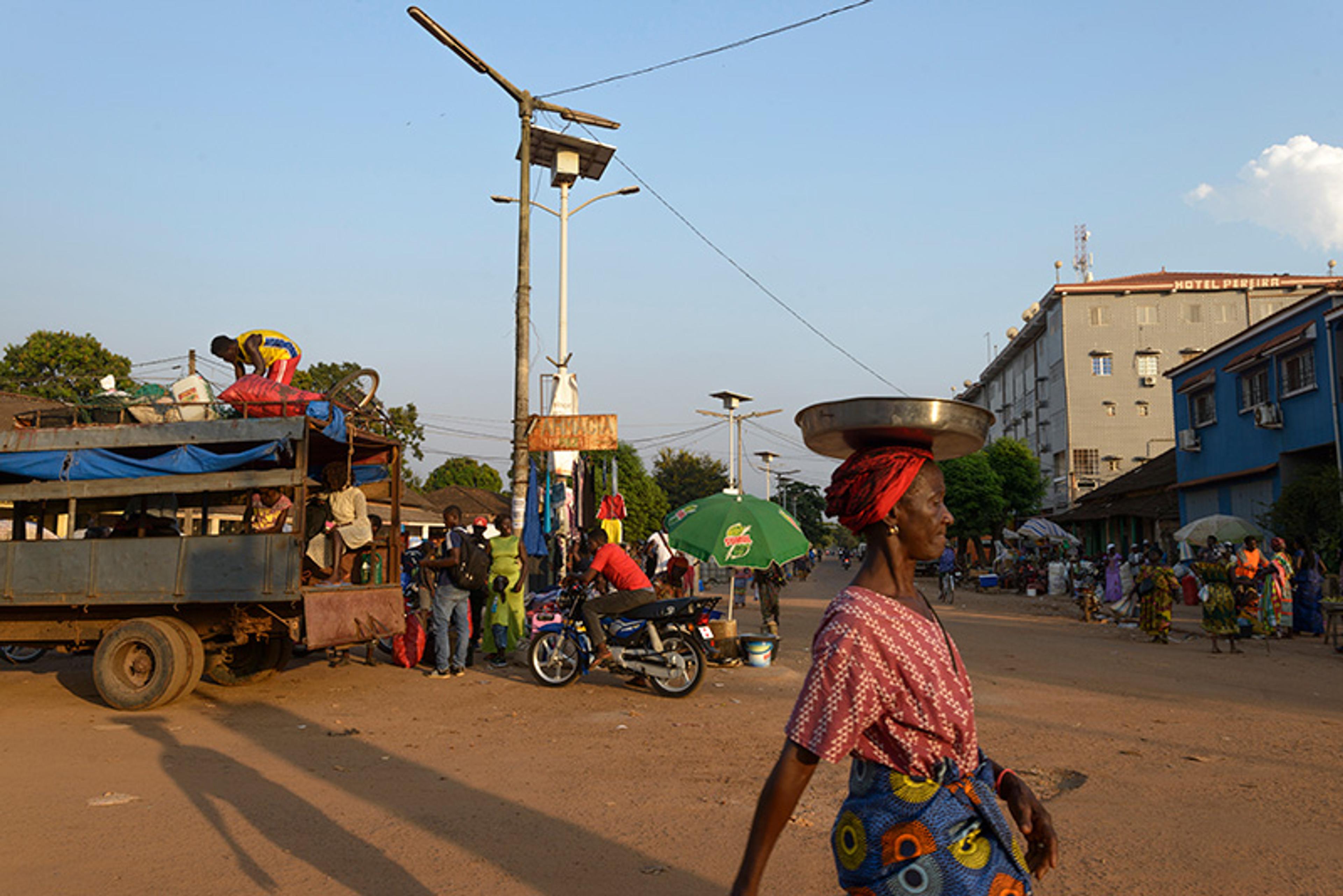
Canchungo, Cacheu, Guinea-Bissau in 2025. Photo by JB Russell/Panos Pictures Panos
It can often feel as if historians ‘raid’ the past for isolated events that might seem to have contemporary resonance. But it’s vital for us sometimes to be able to take the past, as much as possible, on its own terms, as a way of understanding how far communities have changed in the intervening centuries. The past does not exist ‘for us’: it can also exist to reveal the many different ways in which humans have formed their communities, and as a reminder that there is not just one motivating force to history, or way of organising societies.
Having studied Cacheu and its hinterlands for nearly three decades, I have had more time perhaps than most to consider how the history of Crispina Peres can speak of this painful and irretrievable gulf between the past and the present. Writing from the vantage point of a world now fractured and rent by the subsequent centuries of trauma without healing, and multiple contemporary aggravations of the same, this history seems to me to be more urgent than ever. For, in today’s angry world, we must consider moments like this from the past when people from different backgrounds and faiths shared in one another’s lives.
There have, in fact, been many such moments throughout history, and at a time when the divisions between people seem to be growing, it’s crucial to remember this. To avoid the doom loop of identitarian religious nationalism – which seems almost everywhere to be ascendant, whether in Israel, India, Iran, so many parts of Europe, or the United States – and the scapegoating of others, which is increasing worldwide, we must look at these plural past societies in which people organised themselves very differently. The fundamental difference I see between then and now is that these communities in Cacheu did not throw up hard categories and boundaries between people as a means to exploit and control them.
Co-sharing in the lives of people from different backgrounds is key for peaceful coexistence
In fact, before the rise of nationalism as a worldwide phenomenon in the 19th century, shared lives in multiethnic and religious empires were the norm – whether in Christian European empires of the Atlantic world and Russia, or the Islamic empires of the Ottomans, Safavids and Mughals. Understanding how these societies worked and what helped people to get along is probably one of the most important things that a historian can do these days.
So, what lessons follow today from the kind of world that Peres lived in? We learn that coexistence is both precious and fragile – easily broken down by greed and overconsumption, and by inflexibility. It’s clear that co-sharing in the lives of people from different backgrounds is key for peaceful coexistence. This means speaking many languages, participating in one another’s celebrations, and living in a world of more gendered equity.
At the moment, we’re facing in the opposite direction of travel. Misogyny is the key framework uniting extremisms of all stripes. Boundaries are being thrown up between groups for political purposes in all parts of the world. All this arises for many reasons, perhaps most especially because of the increasing inequalities surging both locally and globally.
Historians cannot resolve this, of course. But by recognising the different ways past societies organised themselves, they can acknowledge that the world can be different. It is through looking at different times and places that we can begin to identify the steps that are needed to change course in times of crisis.