Listen to this essay
26 minute listen
In the United States and elsewhere, it’s often taken for granted that the Catholic Church is a conservative institution with little engagement in the fate of the natural world. And for ample reason. Consider the biblical verse that’s slithered into modernity like a false prophet, Genesis 1:28. Here, God tells Adam and Eve: ‘Be fertile and multiply; fill the earth and subdue it. Have dominion over the fish of the sea, the birds of the air, and all the living things that crawl on the earth.’ This single verse has been held accountable for creating a permission structure that’s allowed generations of humans to hunt and fish and kill and maim and pollute; to strip field and forest of vegetation, to mine, drill and frack.
Christianity is an inherently human-centred religion. In his paper ‘The Historical Roots of Our Ecologic Crisis’ (1967), the historian Lynn White Jr pointed to Christianity’s culpability in our plundering of the environment. ‘Christianity is the most anthropocentric religion the world has seen,’ he writes; ‘in absolute contrast to ancient paganism and Asia’s religions,’ Christianity ‘not only established a dualism of man and nature but also insisted that it is God’s will that man exploit nature for his proper ends.’ White casts the Church as a covert actor in the brutalisation of our planet, one that ‘bears a huge burden of guilt’. His prominence has helped this view solidify over the past half-century.
Over the same period, there’s been a notable shift – largely associated with the evangelical movement – that’s seen Christians turn inwards, increasingly fixating on their own moral arc. According to the theologian Terrence Ehrman at the University of Notre Dame in Indiana, ‘Christian belief in God the Creator has been eclipsed’ by ‘belief in Jesus Christ the Redeemer’. With that comes a near-fanatical focus on sin, repentance and a striving for personal redemption. The emphasis is on the believer’s personal relationship with an empowering Christ and a quest for salvation, with all its heavenly rewards. The personal narrativising narrows the scope of the faith to the first person: a kind of bootstrap individualism interpolated into Christian doctrine. What matters to the faithful is not so much the state of the world but rather the state of their own soul.
Given this, Catholicism would appear to be the last place you’d find radical innovation that takes climate consciousness to heart. But were you to look beyond the Church’s contemporary reputation, and see the full sweep of its history, you’d uncover another version of the religion. In this form of Christianity, there’s a shimmering common thread that’s often obscured today, dedicated to radical change, valiant acts of compassion, and a solidarity with all of God’s creation.
Jesus Christ preached a radical way of living that shifted his followers’ priorities away from the strict observation of Jewish rites and rituals and towards an injunction to love both God and their neighbour ‘as thyself’. Neighbours in this usage was a universal category, including the hungry, poor, sick, and incarcerated – all the individuals scrabbling on the margins of society.
The Gospel of Matthew emphasises the primacy of this responsibility in distinguishing between those who are worthy of the kingdom of heaven and those who are not: ‘For I was hungry and you gave me something to eat, I was thirsty and you gave me something to drink, I was a stranger and you invited me in, I needed clothes and you clothed me, I was sick and you looked after me, I was in prison and you came to visit me.’ Jesus tells ‘the righteous’: ‘whatever you did for one of the least of these brothers and sisters of mine, you did for me.’ Throughout the New Testament, Jesus demonstrates a compassion and solidarity with the naked, needy, crippled, and blind, positioning those on the lowest rungs of society as the most beloved of his ministry. In the process, he set the stage for much of the radical Christian thinking that was to come.
When the plague swept the Roman Empire in the 4th century, striking large population centres like Caesarea, Romans fled to evade contamination. Evidence suggests, however, that some Christians elected to stay. The historian Eusebius of Caesarea noted how Christians ‘gave practical proof of their sympathy and humanity. All day long some of them tended to the dying and to their burial, countless numbers with no one to care for them.’ Though exhausted and withered from famine, Christians who remained in the plague-stricken city distributed bread to the sick. Before long, their deeds were hanging ‘on everyone’s lips’.
These Christians were working to bring the revolutionary spirit of Jesus Christ into the present day
When the plague resurfaced in Italy in the 14th century, a Majorcan Catholic named Roch risked his life by tending to the sick and dying in public hospitals on his pilgrimage to Rome. A century later, the Augustinian friar Martin Luther refused to leave the city of Wittenberg when the plague swept through Germany, opting to stay with his wife and tend to the infirm. ‘Those who are engaged in a spiritual ministry,’ he wrote later, must ‘remain steadfast before the peril of death,’ adding: ‘We have a plain command from Christ: “A good shepherd lays down his life for the sheep …’’’
In the modern era, Christians have pioneered the care ministered in leper colonies, established thousands of mission hospitals, and set up clinics focused on maternal and neonatal health in sub-Saharan Africa. But it isn’t just the sick and dying that Catholics have historically taken up as a moral cause. The Catholic Worker Movement, founded in 1933 by Dorothy Day and Peter Maurin, began as a newspaper: its mission, to let those ‘who think that there is no hope for the future, no recognition of their plight’ know that ‘there are men of God who are working not only for their spiritual, but for their material welfare.’ The Catholic Worker Movement aspired to ‘live in accordance with the justice and charity of Jesus Christ.’ Day, Maurin and other Catholics affiliated with the movement established these ‘houses of hospitality’ all over the US – places where those in need could go for food, shelter and clothing. In the decades during and after the Depression, more than 100 of these houses were founded nationwide (today, there are nearly 150 operating in the US, and dozens more worldwide), some serving thousands of people a day.
A similar drive to seek justice and relief for the downtrodden took root in Latin America following the second Latin American Bishops’ Conference, in Medellín, Columbia, in 1968. There, bishops from Central and South America drafted a series of documents focused on moving beyond Catholic pedagogy and directly improving their parishioners’ lives. The bishops wanted to combat the ‘institutionalised violence’ of poverty in their nations, and began to espouse what would eventually be called the ‘preferential option for the poor’. This revolutionary tenet asserted that God, as he is depicted in the Bible, instructed his followers to address the needs of the poor first.
These ideas eventually coalesced into what we now know as liberation theology, a politically charged form of Catholicism that swept Latin America in the 1970s and ’80s. Personified by audacious, visionary figures like Gustavo Gutiérrez, Óscar Romero and Leonardo Boff, liberation theology was miles away from any cloistered Catholicism. Instead of sleepy priestcraft and pedantry, these Christians were working to bring the revolutionary spirit of Jesus Christ into the present day. As Gutiérrez wrote in A Theology of Liberation (1973): ‘The denunciation of injustice implies the rejection of the use of Christianity to legitimise the established order.’
While these movements may appear to represent breakaway strains of the religion, they’re all firmly rooted in Christ’s example and the Catholic doctrine that followed. Catholic social teaching is a part of Church theology that consists of seven pillars. Originally laid out by Pope Leo XIII in an 1891 encyclical, the pillars include the sanctity of all human life, prioritising the needs of the poor, the dignity of work and workers, and care for God’s creation. These pillars are inspired by the religion’s prophets, who, according to the US Conference of Catholic Bishops, ‘announced God’s special love for the poor and called God’s people to a covenant of love and justice.’
Catholic social teaching has been embodied by historical figures like Day, Maurin and Gutiérrez – Catholics committed to action-oriented compassion for those in need. Through their movements and the moral acts they’ve inspired, Catholics are not using their religion to ‘legitimise the established order’; they’re imposing a spiritual responsibility on themselves to change the world for the better and ‘lighten the sum total of suffering,’ as Day put it. This dimension of the Catholic Church can be obscured by the baggage and hypocrisy that barnacle onto many perennial institutions, yet it is critical to understanding how Christianity can be a force for change today. In particular, Catholic social teaching advocates care for the whole of God’s creation, a pillar colloquially referred to as ‘creation care’. This tenet isn’t an archaic, mouldering article of faith, either. The US Conference of Catholic Bishops maintains that care for God’s creation is ‘a requirement of our faith’, with ‘fundamental moral and ethical dimensions that cannot be ignored.’ While most people may not associate the Catholic Church with environmental justice, many of its most revered leaders have been advocating for Earth for a long time.
Human impact on the climate is calamitous. The global surface temperature in 2025 is on pace to be among the warmest ever recorded; sea levels are climbing; and a biodiversity crisis is rapidly underway, with a 2024 World Wildlife Fund report showing that wildlife populations have experienced an average population decline of more than 70 per cent since 1970. By every ecological metric, the figures are staggering. At first blush, the role that the Catholic Church and its roughly 1.4 billion global followers might play in this planetary crisis is not immediately clear. The Church is not Greenpeace, the Environmental Defense Fund or the Climate Action Network – it isn’t an NGO with an explicit objective to fight climate change, promote decarbonisation, or preserve the world’s languishing biodiversity. What it is, however, is a thought leader with the authority and credibility to influence people’s attitudes and beliefs.
If you approach the Bible outside of an anthropomorphic lens, you find that even Genesis reveres the nonhuman aspects of God’s creation, notably in passages in which God looks admiringly on plants and animals, land and sea: after each day of layering in one more facet on his loamy canvas, God ‘saw that it was good’. A passel of psalms celebrates the full breadth of creation. Psalm 104, for example, praises a vast ecosystem in harmonious balance: ‘The trees of the Lord drink their fill, the cedars of Lebanon, which you planted./There the birds build their nests; the stork in the junipers, its home./The high mountains are for wild goats; the rocky cliffs, a refuge for badgers.’ If attention is ‘the natural prayer we make’, as the French philosopher Nicolas Malebranche suggested in 1674, then many psalms might be considered exultant prayers for the natural world, testifying to an elusive, heterogeneous beauty.
During his relatively brief tenure as the head of the Catholic Church, Pope Benedict XVI condemned our extractive relationship with the environment. ‘The external deserts in the world are growing, because the internal deserts have become so vast,’ he said during his first homily as pope in 2005. ‘Therefore the earth’s treasures no longer serve to build God’s garden for all to live in, but they have been made to serve the powers of exploitation and destruction.’
The Church unequivocally recognised the scientific consensus on the warming of the planet
Bartholomew I of Constantinople (technically, the leader of the Eastern Orthodox Church) advocates so passionately for ecological issues that he’s often referred to as the ‘Green Patriarch’. At an environmental symposium held in a Greek Orthodox Church in California in 1997, he became one of the first individuals to articulate a nascent concept that would eventually become known as ecological sin. ‘For humans to cause species to become extinct and to destroy the biological diversity of God’s creation … For humans to degrade the integrity of Earth by causing changes in its climate, by stripping the Earth of its natural forests, or destroying its wetlands … These are sins,’ he said.
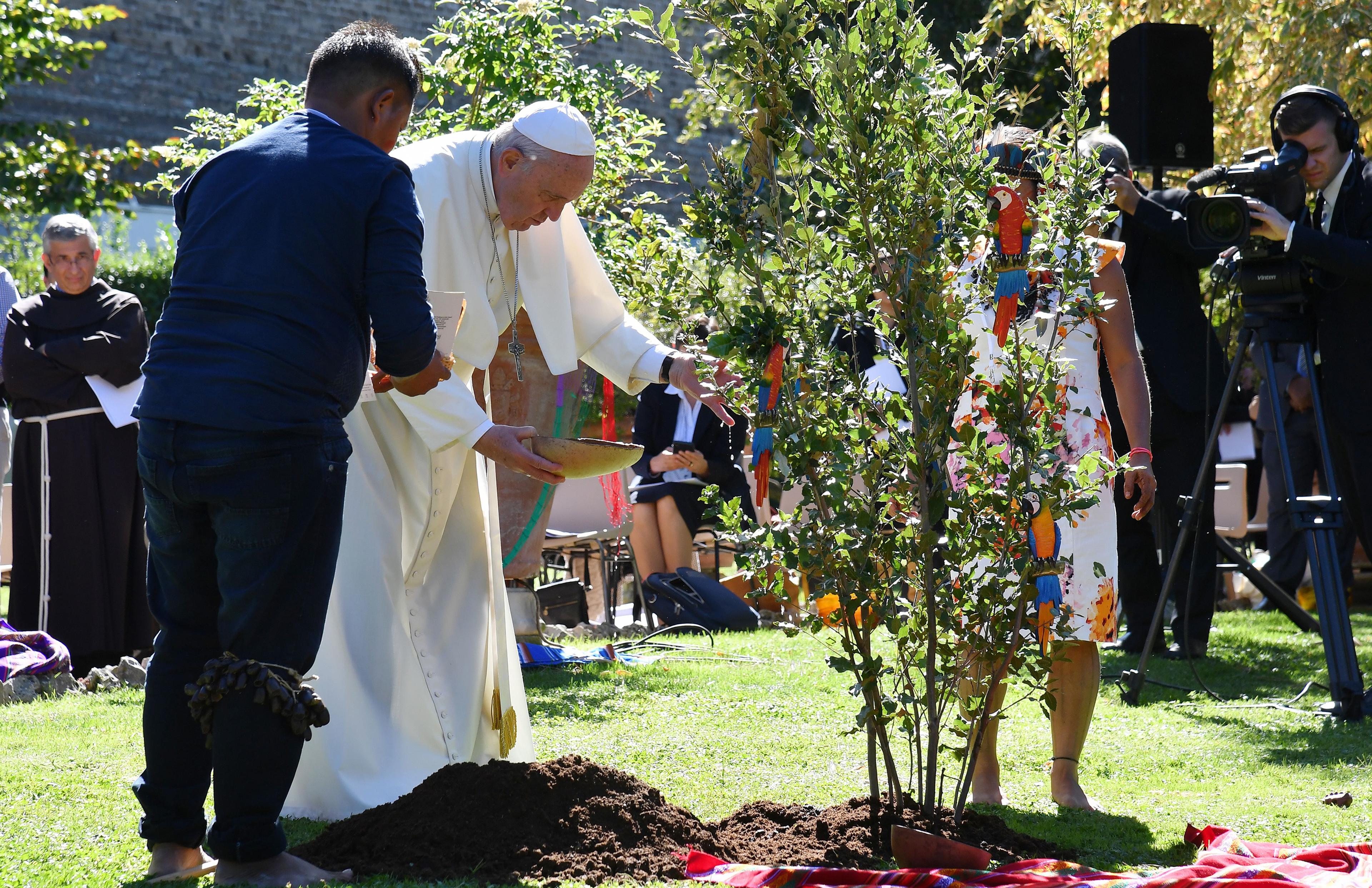
Arguably, the single-greatest influence on Catholic thinking about our responsibility to Earth is the encyclical that Pope Francis published in 2015, when climate change was clawing into the global consciousness during the hottest year on record up to that point. In Laudato si’ (‘Praise Be to You’), Pope Francis drew a sharp line in the sand: the Church unequivocally recognised the scientific consensus on the warming of the planet and humanity’s culpability in it. Laudato si’ is more than a dispassionate document affirming climatological facts, though. It seeks to contextualise the unfolding catastrophe in moral and spiritual terms. Mother Earth, Francis laments, ‘now cries out to us because of the harm we have inflicted on her by our irresponsible use and abuse of the goods with which God has endowed her. We have come to see ourselves as her lords and masters, entitled to plunder her at will.’
Unconstrained by the anodyne, emotionally neutered language of academic science, Pope Francis explicitly ties our environmental crisis to human sin, myopic pride, and an anthropocentric mindset that sees our relationship to Earth in coldly utilitarian terms. His encyclical lays out how the impacts of climate change reverberate through the worlds of plants, animals and vulnerable populations, triggering a cascade effect that imperils both natural ecosystems and the global poor.
In making these connections, Francis articulates a larger, bolder thesis that frames global warming as a starkly moral issue. Climate change is both a cause and an effect of the extreme inequality we see in the world: one that further victimises the most vulnerable lives while perpetuating the gross power imbalance that permitted it in the first place. ‘This is why the earth herself, burdened and laid waste, is among the most abandoned and maltreated of our poor,’ he writes. ‘She “groans in travail” …’ Laudato si’ is, in many ways, a culmination of many of the Catholic moral crusades that preceded it – ecological sin, liberation theology, the Catholic Worker Movement. Like the poor, sick, and stigmatised, Francis decried how ‘the earth herself’ is now being immiserated by exploitation and indifference.
It is difficult to overstate just how influential Laudato si’ has been to the Church’s followers. In conversations I’ve had with nearly two dozen Catholic theologians and activists, they consistently characterise Francis’s encyclical as a watershed event, a clarion call that connects a veritable scientific reality with the spiritual conscience of believers. ‘Pope Francis writing Laudato si’ was this huge gift to people who’ve been caring for creation for so long,’ Anna Johnson, the North America director of the Laudato Si’ Movement, told me. When she reached out to fellow Catholics in the wake of its publication, ‘We were all like: “We’re crying with this encyclical – it’s so beautiful.”’
For other Catholics,Laudato si’ offered the opportunity to grow more comfortable in connecting their passion for the environment to their faith. It gave the cartographer Molly Burhans confidence to found GoodLands, an organisation that works to map the Catholic Church’s vast landholdings for conservation and humanitarian purposes. ‘I got the courage to do that from Pope Francis,’ she said. ‘He brought together the best ecologists, the best scientists to consult on Laudato si’.’
The encyclical arguably opens a new chapter in the Church’s history by encouraging the faithful to be more assertive in embodying the environmental pillar of Catholic social teaching. The Laudato Si’ Movement, for example, is a global network that collaborates with hundreds of Catholic organisations all over the world to promote sustainability and divestment from the fossil-fuel industry. In anticipation of the 2015 United Nations Climate Change Conference (COP) in France, the Movement gathered close to 1 million signatures from Catholics around the world to petition the UN to include language limiting temperature rise to 1.5 degrees. ‘We collaborated in submitting these signatures to both the French presidency and also to Christiana Figueres, who was then the convener of the COP,’ said Christina Leaño, the associate director of the Laudato Si’ Movement. ‘It was the only petition that pushed for keeping temperature rise below 1.5 degrees, and it eventually made it into the final document.’
‘What if the Catholic Church became the largest global network of conservation the world has ever seen?’
Another major Catholic nonprofit, the Catholic Climate Covenant (CCC), takes a grassroots approach by partnering with parishioners all over the US to pursue projects aimed at reducing carbon emissions and promoting sustainability locally. ‘We have close to 400 creation care teams,’ Diana Marin, a programme manager at CCC, told me. Marin continues to be motivated by the legacy left by Pope Francis’s words. ‘Pope Francis spoke about los descartados, the thrown-away people. And so that call to environmental stewardship or that vocation to care for creation, I think that also calls us to care for those people and to rethink that way of living that throws people and things away.’
The Catholic Church itself has taken some modest steps towards more substantively supporting environmental stewardship. In 2023, the Irish Bishops’ Conference agreed to rewild 30 per cent of all parish land in Ireland by 2030. As the Conference explained: ‘All are called to arrest the decline of biodiversity for the sake of the next generation.’ Several years ago, the Church worked with Burhans to map all the land it owns in the US, for the purposes of eventually maintaining its properties more sustainably. The project saw GoodLands map more than 33,000 Catholic-affiliated properties, producing an exhaustive dataset that integrated the Church’s official directory with assessors’ information and commercial datasets to offer a comprehensive picture of Catholic Church landholdings in the US.
Burhans was enthusiastic – exuberant, even – about the Church’s potential to be a world leader in environmental stewardship when we spoke. ‘There’s something that’s inspired me from the start of this, this super-big vision/question,’ she said. ‘Which is: what if the Catholic Church became the largest global network of conservation and ecological regeneration the world has ever seen?’
Burhan’s ambition notwithstanding, it may be quixotic to expect the Catholic Church to become a transformative actor in addressing the climate crisis. But it can serve as a lodestar for the world’s billion-plus Catholics by centring the primacy of creation care. People’s attitudes and feelings need to evolve internally before they’re willing to change their behaviours. Because of the way the institution can set priorities for its followers, and impose moral urgency, the Church is uniquely suited to shake Christians out of the inertia – and self-centred anthropocentrism – that’s taken hold for so many. If the impact of Pope Francis’s encyclical is a harbinger and not a blip, it can continue to rouse them toward meaningful action.
The truth is that the Catholic Church is in a far better position to galvanise Christians than its Protestant counterpart in the US. American Protestantism has more than twice as many followers as Catholicism, with an interdenominational movement that encompasses Baptists, Methodists, Pentecostals and Quakers. Its largest and most powerful contingent, the Evangelical movement, counts nearly a quarter of the US population among its flock. And it is this movement and its flagship denominations – Baptists, Methodists, Lutherans – that have become an animating force in US politics, agitating for the pro-life movement, resistance to LGBTQ rights, and the preservation of a conservative Christian nation (otherwise known as Christian nationalism). These platforms and allegiances make it difficult for the disparate strains of US Protestantism to coalesce around the issue of climate change – especially given its association with progressivism. ‘They basically identify their Christian faith with the cause of American prosperity,’ Norman Wirzba, a theologian at Duke University in North Carolina, and an Anabaptist, told me. ‘They identify it with the flag.’
Wirzba recalls having a recent discussion with several pastors based in the South, on holding a potential workshop about climate issues among their congregations. He didn’t get far before he was sharply rebuffed: ‘It was depressing to hear pastors of major-sized churches tell me that their congregations are not interested in what Jesus had to say about ethical or political issues.’ Protestant denominations in the US are also the keenest advocates of a personal religion that cultivates a private relationship with Jesus Christ in the hopes of personal salvation. ‘It’s about getting your soul into heaven,’ Wirzba said. ‘It’s a very individualistic faith.’
‘The industrialist who doesn’t care if he leaves the land a foul and hideous place is like the pornographer or hedonist who looks upon the human body as an assemblage of parts for the procuring of pleasure’
Despite its hypocrisies and missteps, the Catholic Church does not suffer from the same co-opting of its identity. It’s also demonstrated a unique capacity to inspire followers to reject the status quo and take bold measures to follow Jesus Christ’s radical example, transcending self-interest and even self-preservation for the sake of spiritual conviction. Whether it’s a moral crusade against poverty, disease or systemic injustice, the Church has long given people the courage to sublimate themselves to a nobler cause. It’s this version of Christianity that can move its followers to see the climate crisis and all the ecosystems it imperils with the sense of moral urgency and existential consequence they so clearly warrant.
Far from being an obstacle to stewardship, the Church is actually in a position to reframe the conversation using its longstanding moral authority. So much of the way we now talk about global warming and its catastrophic effects are rooted in scientific and economic jargon – statistics, mechanics, technologies, impacts. While these contexts are important, what we so often leave out may be even more consequential: morality.
When I spoke to Anthony Esolen, a Catholic scholar and translator, he referred to our environmental predicament in a language I rarely hear: one of moral accountability. ‘Our whole orientation toward the world is out of kilter,’ he said. ‘Utilitarianism, whose hard side is industrialism, and whose soft and squishy side is hedonism, considers first what a thing can be used for, and not what it is. The industrialist who doesn’t care if he leaves the land a foul and hideous place is like the pornographer or the hedonist who looks upon the human body as an assemblage of parts for the procuring of pleasure.’
This is the kind of language we need now – not the spigot of data that turns extraction and destruction into sterile figures that camouflage our culpability. The words of past Christian leaders – Pope Francis and ‘los descartados’, Bartholomew I and ‘ecological sin’ – can be an antidote to the utilitarianism Esolen laments, which is currently the chief lens through which our transactional society views creation. Inspired by the ‘justice and charity of Jesus Christ’, as well as the long lineage of believers who strove to personify them, the Church can hold its followers to a higher standard than capitalism, market logic, or any of the other contemporary gods who lord over us today.