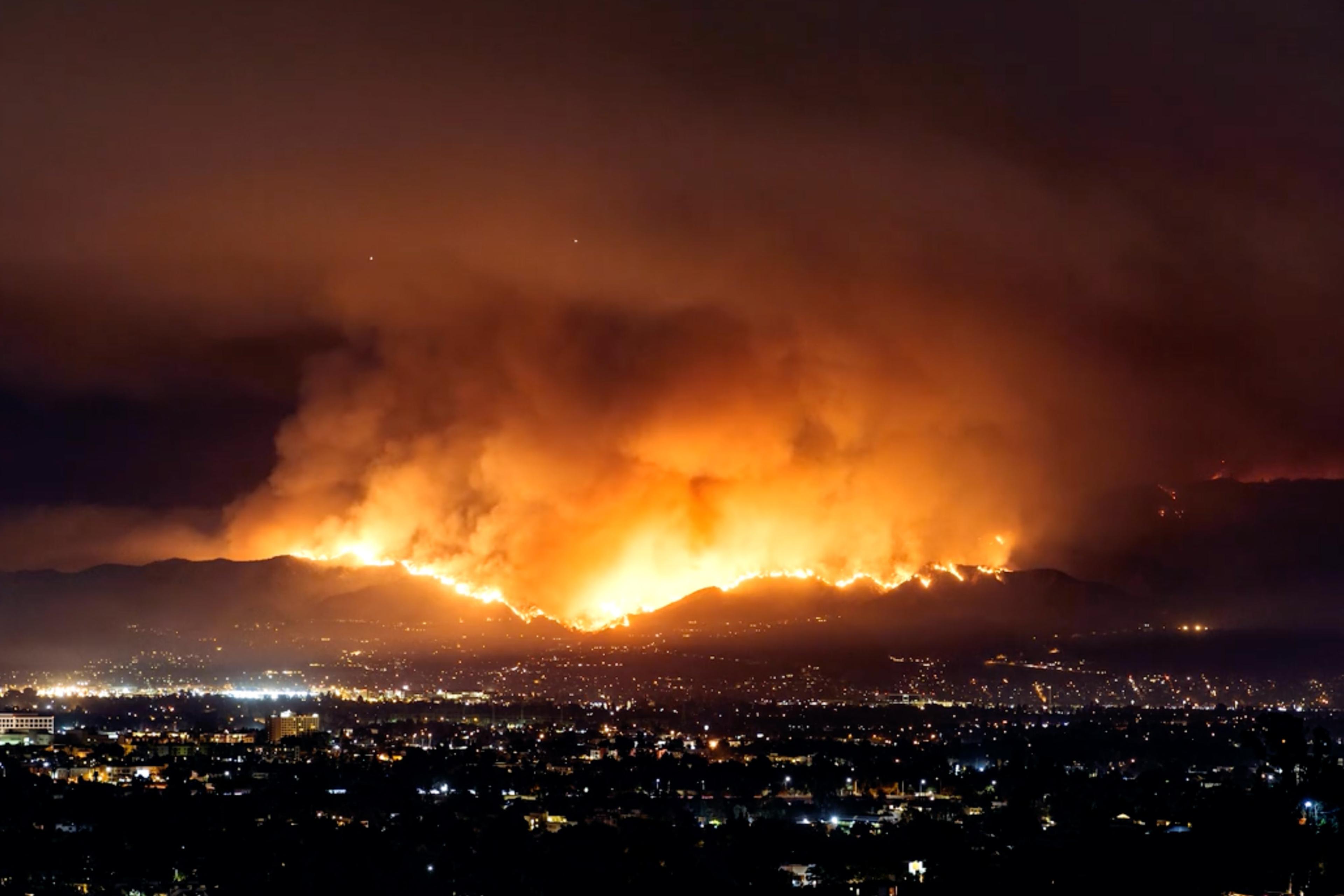
Will a Category 5 hurricane make landfall in the US before 2027? Will there be a megaquake by 30 June? Will 2026 be the hottest year ever? You can bet on these and dozens of other disasters in the online prediction markets Kalshi and Polymarket, where users trade ‘yes’ and ‘no’ shares in the outcome of future events in politics, sports, popular culture, business, and weather. Interspersed with trending categories like ‘Ukraine’, ‘Trump’ and ‘Crypto’ are event markets in ‘Hurricanes’, ‘Natural disasters’ and ‘Climate change’.
In January 2025, emergency management officials and insurance companies began estimating losses in the Los Angeles wildfires that ultimately included 31 direct deaths and at least 409 indirect deaths, and between $76 billion and $131 billion in property and capital losses. Online bettors had been wagering on this event and tallied their winnings or losses in catastrophe markets. By mid-January, Polymarket bets on the wildfires’ spread, duration and political fallout totalled more than $1.2 million. A Polymarket user posted a comment: ‘Volume so high in this market it cause another fire.’
After the 1906 San Francisco earthquake and fire, The New York Times published an article entitled ‘Catastrophe Markets’ that discussed the short-lived impact of the disaster on stock prices. Today’s online catastrophe markets are markets literally in disaster. People bet on whether disasters will happen and how bad they will be. These catastrophe markets raise some questions, including what, besides money, is at stake? What kind of thinking about risk in society do they promote and preclude?
One aspect of the history of catastrophe markets is very old. Weather gambling was described by one newspaper in 1931 as ‘one of the oldest, most fascinating and uncertain gambles in the world’. In 1886, betting on how long it would rain was ‘in vogue’, and, by the 1930s, office weather pools were commonplace. Weather gambling has taken on different and increasingly organised forms from the 19th to the 21st centuries, from informal wagers to gambling rings and lotteries to gamified forecasting apps like Weather Champs.
Rain betting, the oldest and most common form of weather gambling, was often tied to local community traditions. It flourished in Calcutta and Bombay in the 1880s and ’90s. Crowds gathered to gamble on whether a rain gauge would overflow, confident that cheating was impossible because there was no ambiguity in a downpour. As one newspaper remarked: ‘When it rains in India it rains; there is no half-way business about it.’ This assumption that the natural world defied market manipulation was echoed by accounts imagining rain betting as a model for speculation in the US because of its distance from volatility in railroad stocks and market swings in general.
Capitalism turned the uncertainty of the weather into a calculable risk and source of profit
So-called ‘pools on the weather’ in the early to mid-20th century signalled the growth and bureaucratisation of weather gambling, made possible in the US by government weather data. With the rise of government forecasting in Europe and the US, meteorological data became a steady stream in what the Canadian philosopher Ian Hacking called the 19th-century ‘avalanche of printed numbers’ produced by European state bureaucracies, and it led to the systemisation and scaling up of weather gambling in the 20th century. As a Texas newspaper observed in 1915: ‘Gambling on the weather has become an institution throughout a great part of the United States.’ Large syndicates in cities in the US and Canada were well organised, lucrative, and illegal. In 1950, St Louis police raided what newspapers called a ‘weather-betting racket’ that pulled in a reported $2.6 million annually. Some lotteries were pure chance, while others involved forecasting skill and judgment. Some cities had pools on the temperature at a specific hour the next day or on other combinations of weather data. Gamblers attempted to bribe US weather officials to falsify temperature figures and tampered with government weather reports en route to newspaper offices. In St Louis, extra security measures were implemented to prevent this manipulation, and the national weather service stressed its commitment to keeping weather data, a public good in the US, accessible to the public.
Weather data also enabled the financialisation of catastrophe, another precursor of catastrophe markets. In his speech on ‘New England Weather’ (1919), Mark Twain catalogued weather varieties, including ‘weather to sell; to deposit; weather to invest.’ Twain’s satirical assetisation of the weather was prescient. Speculative financial instruments designed to manage weather-related risk – rain insurance, flood insurance, weather derivatives, and catastrophe bonds – emerged during the 20th century. Through insurance and reinsurance, capitalism turned the uncertainty of the weather into a calculable risk and source of profit. This process of taming weather-related risk hinged on the assumption that the stochastic nature of rain, hurricanes and other natural hazards could be rationally managed, like an asset, with market logic. But insurance agents, energy traders and hedge fund managers were only ever partially successful. The uncertainties of bad weather and natural hazards always persisted.
Neat categorical distinctions between gambling and speculation often look messy up close. Such distinctions are typically class-based efforts to legitimise elite financial practices by discrediting allegedly irrational economic behaviour of non-elites. In the Gilded Age, commodity exchanges and ‘bucket shops’ faced off in a legal battle over whether speculating on commodity futures in an organised exchange was any different from wagering on the rise and fall of prices in a betting parlour. In 1905, the US Supreme Court ruled that ‘speculation … by competent men’ was a desirable form of modern risk management in the Chicago Board of Trade – but that bucket-shop gambling was illegal.
In 1907, The New York Times observed that: ‘From a philosophical point of view, all insurance is gambling.’ This was literally true of rain insurance, introduced in England during the 1910s and written in the US from 1919. ‘Pluvius policies’ could be purchased seven days before an event, like baseball games or county fairs, that an individual or company wanted to insure against losses due to rainfall. As the journal Commerce and Finance explained, ‘you put up so much money and bet that it rains; the insurance company gives you odds and bets that it doesn’t. Gambling, of course, but quite legitimate. In this life everything’s a gamble.’ Weather forecasting in the 1920s was accurate for 24 to 36 hours ahead, so neither insurer nor insured would have had a reliable five-day forecast. In 1925, Andrew H Palmer, a US government climatologist-turned-Aetna insurance executive, touted rain insurance as a ‘public service in that it removes an unavoidable risk and helps to stabilise business, incidentally promoting success and prosperity.’ However, in the early days of the industry, some people who bought rain insurance but then saw no clouds in the sky created informal markets to unload their policies. In the days before customers had to demonstrate an insurable interest, they insured other people’s businesses, hoping for rain so they could cash in. As an insurance trade journal observed in 1923, an ‘element of wager … first strongly characterised rain insurance’.
Rain insurance protected businesses from ordinary, not catastrophic, risk. In 1968, the US National Flood Insurance Program (NFIP) was established to provide insurance for homeowners in flood-risk areas. The challenge of calculating actuarially fair yet politically palatable premiums has bedevilled NFIP from the start. Flood-risk zones are premised on a kind of statistical gamble: the ‘100-Year flood standard’, a base standard of a flood of a certain magnitude that has a 1 per cent chance of occurring in any given year in a 100-year timeframe (not once in 100 years, as it is often misconstrued), which is an important mechanism, however flawed, for pricing and imagining catastrophic risk.
If the disaster happens, investors can lose everything, but if it doesn’t, they walk away with double-digit returns
In the 1990s, more complex financial instruments for managing uninsurable weather-related risk emerged. Energy traders, risk modelers and reinsurance companies devised new techniques for calculating and pricing risk. These techniques led to the new asset classes of weather derivatives and catastrophe bonds, which financial journalists described as speculative investments but also gambling. Called ‘betting on the weather’ by Fortune magazine, weather derivatives were created in the late 1990s by Enron and other leaders in the energy industry to deal with fluctuating usage in a deregulated US energy market when insurance companies would not insure against non-extreme weather risks (like warm winters) because they could not accurately price them. Energy companies realised that, if they could index weather according to average monthly or seasonal temperatures and attach a dollar amount to each index value, they could trade weather just like currency values, interest rates or agricultural commodities. Weather derivatives are contracts tied to indexes like temperature, precipitation and wind, and pay out whether or not any physical damage actually occurs, unlike insurance. But because ‘weather is not physically deliverable’, in the succinct words of the geographer Sam Randalls, it is not surprising that most of the market in weather derivatives is devoted to speculation rather than hedging.
Karen Clark, a Boston-based insurance consultant, developed the first computer models for catastrophic risk in the 1980s. Speaking to Bostonia magazine in 2010, she said: ‘In order to price insurance, I need to know if this is a one-in-10-year event or a one-in-a-100-year event or a one-in-a-1,000-year event.’ So Clark used historical data on hurricanes and structural damage to build her models, and launched her own firm. Insurance companies did not want to believe the staggering losses predicted by her risk models. But in 1992, Hurricane Andrew changed their minds. After Andrew, reinsurance companies like Hannover Re and Swiss Re created catastrophe or ‘cat’ bonds for extreme weather risks. The costliest disaster in US history until Hurricane Katrina in 2005, Andrew caused 65 deaths and $27 billion in damages, which led to the bankruptcy of 11 insurance companies.
Cat bonds were designed to insure against a ‘megacatastrophe’ by financialising catastrophic risk: as a form of insurance-linked securities, they provide a mechanism for insurance and reinsurance companies to transfer catastrophic risk to capital market investors. When specific conditions are met (like a certain magnitude earthquake or a threshold of insured losses from a hurricane), the issuer gets a payout. Writing in The New York Times magazine in 2007, Michael Lewis called cat bonds ‘nature’s casino’, and they are high-risk, high-reward: if the disaster happens, investors can lose everything, but if it doesn’t, they walk away with double-digit returns. John Seo, a biophysicist-turned-Wall Street quant, co-founded a hedge fund in 2001 that became the world’s largest cat bond investment manager in about a decade. In an episode of the Dutch TV series Planet Finance in 2023, Seo explained that a ‘catastrophe bond is brilliant because it’s so simple. There was no complexity for the investors.’ In the global cat bond market, overwhelmingly concentrated in the US, hedge funds have reaped enormous returns from record-high spreads in cat bonds in the past two years. As Fortune observed in 2024: ‘The world being on fire is swelling “catastrophe bonds” to a record $45 billion – and it’s a key hedge fund strategy.’ Cat bonds appeal to investors because of high returns – 20 per cent in 2023, and 18 per cent in 2024, according to The Economist – and uncorrelated risks not tied to typical market volatility of stocks and bonds. As of April 2025, retail investors can now invest in an exchange-traded fund on the New York Stock Exchange (NYSE) that bundles cat bonds covering risks from around the world.
Event contracts on disasters are the latest and most literal version of catastrophe markets. In the US, from 2018 to 2022, the number of annual major disaster declarations was nearly double the annual average from 1960 to 2010. With climate change ‘supercharging’ extreme weather, hurricanes, thunderstorms and floods, 2024 became the third-most expensive year for insured losses since 1980. These disasters are not inevitable or unavoidable. As disaster experts say, there is no such thing as a ‘natural’ disaster. Because of the long-term historical processes of unsustainable development, neglected public infrastructure and systemic socioeconomic inequities, certain social groups – particularly people of colour, disabled people, and economically disadvantaged people – are disproportionately concentrated in risk-prone areas.
Event contracts are zero-sum, yes/no bets on the outcome of a particular event in the future, and can pertain to anything from elections to Fed rate changes to sporting events. The price of an event contract is always between zero and $1 and reflects the probability, according to the participants, that the event will occur. If an event contract is priced at 75 cents, three-quarters of the participants are betting that the event will happen. Kalshi describes itself as ‘a stock exchange for events’ that converts individual predictions into assets. Kalshi’s co-founder Tarek Mansour, an MIT graduate and former trader at Goldman Sachs and Citadel, told Bloomberg in December 2025 that ‘the long-term vision is to financialise everything and create a tradeable asset out of any difference in opinion.’ Using populist and neoliberal language like ‘levelling the playing field’ and ‘the marketplace of ideas’, Kalshi’s website touts the predictive acumen of the individual, as opposed to the expertise of the financial elite. It’s a classic ‘wisdom of crowds’ approach to forecasting. Speaking on the Alts.co podcast in 2022, Kalshi’s fellow co-founder, Luana Lopes Lara – another MIT grad, a former quantitative trader and professional ballet dancer, and now the youngest self-made woman billionaire – said: ‘the core of the power of the predictive side of Kalshi … is when you get all of these people of different opinions wanting to be right, they will do more research, they will bring more information to the market. And then you have the price of the market, really being the best forecaster for whether that event’s going to happen.’
Kalshi’s website claims that the yes/no proposition ‘democratises trading’. Everyone has an opinion or can flip a coin, after all. Lopes Lara explained that ‘event contracts [are] meant to be simple and they’re powerful because they are simple … And I think the yes/no question is really the natural form of these contracts.’ But binary event contracts are the wrong way to think about catastrophe. Event contracts reduce disasters to discrete events, but, as scholars have emphasised in Rethinking American Disasters (2023), disasters are not isolated events and must be understood as the result of long historical processes. Event contracts also erase the broader context of ‘cascading’ or interconnected disasters. And the scale and complexity of some disasters defy the very category of event itself.
Moral outrage over gambling on death and destruction faded as the news cycle moved on to the next disaster
Betting on disaster might seem like yet another, if especially grotesque, version of disaster capitalism. The Canadian scholar Naomi Klein originally located this phenomenon in the aftermaths of shocks like wars and natural hazards, when private industries emerged to profit from catastrophe, and governments seized the opportunity to push through neoliberal economic agendas of privatisation and deregulation. Other scholars have used the concept more broadly to examine the business of catastrophe and how disasters benefit capitalism. The ‘disaster capitalism complex’ that Klein identifies at the nexus of neoliberal and corporate power in The Shock Doctrine (2007) takes on a different form in online catastrophe markets: they signal a new version of disaster capitalism in which financial transactions, data visualisations and users are consolidated into a single platform, facilitating gambling on a range of climate impacts in the wake of the warmest year on record (2024) and the first time that average global temperatures have surpassed the 1.5°C increase above preindustrial levels.
Polymarket, which bills itself as ‘the world’s largest prediction market’, faced harsh critique in early 2025 over its wildfire markets. In mid-January 2025, active markets related to the LA wildfires had a volume of $831,000 wagered on these events: when will the Palisades wildfire be 50 per cent or fully contained? Will all LA wildfires be fully contained before February? How many acres will the Palisades wildfire burn in total?
Backlash against Polymarket’s ‘gamification of disaster’ was swift. Condemnation of ghoulish wildfire markets appeared on social media and in major news outlets. Moral outrage over gambling on death and destruction quickly faded as the news cycle moved on to the next disaster. But the wildfire markets tell a more complicated and maybe even more unsettling story about disaster capitalism, the financialisation of catastrophe, and how humans, including the wildfire gamblers themselves, try to make sense of what it means to bet on disaster in cryptocurrency while the planet is burning.
Online catastrophe markets are virtually identical on different platforms. Kalshi and Polymarket, however, brand themselves differently, thereby propping up the arbitrary boundary between gambling and investment. Kalshi characterises itself as a speculative investment vehicle featuring an interest-bearing portfolio and advanced options like collateral return and flip selling. Polymarket describes itself as a betting platform: ‘1. Pick a Polymarket. 2. Place a Bet. 3. Profit.’ In an interview with Forbes magazine in December 2025, Lopes Lara said Kalshi’s ‘vision was to build the biggest financial exchange in the world’. A few days earlier, in an interview with CBS News, Polymarket’s founder Shayne Coplan had described his company as ‘a site where you can basically bet on current events.’ Rhetorical differences aside, both companies are headed by 20-something billionaires, have eye-popping valuations ($11 billion for Kalshi, $9 billion for Polymarket), and enjoy a favourable regulatory climate in Washington, DC, with Donald Trump, Jr on both advisory boards. Since October 2024, Kalshi has been permitted to operate event markets on US elections, and in September 2025 Polymarket secured regulatory approval to relaunch and operate legally in the US, where it had been banned since 2022 for operating an unregistered event market. Some big players in finance and media are all in: in October 2025, the parent company of the NYSE invested $2 billion in Polymarket; two months later, CNN and CNBC announced partnerships with Kalshi to integrate its real-time odds into news broadcasts. Prediction markets are big business and quickly becoming mainstream.
Online event markets don’t just predict; they can also impact our environmental futures. Kalshi users can link their crypto wallets, along with bank accounts and debit cards, and Polymarket is a blockchain-based exchange using only cryptocurrency. The insatiable energy demands of the cryptocurrency mining and data centres undergirding online event markets ironically contribute to the very temperature increases that disaster gamblers bet on. In catastrophe markets, economic effects and climate impacts fuel each other in a feedback loop: more bettors produce more data, which requires more energy, which contributes to greater climate impacts, which generate more catastrophes to bet on, which attract more bettors, and so on. In these ways, catastrophe markets can increase the existing inequities of capitalism and climate change. Crypto is now considered a major asset class, with a combined market capitalisation in the trillions and ownership largely controlled by crypto exchanges and so-called ‘whales’. As crypto wealth is consolidated in the financial elite of the Global North, its environmental costs disproportionately fall on the Global South, resulting in heatwaves, droughts, crop devastation, and displacement. Crypto mining is notorious for its electricity consumption and fine particulate air pollution. In the US, some communities are protesting against proposed data centres because of their carbon emissions, water consumption and noise pollution.
Would a homeowner betting in the wildfire markets be met with moral condemnation or sympathy?
Betting on a catastrophic event like the LA wildfires – with the larger-than-life horrors of a disaster movie turned tragically real – seems morally distinct from casino gambling or sports betting. Yet ‘Wildfire’ and ‘Weather’ were just two among the 30 trending categories on Polymarket in January 2025, normalised by their appearance alongside other newsworthy markets, which included, in February 2026, Trump, Iran, Olympics, AI, and Government Shutdown. Polymarket and Kalshi offer different data visualisations akin to a personal finance dashboard, standardising all propositions into a series of indicators, for example per cent chance, volume, and potential return. The effect is to produce an illusion of human control over dizzying uncertainty. Polymarket’s dashboards in February 2026 displayed markets in Macro, Elections, Fed Rates, Trump, and Sports, with the probability of a ‘yes’ outcome based on current market activity displayed on a needle indicator between 0 and 100 per cent. The intricacies of global politics, economy and culture are reduced to simple ‘Yes’ or ‘No’ propositions; the user just clicks a green or red button to enter the world of Polymarket. As Shannon Mattern observes in her history of urban dashboards and city governance, data dashboards afford a limited and oversimplified view. The same is true of catastrophe markets.
Beneath the neat dashboard interface, the comments reveal anonymous users navigating the moral and political tangles of betting on others’ misfortune. Polymarket comments on wildfire markets contained the typical jumble of practical advice, political posturing and conspiracy theories. The gung-ho gambler, completely detached from the tragedy, spotted easy profits: ‘Wow, I could do markets like this all day.’ The bettor with a social, and perhaps guilty, conscience realised that the safety of strangers might outweigh their own financial gain: ‘I hope I do lose.’ All event markets are ephemeral, closing when their conditions are resolved, and their comment sections reflect and sometimes drive the ebb and flow of trading shares.
One commenter identified the potential moral hazard in which betting on the conflagration’s spread could entice a local resident to keep the wildfires burning: ‘This is deeply unethical. Someone could bet against containment and have direct financial incentive to commit arson.’ Another responded: ‘Good point. A lot of markets are too big for an average person to influence.’ When Polymarket’s Coplan, a crypto entrepreneur, was asked by CBS News to comment on the ethical critique of ‘arson markets’, he equivocated: ‘There were a lot of conversations about it and there was a very select few markets that felt that they were the most informational – with, like, the least sort of, you know, risk. These are really small markets. And there’s tons of markets. And I understand this is really sensitive.’ Despite Coplan’s downplaying of the wildfire markets, it is worth pausing to speculate about how an average person, other than a hypothetical arsonist, could be directly connected to both an event market and a wildfire itself.
Imagine a homeowner who lost everything in the fire betting against containment to offset losses because their property was uninsured or underinsured. This scenario is increasingly common now that major insurance companies are pulling out of areas with severe wildfire and flooding risk. Would such a homeowner betting in the wildfire markets, perhaps to augment their GoFundMe, be met with moral condemnation or sympathy? Or both? Imagine insurance agents trading shares in wildfire markets in between fielding calls from panicked policyholders who need help filing claims because their insurance policy burned along with everything else. Or insurance companies entering catastrophe markets as institutional investors, using Polymarket as a hedge in case a cat bond doesn’t trigger a payout. In Polymarket’s version of disaster capitalism, all these scenarios are possible. A homeowner, an insurance agent and an arsonist could all be in the same wildfire market, posting advice that might be sound or self-interested or both: ‘Oh god, the fire’s already out, don’t burn your money.’
In response to the discussion of moral hazard, some moralising comments like ‘Burn baby burn. LA deserves this’ and ‘LA needs this reset’ invoked a secular version of the centuries-old providential framework of disaster. In this worldview, European colonisers justified catastrophe as a divine punishment for sinners and an avenue for social and material improvement by wiping a city off the map and forcing its leaders to rebuild. Other commenters pronounced this idea ‘insane’, with the reminder that ‘Ideological differences aside, they are still people with families and lives. Stop politicising every disaster.’ Predictably, some commenters launched the standard racist Right-wing attacks on Democratic politicians and residents. Other comments with US flag emojis conflated empathy, patriotism and nationalism.
Commenters also faced the familiar problem of distinguishing between trustworthy information and baseless rumour. Many users crowdsourced meteorological data and forecasts from the US National Weather Service and Weather.com to inform bets on wildfire containment. Some posted links to their sources, while others remained sceptical. One commenter warned: ‘I think there is a lot of misinformation in comments lol.’ It is easy to see the incentive to provide disinformation and manipulate a catastrophe market. For example, claims that a certain percentage of a wildfire had already been contained could push users to unload ‘no’ shares in a market for a specific date for containment. It is impossible to know if or how these comments moved markets. What is clear is that the stream of data and debate produced more uncertainty, not less. As one user declared: ‘Your comments are just fuelling your self-delusion. Trust the market.’ But what does it mean to trust in catastrophe markets?
Catastrophe markets all look identical in the dashboard display, but they exist in different temporalities. Short-term weather events or natural hazards are ‘fast’ disasters that unfold in a matter of hours or days, whereas long-term climate trends signal a ‘slow’ but rapidly accelerating disaster. In addition to singular catastrophic events like wildfires, hurricanes and earthquakes, users place more mundane bets on climatological data in a specific location such as the highest temperature in London or LA on a given day, and planetary-scale bets on the intensifying climate crisis such as minimum Arctic sea ice extent. Although event markets generally favour short-term contracts, Kalshi includes long-term climate event markets on questions such as will the annual global mean surface temperature anomaly pass 2°C above pre-industrial levels before 2050? These long-term climate markets have drawn virtually no media attention at all. In contrast to the controversial wildfire markets, betting on rain or temperature seems rather innocuous.
The biggest loss in online catastrophe markets comes from individualising risk
Yet, in the long run, climate event markets are far more consequential in terms of profit and the planet. Hundreds of millions of dollars have been wagered in total in Kalshi daily temperature markets for Austin, Chicago, Denver, LA, Miami, New York City, and Philadelphia. In February 2025, a Polymarket user betting on whether 2025 would be the warmest year on record offered sobering overviews of climate trends and projections from the US National Oceanic and Atmospheric Association, NASA, and the UK Met Office, while others celebrated ‘easy money’ and ‘free money’. No one mentioned the staggering fact that the period 2015-2024 had been the hottest 10 years in recorded history. The future is all that matters in Polymarket. One user declared: ‘what’s done is done, time only moves forward.’
Prediction markets are based on the idea that crowdsourcing public opinion produces accurate forecasts. But they are also based on a flawed conception of ‘the future’. Trading ‘event-based binary options trading contracts’, as they are defined by the derivatives regulators at the Commodity Futures Trading Commission requires deterministic, yes/no thinking about a single, static version of ‘the future’. But this framework is inadequate for catastrophic risk or complex natural systems like weather and climate. Social scientists and climate scientists think probabilistically about a range of possible outcomes in multiple possible futures. Recognising that ‘the future’ is plural and that futures are not overdetermined by the present offers a way to grapple with complexity and uncertainty, as well as a way out of fatalism. As the science-fiction writer Octavia Butler observed in ‘A Few Rules for Predicting the Future’ (2000), ‘the very act of trying to look ahead to discern possibilities and offer warnings is in itself an act of hope.’
Casual bettors in catastrophe markets could be out a few dollars here and there, but greater moral losses add up. The loss of a broader view, beyond the single event, obscures how long-term historical processes and decisions have led to where we are today. It also misses how more equitable preparedness, response and recovery could lead to disaster justice in the future. The loss of an empathic, collective view of disaster means losing sight of others as human beings in an interconnected society. The biggest loss in online catastrophe markets comes from individualising risk. Catastrophe by definition affects a large group of people. Perhaps the main lesson from the COVID-19 pandemic – which Ed Yong in The Atlantic rightly characterised as ‘an individualist free-for-all’ in the US – is that individualised responses to collective risk are simply insufficient. Dashboards indicate one’s own financial risk by displaying the number and value of yes/no shares relative to the crowd in a given catastrophe market, creating the fiction of individual control over complexity and uncertainty. A bettor’s risk is likely far removed from the physical hazard itself and the broader community experiencing it. Catastrophe markets produce individualised financial risk based on collective suffering. At the same time, the dashboard reduces collective human suffering to an event market condition, erasing the identities and experiences of human beings through the datafication of disaster. Individual lives are lost in the disaster and in the data.
Online catastrophe markets are based on the wisdom of crowds. But a crowd is not a community. In A Paradise Built in Hell: The Extraordinary Communities that Arise in Disaster (2009), Rebecca Solnit illuminates the powerful, informal networks of support and care that have consistently emerged in the wake of catastrophes such as the 1906 San Francisco earthquake and fire, the 1985 Mexico City earthquake, and Hurricane Katrina in 2005. She observes that ‘the constellations of solidarity, altruism and improvisation are within most of us, and reappear at these times. People know what to do in a disaster.’
Do people still know what to do in a disaster? (It’s a yes-or-no question.)
You can bet on it.