Listen to this essay
27 minute listen
‘Bitch’ is a word with bite. Once a straightforward insult, it is now used in so many different ways that it’s no longer clear what it means. Bitch is a linguistic chameleon: there are good bitches and bad bitches; boss bitches and perfect bitches; sexy, difficult, dangerous or even psycho bitches. After so many variations and attempts to reject or reclaim the word, some now wear the label defiantly, while others still have it thrown at them. Its evolution is messy, complicated and revealing.
A single word can tell us a great deal. The journey of bitch, from a literal term for a female dog to one of the most charged words in the English language, shows how language shifts alongside changing ideas about gender, power and identity. In this case, it suggests that sometimes you really can teach an old dog new tricks.
In its most literal sense, a bitch is a female dog, and this is also the word’s earliest meaning. Because bitch feels so contemporary, so casually present in everyday speech, it’s easy to assume it’s a relatively recent addition to the language. The etymology, however, tells a different story. ‘Bitch’ meaning ‘female dog’ dates to around 1000 CE, giving the word a pedigree that stretches back more than 1,000 years. It is older than ‘fuck’ and ‘cunt’, and older than many of the insults we now think of as timeless.
In those early centuries, the word didn’t quite look, or sound, the same. Bitch is an Old English word, inherited from Germanic, and during the Anglo-Saxon period it would have been unfamiliar to modern readers. Old English was the spoken and written language of the time, though literacy was limited, and bitch appeared as bicce, pronounced roughly as ‘bitch-eh’.
The earliest recorded use of bitch is from a medieval text known as the Medicina de Quadrupedibus – Medicines from Four-Footed Creatures: a compendium of traditional remedies made from animal parts. Originally written in Latin and translated into Old English in the 11th century, the manuscript contains two early examples of bitch used in its literal sense.
Over time, the term broadened to include foxes and wolves, and later bears, seals, otters and even ferrets
One appears in a remedy for teething pain involving ‘bitch’s milk’: Biccean meolc gif ðu gelome cilda toðreoman mid smyrest & æthrinest, butan sare hy wexað: ‘If you frequently smear and touch a child’s gums with bitch’s milk, the teeth grow without pain.’ Another cites ‘bitch’s urine’ as a treatment for corns and warts: Wearras & weartan onweg to donne, nim wulle & wæt mid biccean hlonde, wrið on þa weartan & on þa wearras: ‘To do away with corns and warts, take wool and wet it with bitch’s urine, bind it to the warts and corns.’ In the folk medicine of the time, dogs were believed to possess medicinal, even magical, properties, and their bodily fluids were thought to offer therapeutic benefits.
We also occasionally find the word spelled bicge in Old English, a reminder that its modern form was far from settled. (We can still spot the modern descendants of other contemporaneous spellings, such as frocga [frog] and stacga [stag].) Over the centuries, bitch underwent a series of shifts in both pronunciation and spelling. In surviving manuscripts, it appears in many guises, from bycce in early Middle English to becch, bichche, bych and bytche in later forms of the language. Scottish texts introduced further variations, including beiche and beitch.
These inconsistencies reflect the fact that English spelling had yet to be standardised. That began to change in the 15th century, when William Caxton introduced the printing press to England, helping to freeze spellings in place (at least in theory). By the 17th century, bitch had largely settled into its modern form, sometimes with an -e tacked on to the end. Examples from this period are far more recognisable, such as this line from a collection of vulgar poetry:
Nor putting Pigs t’ a Bitch to nurse;
To turn ’em into Mungrel-Curs.
Over time, the term broadened to include other female, four-legged, furred canines, such as foxes and wolves, and later extended to female members of other carnivorous mammals, including bears, seals, otters and even ferrets. As the centuries passed, bitch changed not only in how it sounded and looked but, more importantly, in what it meant.
We can’t talk about ‘bitch’ without also talking about ‘dog’. Long before bitch became an insult in its own right, dog was already doing that work. Referring to people as dogs, women and men alike, is far older than the English language itself. The practice can be traced back to ancient Greece and Rome, where canine metaphors were commonly used to signal moral failure, social inferiority or a lack of self-control.
In the Odyssey, Helen of Troy reflects on her role in the adultery that sparked the Trojan War. Celebrated as the most beautiful woman in the world, she condemns herself: ‘when the Achaeans went down to Troy on account of dog-faced me, raising up their audacious war.’ Canine metaphors carried sharply gendered meanings. A man described as a dog was seen as greedy, arrogant or cowardly; a woman branded the same way was judged disobedient, immodest and sexually licentious. The Greeks loved dog as an insult because dogs embodied what polite society feared: shamelessness, appetite without restraint and a refusal to know one’s place. To call someone a dog was to brand them brazen and antisocial, someone who flouted social boundaries and moral restraint.
Almost as soon as bitch was used to mean a female dog, it was also applied to women. The word underwent a classic case of pejoration, shifting from a neutral descriptor to a slur for a sexually promiscuous or sensual woman, a metaphorical extension of the behaviour of a ‘bitch in heat’. In the Middle Ages, a bitch could refer quite straightforwardly to a prostitute. The term functioned much like ‘whore’, and later came to overlap with what we would now call ‘slut’. Traces of this older meaning still linger. In some dialects and cultural contexts, including rap and hip-hop, bitch continues to carry connotations of prostitution, desire and sexual availability, echoing its medieval past.
Bitch has been used to label women as promiscuous, unpleasant, disagreeable, despicable, treacherous, nagging, spiteful, mean, malicious, manipulative, annoying
By the late 18th century, bitch had become so improper that Captain Francis Grose, compiler of The Classical Dictionary of the Vulgar Tongue (1785), declared it ‘the most offensive appellation that can be given to an English woman – even more provoking than that of whore.’ For Samuel Johnson, the word was so distasteful he could only allude to it in an anecdote to his friend: ‘I did not respect my own mother, though I loved her; and one day, when in anger she called me a puppy, I asked her if she knew what they called a puppy’s mother.’ A common saying at the time ran: ‘I may be a whore, but can’t be a bitch,’ roughly equivalent to the modern retort: ‘I may be drunk, but you’re ugly.’ It was arguably better to be a prostitute, who was, at least, paid for her labour, than to be a bitch.
Over time, bitch has been used to label women as promiscuous, unpleasant, disagreeable, despicable, treacherous, nagging, spiteful, mean, malicious, manipulative, annoying and much else besides. This sense still bears traces of the word’s literal origins, invoking the image of a feral mother dog snarling, growling, barking and biting to protect her young and drive others away. But ‘bad’ words can be retrained.
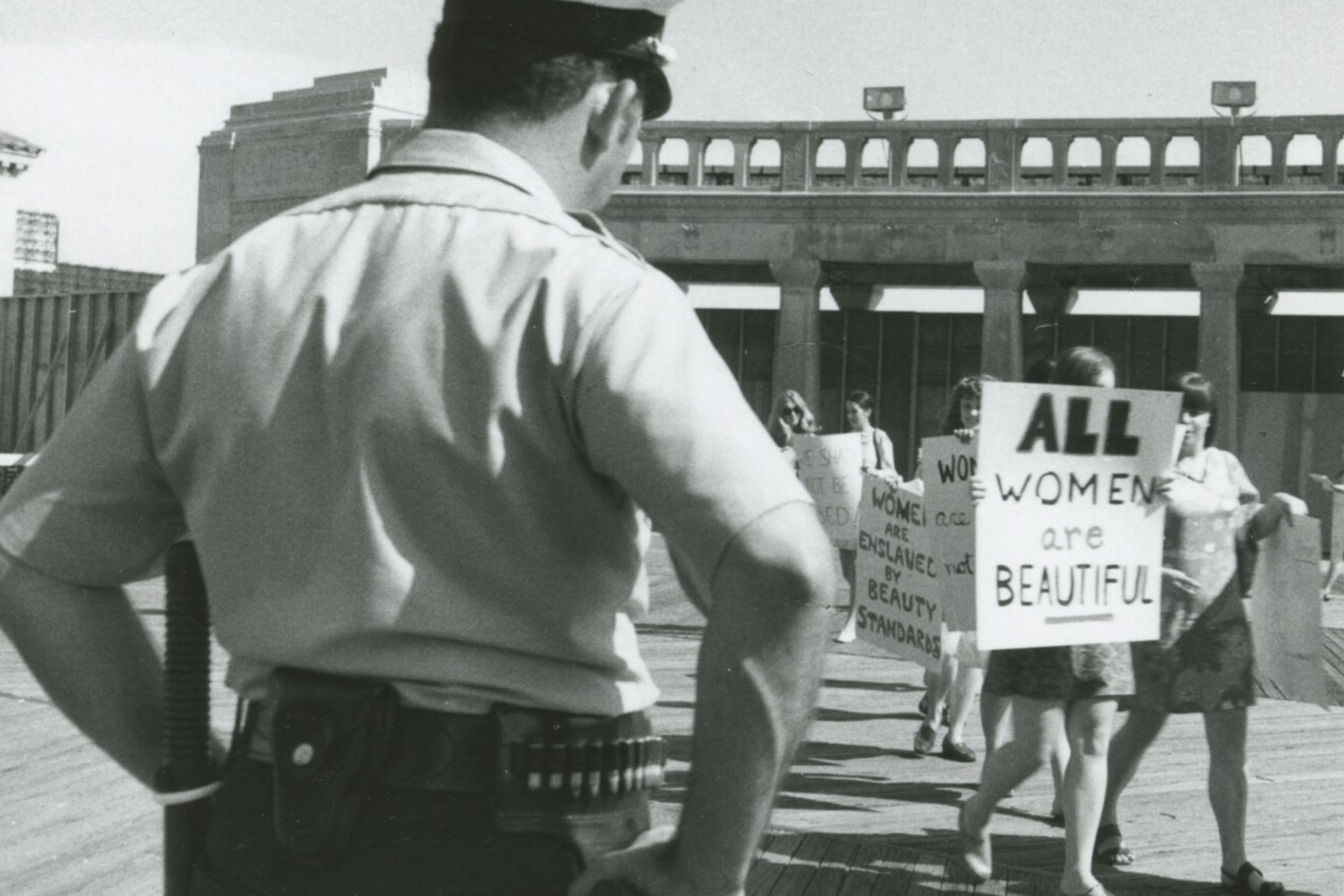
During the first wave of feminism in the 19th and early 20th centuries, bitch became a familiar backlash aimed at women who sought equal rights and broader opportunities in society. In the second wave, however, feminists pushed back, deliberately reclaiming the insult as an act of defiance and empowerment, much as ‘queer’ and ‘gay’ were later reappropriated by the LGBTQ+ community. In 1968, Jo Freeman wrote the feminist tract ‘The Bitch Manifesto’, published under the pseudonym Joreen, in which she argued that women branded ‘bitches’ are often those who are outspoken, confident, assertive and strong-minded. Freeman exposed a familiar double standard: traits celebrated in men are condemned when they appear in women. What counts as ‘dominant’ behaviour in men is recast as ‘difficult’ in women. Men are assertive; assertive women are ‘aggressive’. Men are competitive; competitive women are ‘combative’. He’s a boss, but she’s ‘bossy’.
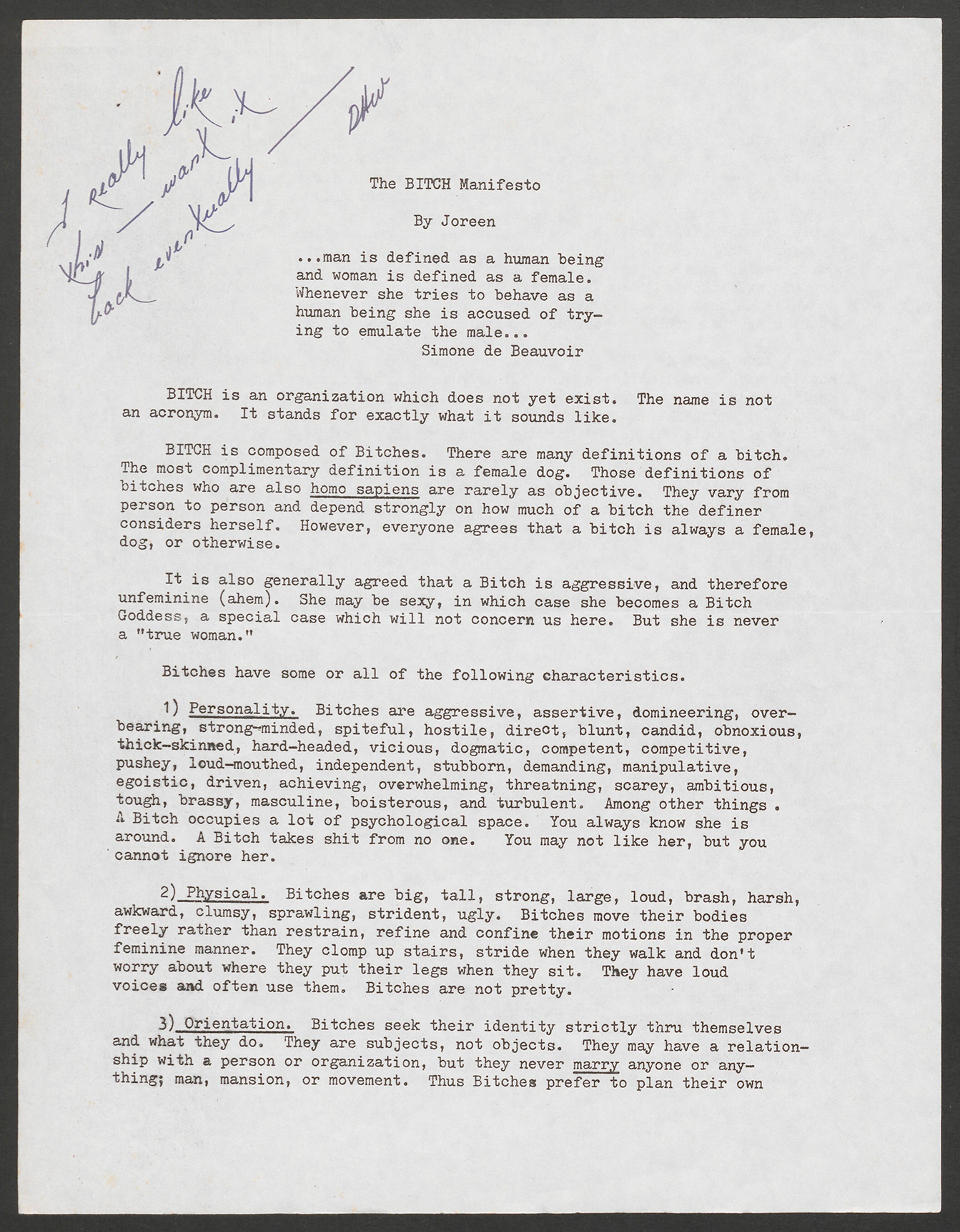
‘The Bitch Manifesto’, by kind permission of Jo Freeman
In her groundbreaking essay, Freeman reframed bitch as a figure of strength. By seizing control of the word and turning its meaning on its head, bitch received a feminist facelift, becoming a self-applied label for women who were ambitious, strong and independent, but unwilling to apologise for it.
Curiously, bitch has been aimed at men for almost as long as it has been aimed at women. Like dog, the term crosses gender lines, though it does very different work on either side. We’ve seen how bitch can acquire positive connotations when reclaimed by women. When applied to men, however, it is rarely a compliment.
Where bitch can signify a strong woman, it usually denotes a weak man. Women tend to be branded bitches for being assertive, unyielding or powerful; men are labelled bitches when they are perceived as powerless. In this sense, the insult operates in opposite directions. Calling a woman a bitch likens her to a man; calling a man a bitch likens him to a woman. It is typically an emasculating slur, suggesting a lack of courage, strength or toughness, and it may also imply effeminacy or queerness.
There are many variants. A man might be a plain old bitch, but he can also be dismissed as a ‘little bitch’, a ‘prison bitch’, or a ‘son of a bitch’. And while a man branded a bitch is usually framed as cowardly, a son of a bitch can, paradoxically, be bold, formidable or even admirable.
Like its sister term, son of a bitch has a long history. Old Icelandic already had a close relative in the insult bikkju-sonr. In English, the earliest recorded form appears as bichesone (‘bitch’s son’) in the medieval romance Arthur and Merlin. Centuries later, the phrase was thriving in London’s underbelly, where it was picked up by none other than William Shakespeare. In King Lear, the Earl of Kent delivers a particularly barbed version, complete with the modern spelling, when he calls Oswald ‘a knave; a rascal; an eater of broken meats … and the son and heir of a mongrel bitch.’
Son of a bitch had become such an all-American phrase that it was even acceptable for a president to use
Over the centuries, use of the phrase waned but, just as son of a bitch was fading in England, it found new life in the United States. The expression appears in John Neal’s gritty Revolutionary War novel Seventy-Six (1823), and was later popularised by Lost Generation writers such as John Steinbeck, Sherwood Anderson, William Faulkner and Ernest Hemingway.
Its real staying power, however, came from the cinema. Son of a bitch became a stock line of Western films, where it was woven into the mythology of the American frontier. In an iconic scene from True Grit (1969), John Wayne’s quintessential cowboy, the one-eyed marshal Reuben J ‘Rooster’ Cogburn, challenges his enemies with the line: ‘Fill your hand, you son of a bitch!’ (Naturally, he wins the showdown.)
By this time, son of a bitch had become such an all-American phrase that it was even considered acceptable for a president to use. In 1939, as the US pursued friendly relations with the Nicaraguan dictator Anastasio Somoza Debayle, valued as a non-communist ally, Franklin D Roosevelt was allegedly quoted as saying: ‘He’s a son of a bitch, but he’s our son of a bitch.’ Whether or not Roosevelt actually uttered the words, the line neatly captured the prevailing attitude. (It has since been variously attributed to Lyndon B Johnson, Ronald Reagan, and Richard Nixon.)
In this sense, a son of a bitch was not merely objectionable, but useful: a devious operator who could be relied upon to do the dirty work and get results. Nixon invoked the phrase explicitly during the Watergate scandal when searching for someone willing to leak information to the press: ‘I really need a son of a bitch like [White House aide Tom Charles] Huston who will work his butt off and do it dishonourably.’
Over time, son of a bitch spawned a range of euphemisms, from ‘son of a gun’ to ‘sumbitch’ and, like them, it has largely lost its bite. Even so, the insult still points back to women. Its force depends on maternal lineage, invoking a woman as the source of moral failure or contamination. There are plenty of slurs aimed at men, from ‘bastard’ to ‘asshole’, but there is no true male equivalent of bitch. When levelled at a woman, bitch remains a mic drop.
As a multitude of other meanings sprang up over the centuries, not all of them were offensive. Bitch could even swing in the opposite direction, becoming a bitchin’ word used to describe something good, impressive or cool. In the 18th century, Grose’s Classical Dictionary of the Vulgar Tongue recorded the verb ‘to stand bitch’, meaning simply ‘to make tea, or do the honours of the tea table’. From this emerged the quaint expression ‘to bitch the pot’, to preside as hostess at a tea party, a phrase that survived well into the Victorian era.
Part of the phrase’s longevity may lie in its adoption by university students, who were, at the time, exclusively male. Women were barred from universities, much as they were from coffeehouses, yet tea-drinking was still a social ritual. Within an all-male gathering, one man would be designated ‘old bitch’, the person tasked with brewing and pouring the tea. ‘Who’ll bitch the pot?’ meant who would serve, and a gentleman who performed the role with flair could even be praised as ‘an excellent bitch’.
If bitch could signal service at the tea table, it also came to convey swagger on the bandstand. In jazz circles in the 20th century, the label functioned as a genuine compliment. A musician who was truly ‘hot’, a master of their instrument, might be described as a bitch. Miles Davis used the word this way, both for himself and for players he admired, most famously in the title of his album Bitches Brew (1970).
The usage surfaces repeatedly in memoirs and music journalism. Writing about the jazz scene of the 1930s, the jazz musician Mezz Mezzrow recalled a gifted cornet player named Yellow: ‘That boy was really a bitch, even though he was never taught to play music. He had more music in him than Heinz has pickles.’ Decades later, Crescendo magazine struck the same note in an article on the jazz bassist George Duvivier: ‘That’s one of the greatest bassists of all time on there. Very underrated – but he is a bitch, believe me.’ In the language of jazz, bitch meant talented, gifted and effortlessly cool.
Bitch survived in Hemingway’s book, which was banned in several cities, a controversy that only amplified its notoriety
In the era of classic jazz, however, women singing the dirty blues wielded the word differently, and far more subversively. Gertrude ‘Ma’ Rainey, the self-styled ‘Mother of the Blues’, along with her protégée Bessie Smith and the unapologetically explicit Lucille Bogan, used bitch to assert autonomy in a musical world controlled by men, decades before feminist reclamation even had a name. Their obscene, defiant lyrics celebrated women’s right to live expansively and misbehave as freely as men. Packed with sexual braggadocio, these songs were often performed in brothels and barrooms or circulated quietly as ‘party records’, the kinds of recordings that thrived precisely because they were not meant for polite ears.
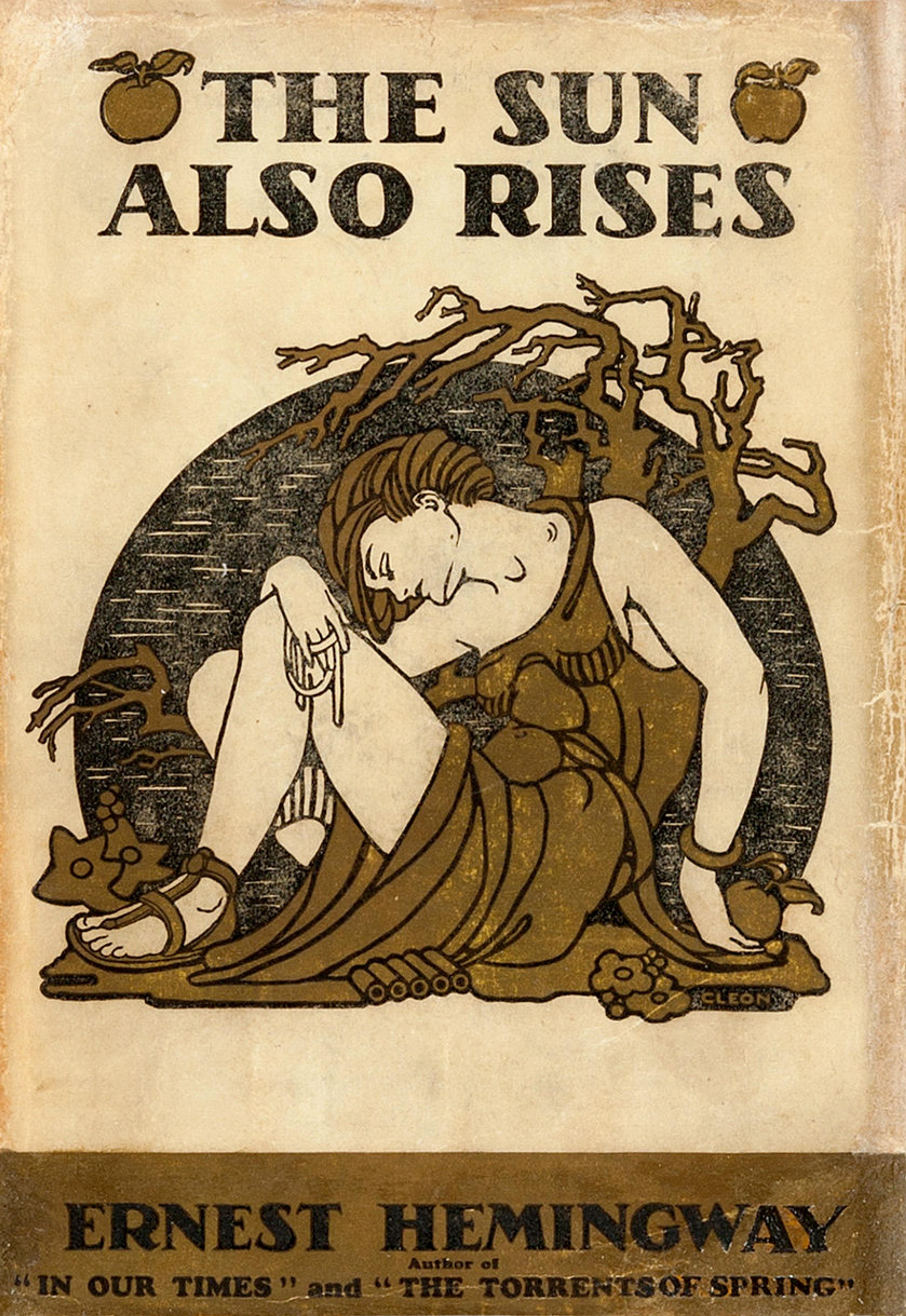
Despite its everyday prevalence now, bitch has been censored, and at times effectively banned, for much of its history. When the publisher Charles Scribner acquired the rights to Ernest Hemingway’s The Sun Also Rises (1926), its publication was nearly derailed by the novel’s use of the word. Offended by what he regarded as vulgar language, Scribner reportedly declared that he would no sooner allow profanity in one of his books than invite friends to use his ‘parlour as a toilet’. Hemingway replied that he ‘never used a word without first considering if it is replaceable.’ In the end, bitch survived in the book, which was banned in several cities, a controversy that only amplified its notoriety.
Nearly a century later, sensitivities had hardly disappeared. In 2005, The New York Times omitted the title of the book Chess Bitch: Women in the Ultimate Intellectual Sport in an article, prompting criticism for what one observer called the paper’s ‘astonishing squeamishness and misplaced political correctness’. The irony deepened when an op-ed about the book’s controversy appeared in the same issue, written by its author, the chess grandmaster Jennifer Shahade, and commissioned by the newspaper itself. But neither piece mentioned the word at all.
The word nearly made it onto George Carlin’s list of the ‘seven dirty words’, though its innocuous literal meaning, a female dog, ultimately spared it. Carlin classified bitch as only a ‘part-time dirty word’, grouping it with ‘prick’, ‘ass’, ‘cock’ and ‘balls’. Today, bitch is still occasionally censored, but it now appears freely across literature, movies, music and online media. Shows such as How I Met Your Mother (2005-14) and Breaking Bad (2008-13) have even revelled in its repeated use, fans often gleefully keeping score. (If you’re wondering, the tally comes to 121 and 54 times, respectively.) Rather than avoiding profanity, contemporary writers often deploy it deliberately, knowing that, while it may offend some viewers, it also attracts others. Swearing, like sex, sells.
Like bitch, ‘cunt’ is also a powerful sexist slur, but one with a very different cultural trajectory. The linguist Deborah Tannen once compared the two insults, observing that ‘bitch is the most contemptible thing you can say about a woman – save perhaps the four-letter C word.’ When cunt emerged in the 13th century, it was not an insult at all, but a literal term for the body part, used even in anatomical contexts. It also appeared as a surname in medieval records, with examples such as John Fillecunt (1246) and Bele Wydecunthe (1328). By Shakespeare’s time, however, it had become obscene. Rather than uttering it outright, Shakespeare merely alludes to it in Hamlet, when the prince asks Ophelia: ‘Lady, shall I lie in your lap?’ After she demurs, he feigns innocence: ‘Do you think I meant country matters?’
In this early period, cunt was often associated with sexual impropriety, referring to a promiscuous woman, much like some early uses of bitch. Its taboo intensified over time. By the 18th century, Dr Johnson had omitted the ‘low, bad word’ entirely from his dictionary. Grose included it, but only to dismiss it as ‘a nasty word for a nasty thing’. Cunt did not appear in a major English dictionary again until the 1960s, when it was finally admitted to Webster’s Third New International Dictionary. Even then, its shift into a generalised insult was still new, having taken hold only in the early 20th century.
Unlike bitch, cunt has proven far more resistant to reclamation. There have been sustained attempts to reframe it as a positive or empowering term by those who object to the misogynistic denigration of a word for a female body part. Feminists such as Germaine Greer, in her essay ‘Lady Love Your Cunt’ (1971), and Eve Ensler, through The Vagina Monologues (1996), sought to recast it as a symbol of power, sexuality and beauty. More recently, some feminists and members of the LGBTQ+ community have continued these efforts, though they have tended to be limited in reach and longevity. This may be due in part to censorship in mainstream media, but also to the word’s deep cultural stigma.
Chaucer used slut to describe a man, not a woman, and not his sexual behaviour, but his unkempt appearance
There are notable exceptions. In Australian and Scottish English, cunt is often used jocularly and non-derogatorily, much like bitch, as in greetings such as ‘How are you going, you old cunt?’ The word has also surged in online usage, where the distance of text makes it easier to type what might be harder to say aloud. Even so, cunt remains heavily taboo in most English-speaking contexts. Unlike bitch, it has not shed its stigma and, given its long history of misogynistic use, it may never fully do so.
‘Slut’ is another related sexist slur, but one that has taken a somewhat different path. As we’ve seen, bitch was once closer in meaning to the modern-day slut. So, if bitch used to mean slut, what did slut mean?
In Middle English, slut coexisted with bitch, but it had nothing to do with sexual promiscuity. Instead, slutte referred to a woman who was dirty, untidy or slovenly. The word was closely related to slattern, an insult for a woman who was dishevelled in her appearance or careless in keeping her household. An early example appears in the 14th century, when Geoffrey Chaucer used the word in the Prologue to ‘The Canon Yeoman’s Tale’: ‘Why is the lord so sluttish, I thee pray.’ Chaucer was using slut to describe a man, not a woman, and not his sexual behaviour, but his unkempt appearance, which clashed with his noble status. Later uses of slut, however, appear almost exclusively in reference to women.
Like bitch, slut has been a linguistic shape-shifter. By the 15th century, it referred to a kitchen maid who performed menial labour, such as emptying chamber pots. (She might also be called a ‘drudge’, from which we get ‘drudgery’, meaning hard or monotonous work.) The diarist Samuel Pepys used slut in this sense when he wrote approvingly of his new maidservant: ‘Our little girl Susan is a most admirable slut and pleases us mightily.’ Over time, the word shifted again, coming to denote a woman of low or loose character, though the sexual element was still vague. In the 18th century, Dr Johnson defined slut simply as ‘a dirty woman’, noting that it was a term of only ‘slight contempt’ (at least in his estimation). Slut was undergoing the same process of pejoration as bitch, a fate shared by many words for women, including ‘mistress’, ‘dame’, ‘wench’, ‘tart’ (originally an abbreviation of ‘sweetheart’) and ‘hussy’, which once simply meant ‘housewife’.
It wasn’t until the 20th century that slut took on its modern meaning, condemning a woman for having, or being presumed to have, many sexual partners. By the era of free love in the swinging 1960s, slut had firmly joined the ranks of words used to police women’s sexuality: ‘whore’, ‘moll’, ‘tramp’, ‘tart’, ‘floozy’, ‘skank’ and ‘Jezebel’, terms frequently paired with bitch. Yet slut has little to do with a woman’s actual sexual behaviour. It has become a catchall slur used to diminish and discredit women. A girl or woman might be branded a slut for having more male friends than female friends, wearing a short skirt, showing cleavage or simply being attractive. Like bitch, it can be deployed for almost anything, or absolutely nothing at all.
And like bitch, slut has been reclaimed, at least partially. For some, it functions as a self-defined label of sexual autonomy and resistance. This reclamation gained visibility through movements such as SlutWalk, a protest that began in Toronto in 2011 to challenge rape culture, victim-blaming and slut-shaming. Pop culture figures such as Samantha Jones in the TV show Sex and the City (1998-2004) and the media personality Amber Rose have also embraced the term, recasting it as a badge of sexual freedom. Still, as with bitch, critics argue that slut is too deeply rooted in misogyny and moral judgment to ever be fully redeemed. Reclamation may blunt its edge in some contexts, but it doesn’t erase the word’s history, or its ongoing use as a weapon.
Today, bitch wears hundreds of faces. Since its earliest form, bicce, it has spawned a host of creative respellings, many of them modern, like ‘biznatch’, ‘biatch’, ‘bish’ and others besides. It appears in dozens of idioms and stock phrases, from ‘resting bitch face’ and ‘bitch tits’ to ‘Bitch, please!’ and ‘Life’s a bitch, and then you die.’ This is a word that’s very much alive. Bitch is also global. Equivalent slurs and glosses exist across languages, from Arabic to Zulu, and in many contexts the English word itself is borrowed wholesale for maximum punch.
Bitch is a hardworking multitasker, happy to switch from noun to verb to adjective. It leapt from canine to human, and even from female to male. It shifted from a person to a situation to a thing. To some, it is invariably an insult. To others, it’s a compliment. It can be friendly, funny, playful or sexual and, when adopted by women, it is often used as a form of empowerment. Yet it also has a much darker side that’s misogynistic, abusive, violent and ugly. Rich and complex in meaning, bitch carries so many semantic nuances that we must always look to context to understand what is intended.
It seems obvious but still needs saying that most women do not like being called a bitch. It’s a personal attack, hurtful by design, and meant to sting. Even Meredith Brooks, the singer-songwriter behind the 1990s anthem ‘Bitch’, has acknowledged this tension: ‘All I can say is no woman wants to be called a bitch.’ She went on to observe that for most people the word remains ‘a derogatory comment against a woman’, adding: ‘That’s never going to change. You can’t unring the bell.’ Bitch is offensive in most of its uses, and that is very much the point. At its core, it remains an insult aimed at a woman who is doing or saying something – anything – that someone else does not like.