Listen to this essay
32 minute listen
In a scathing New York Times piece published in 1971, the journalist Joan Didion commented: ‘To read a great deal of Doris Lessing over a short span of time is to feel that the original hound of heaven has commandeered the attic. She holds the mind’s other guests in ardent contempt.’ There’s a touch of ironic insolence here: surely it was her own carefully contrived, faux-casual derisiveness that catapulted Didion herself to fame? More woundingly, perhaps, Didion claimed that Lessing ‘does not want to “write well”.’ The author was accused of being solely interested in ‘cosmic reform’ – of doggedly pushing a specific ideology at the expense of so-called ‘good’ prose.
Yet this ‘hound of heaven’ was, and remains, a wake-up call in terms of her ideas, her brilliance and lack of convention, her persistent uncongeniality. There is little that is predictable or vanilla about Lessing, either as an author or as a person. Despite the fact that she did not ‘write well’, she would go on (albeit grumpily) to win the greatest of writerly accolades – the Nobel Prize in Literature – in 2007. Lessing eschewed conformity in a restless search for ‘cosmic reform’ – a phrase that, even when taken out of context, beautifully, if unintentionally, flatters her work.
Lessing’s vision and her perennial outsider status have made her writing essential to me since I first started reading her in 1980s Yorkshire, aged 14 or 15: a teenager hungry for examples of authentic, lived, intellectual feminist experience. Part of the fascination was Lessing’s background, symbolised by her movement across continents, the changing placenames reflecting the political upheavals of the 20th century. She was born in October 1919 in Persia, now Iran, and grew up in Southern Rhodesia, now Zimbabwe: a child of empire, then a postwar émigré to the UK in 1949, where she stayed for the rest of her life (she died in 2013, aged 94). A fervent communist, she quit the Party following the Soviet Union’s invasion of Hungary in 1956. Most egregious of all, Lessing – who even in her obituaries was condemned as a ‘bad mother’ for ‘abandoning’ the two children of her first marriage – refused to bow down to the stereotype of what a ‘proper’ woman was supposed to be.
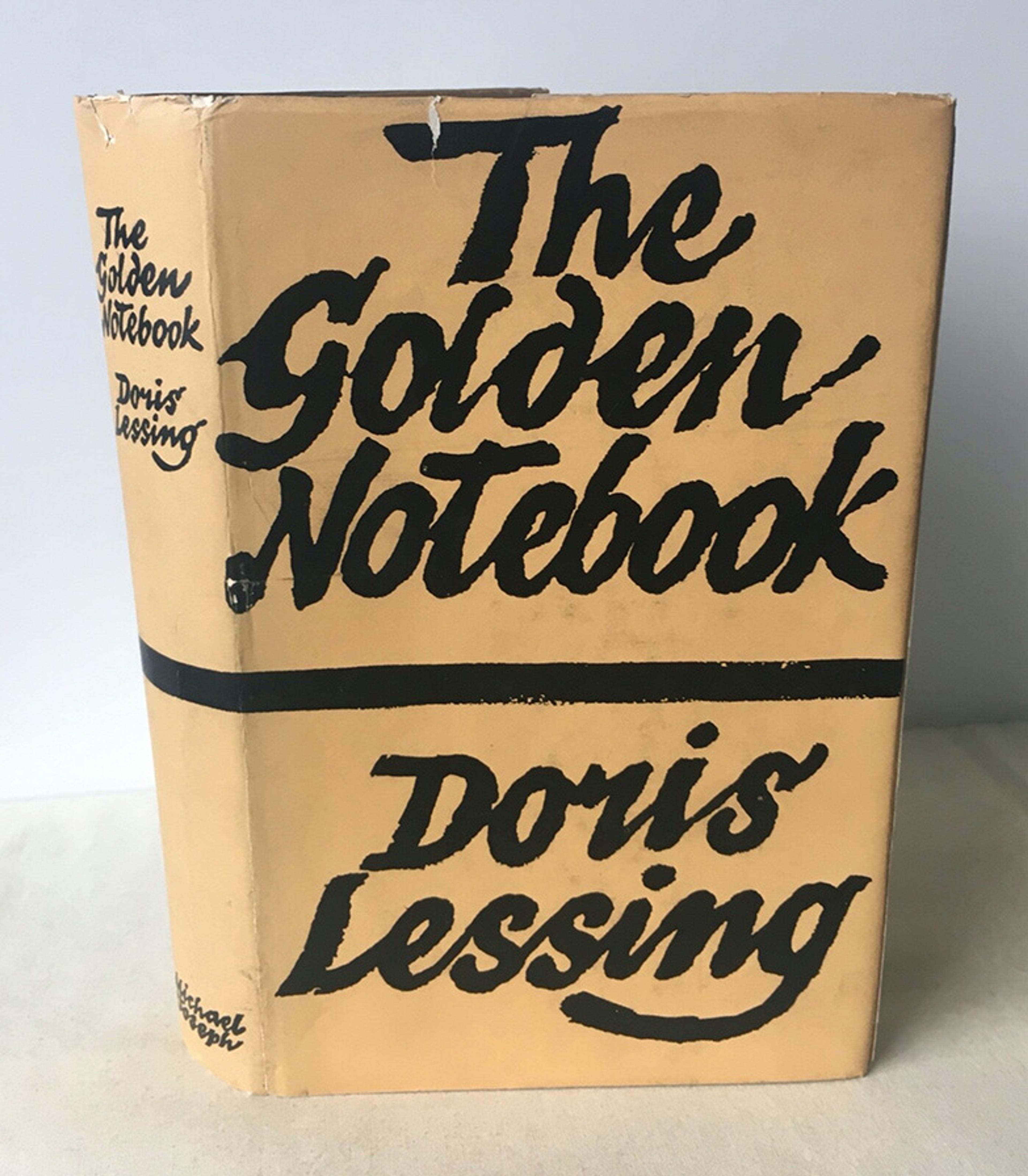
Her extraordinary life made its way into short fiction, novels, journalism and two burning volumes of autobiography. When I first randomly plucked from my mother’s bookshelf Lessing’s opus, The Golden Notebook (1962), the novel that made her name and has ever since been touted as a landmark of feminist literature, I was performing my own very limited rebellion. A regular truant from my snobbish all-girls’ school, I spent my teenage years sneaking off to the women’s protest camps at Greenham Common airbase in Berkshire; closer to home, I witnessed the devastation of the 1984-85 miners’ strike, observing how women from those communities became empowered in the fight to halt pit closures. I even made an appearance as an extra in the apocalyptic film Threads (1984), which saw my home city of Sheffield annihilated in a fictional nuclear attack.
In all of these actions, I realise now, I was channelling some of that anti-establishment spirit of Lessing’s life and work. There’s an iconic photograph of Lessing, taken in September 1961 at a Ban the Bomb sit-in in Trafalgar Square in London, together with the actress Vanessa Redgrave and the playwrights John Osborne and Shelagh Delaney: all look ineffably cool and committed and young, and all were later arrested. This was an image of glamorous resistance. Some 20 years later, I would, less photogenically, participate in mass ‘die-ins’ organised by CND (a movement Lessing enthusiastically supported).
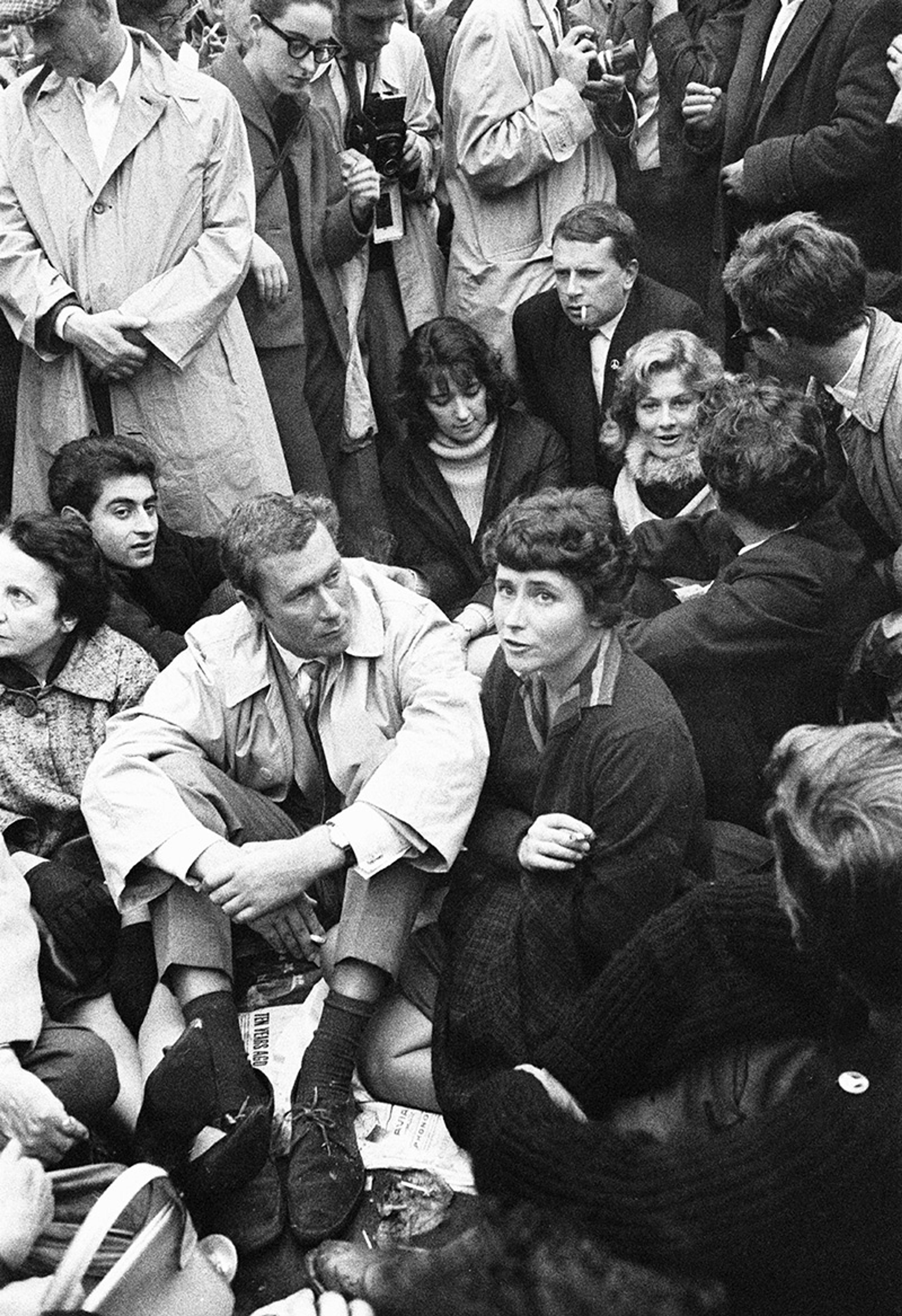
Doris Lessing with John Osborne and Vanessa Redgrave at a Ban the Bomb sit-in in Trafalgar Square in London on 17 September 1961. Photo by Mirrorpix/Getty Images
At home, Lessing’s books were sandwiched on the shelves between such high priestesses of women’s writing as Simone de Beauvoir, Edna O’Brien and Iris Murdoch. The books belonging to my mother were separated by a chimney breast from those of my father. His collection – frozen in time – had neither been diminished nor replenished since he effectively walked out of our lives when I was nine. All that was old and cumbersome – family, friends, children, possessions – remained behind, as he moved on to his new liberated life, leaving my mother to deal with bankruptcy, sole childcare, the pressures of being the only breadwinner, and the stigma of becoming, in her late 40s, a divorced woman.
Typically for my mother, she turned that stigma into allure, let out rooms in our suddenly unaffordable and ever-shabbier house, and promptly joined the Labour Party – still, in the late 1970s, an actively Left-wing organisation. Although she had worked all her married life as a schoolteacher, then bookshop owner, her profession was listed as ‘housewife’ in her passport. This self-erasure rankled with me then and still does. My mother, strong, independent, adaptable, resourceful, always reminding me that I would have to earn my own living, was more chameleon than card-carrying feminist – rather like Lessing. I imagine Lessing appealed to her because she too was an exile from the colonies: in my mother’s case, from rural New Zealand, where she’d grown up in the 1930s and ’40s in poverty and violence. However, our copy of The Golden Notebook, that alleged bible of feminism, seemed suspiciously unread when I began to turn its pages.
At that age, I couldn’t entirely follow its lengthy, refracted arguments, though the bold scenes featuring sex, ruminations on orgasms (and – unheard of hitherto – a matter-of-fact reference about inserting a tampon) were certainly memorable. But it was too long. I read more avidly, perhaps with a sense of forewarning, The Summer Before the Dark (1973), Lessing’s midlife crisis novel, which gave women ‘permission to blow up their lives’ 50 years before Miranda July’s excitable novel All Fours (2024) urged every woman aged 45 and over to take an exit ‘in Monrovia’ – that is, to swerve from the life you were living up to that point. Nowadays, The Summer Before the Dark would probably be earnestly classified, like All Fours, as ‘perimenopausal fiction’. When I read it as a teenager, it terrified me: how could a wealthy, successful woman voluntarily disappear from her own life? Today, I’m urgently aware of how ahead of their time Lessing’s themes are. Success and domestic stability are superficial: as a woman, you’re only really viewed as the sum of your parts. What happens when that façade falls away? Was this the future that awaited me?
Kate has played truant from her life, temporarily stopped conforming, and it has slapped her in the face
Lessing’s heroine, Kate Brown, is – like July’s protagonist – aged 45, a housewife and mother, with four grown-up children. She and her husband have long since accommodated each other’s vagaries. One summer, while he is away in the States, their children scattered, she also blows up her life. She gets a job organising an international conference in Turkey, and has an affair with a younger American delegate. It seems perfect, no-strings; yet everything goes awry. Her lover becomes seriously unwell as they travel through a remote region of Spain. Returning to London, Kate cannot face her empty, affluent house. She checks into a city-centre hotel, succumbs to illness, and runs out of money. Looking in the mirror:
She saw a woman all bones and big elbows, with large knees above lanky calves; she had small dark anxious eyes in a white sagging face around which was a rough mat of brassy hair. The grey parting was three fingers wide. She looked nothing like the pretty cared-for woman of the home in South London; …
In fact, she is unrecognisable – even her next-door neighbour looks through her when Kate surreptitiously visits her old street.
Eventually, Kate ‘descends’ to a cheap room in a basement flat, sharing with young people, which prompts a kind of awakening. Kate has played truant from her life, temporarily stopped conforming, and it has slapped her in the face. In July’s book, this altered state is presented as a triumph; Lessing is rather more realistic.
The Summer Before the Dark, like a bad fairy tale, haunted me so much as a teenager that I couldn’t bear to look at it again for decades, even while acutely aware that I’d adopted and played around with some of its tenets in the intervening time. On one occasion, in my early 20s, newly living in London and fed up with omnipresent minor street harassments from strangers, I copied one of Kate’s tactics in the novel – leaving home in full make-up and stylish clothes, ready to elicit the inevitable reactions from male passers-by. An hour later, I made the same exit, dressed in baggy jeans and jumper, no make-up, with an old pair of glasses, and hair all anyhow – and received not a flicker of attention. It was a pathetic action – and yet why did being visible (or not) matter so much? It seems obvious to state, but Lessing showed that there has to be more to a woman’s self-worth and sexuality than being viewed as either fuckable or unfuckable.
Of course, The Summer Before the Dark wouldn’t exist without the overarching colossus that is The Golden Notebook, and in July 1991 the Notebook was my companion for the long train journey through a newly reunified Germany to join my boyfriend, a modern languages student on his year abroad in Saarbrücken. Here was life, I thought – the novel unfolding before me as the miles slipped away, bringing me closer to my partner. Groundbreaking, messy, less a manifesto than an unravelling, The Golden Notebook fused the personal and political perhaps as never before in literature, in terms of a woman writing on her terms; and bleak terms at that. For the past three years, I’d barely read a book published after 1930, and the only women authors to feature on my dry-as-dust curriculum were two of the Brontë sisters and George Eliot. Now, in possession of a shiny new degree, I was eager to break away from what I considered the dreary, male-canon staples of the Eng Lit course.
The Golden Notebook was the thing for any self-respecting feminist to get to grips with in order to obtain a modus vivendi, much as the book’s main character Anna Wulf is attempting. (And it remains the thing – my now 40-year-old niece cites this particular Lessing novel as the one she most returns to and recently gave a copy to her younger sister.) Each generation, then, can discover something relevant and showstopping in Lessing.
She does not, it is implied, know how to live. But do any of us?
What did I find? During that summer, my boyfriend and I fell out, fell back in, raged, drank beer and whisky, smoked weed and ate flammkuchen, enjoyed a lot of making-up sex and, as self-respecting Leftists, dutifully travelled to places of historic interest, such as nearby Trier (the birthplace of Karl Marx). I wondered if I, the product of a seemingly blissful childhood shattered by my parents’ bitter divorce, and long estranged from my father, could ever live with a man, as we were planning to do in the near future, and, crucially, on what terms. Perhaps I should blame The Golden Notebook for the relationship’s eventual end six years later, following betrayals and infidelities on both sides. The book, I felt then, was a bad omen. In truth, I didn’t understand it, taking exception to the many contradictions of its main character while not identifying similar howling idiosyncrasies in my own.
Anna, Lessing’s proxy in the novel, is ostensibly a ‘free woman’. In her early 30s, divorced, a single parent of a young daughter, a writer, an intellectual, and a frequent taker of lovers, she lives in mid-1950s London amid her middle-class communist cohort. Horrified by the news coming out of the Soviet Union about the reality of ‘Father’ Stalin’s totalitarian rule, she abandons the Party (as did Lessing). This decision is part of a greater crisis that leads Anna to repeatedly describe her life as ‘chaos’. Anna has written one successful novel, Frontiers of War (elements of which are based on Lessing’s own 1950 debut, The Grass Is Singing), from which she is still living on royalties (unimaginable in today’s culturally impoverished economic climate) and is suffering from writer’s block, or rather a life block, because, according to one of her lovers and as is clearly apparent to the reader, she is always ‘spinning out all these words’. She does not, it is implied, know how to live. But do any of us? That is what makes the book so shocking and so necessary.
In an attempt to write herself out of deadlock, Anna uses four differently coloured notebooks – each one for the different aspects of her life and her persona:
a black notebook, which is to do with Anna Wulf the writer; a red notebook, concerned with politics; a yellow notebook, in which I make stories out of my experience; and a blue notebook which tries to be a diary.
These four narratives, intersected with chapters entitled ‘Free Women’, relaying the current situation of Anna and her friend Molly, do not run sequentially: they alternate. Lessing’s intent is clear. As she explained in a 1971 preface to a new edition: ‘She keeps four, and not one because, as she recognises, she has to separate things off from each other, out of fear of chaos, of formlessness – of breakdown.’
The academic and critic John Mullan in 2007 described The Golden Notebook as ‘a novel elaborately divided within, even against, itself.’ It is that ‘against’ which makes the reader an additional participant in the discourse as Anna tries to make sense of the postwar atomic age and as we, in its shadow, argue with her and reflect on our own time, whenever it is that we happen to encounter the book, as if it is a tool to be used on how to construct a meaningful life.
The golden notebook of the title doesn’t actually appear until page 527. Anna relinquishes this sensually affecting object to her latest departing lover, Saul, because practically, and symbolically, she can’t identify what she wants from it. ‘Then I want it,’ he says – one of many ironies in a work that relies far too much on the opinions of its male characters; adding: ‘Women of your age don’t laugh, you’re all too damned occupied with the serious business of living.’ Lessing intersperses the realist plotline of a woman grappling with the prosaic day-to-day – politics, lovers, the business of writing – then complicates this with the inner life, a dissonance, as displayed by Anna’s dissenting selves. At the end of the book, the conventional plot returns: a partially ‘free woman’ is liberated from further catastrophe, her ‘psychological fog’ clearing to reveal more life, new opportunities.
From today’s standpoint, Anna seems anomalous: she is economically independent yet emotionally dependent on men; and not any man but a ‘real man’ who will give her ‘real’ orgasms (strictly vaginal). Not to be prurient, but with all the sex that ‘liberated’ Anna has, there seems no concern about contraception, though this was the era before the Pill and semi-legalised abortion. There’s a tone-deafness in the book, too, in Lessing’s offensive stereotyping of gay men.
How true to life the partially liberated Anna is – complete with Lessing’s own blind spots
In 2015, the writer Jenny Diski gave a vivid snapshot of Lessing’s London milieu. In the early 1960s, the teenaged Diski had moved out of foster care and into a schoolfriend’s household – Lessing’s – becoming the author’s reluctant ‘mini-me’:
I don’t remember the exact date when I went to live in Doris Lessing’s house in Charrington Street, north of King’s Cross. I think of it as being just a few weeks after Sylvia Plath killed herself in early February 1963. The suicide was still very raw and much discussed by Doris’s friends … She refused to join in the soul-searching and excited chatter about why the tragedy of Sylvia and her two children had come about. For the first time I heard that moral qualifier Doris used almost automatically and almost always for a man: ‘Poor Ted’. Over the years the name changed, ‘Poor Roger’ (my first husband), ‘Poor Peter’ (her son), ‘Poor Martin’ (or any other man who she thought had been treated badly by a woman).
This privileging of men echoes Anna Wulf’s emotional dependence on her lovers Michael, Saul, etc, and her habit of excusing/subjugating herself to them. Women should have their freedom, Lessing’s message seems to be – but not at the expense of a man. (It continues to annoy me that Anna relinquishes the fifth and final notebook to Saul, as if granting him the last word.) Yet how true to life the partially liberated Anna is – complete with Lessing’s own blind spots. Nor is Lessing afraid to send up (via Anna) the intellectual Left-wing circles in which she herself found a home. There is nothing one-dimensional about either the character or the writer.
The Golden Notebook is a blueprint, a dazzling experiment, and its flaws are life’s flaws – there to be interrogated and worked though. That is the take-it-or-leave-it dichotomy that Lessing explores. Looking back on the book’s initial reception, in her preface to the 2007 edition, Lessing acknowledged: ‘Apparently what many women were thinking, feeling, experiencing came as a great surprise.’ However, she repeatedly distanced herself from any claim on the novel as a foundational feminist text; as she told The Guardian in 2007: ‘I’m not interested in being a feminist icon. If you are a woman and you think at all, you are going to have to write about it, otherwise you aren’t writing about the time you are living in.’
How did Lessing come to be that person, that writer, observer, conscience? From the beginning, she was an outsider, with a unique perspective, an individualist who nevertheless believed that members of her chosen profession should adhere to collective responsibility: ‘I see writers, generally, in every country, as a unity, almost like an organism, which has been evolved by society as a means of examining itself,’ she chided in the essay collection Prisons We Choose to Live Inside (1987). Lessing never shied away from talking tough, from using moral imperatives, even when unfashionable and unpalatable. The family had moved from Persia to Southern Rhodesia in 1925 to farm maize. In the first volume of her memoirs, Under My Skin (1994), Lessing recalled that arrival: ‘there is only one memory, not of unhappiness and anger, but the beginnings of a different landscape …’ This childhood in the African bush became the wellspring for many of her subsequent short stories.
Lessing was educated largely at convent school but dropped out at 14, mainly to annoy her mother with whom she did not get on: ‘I was in nervous flight from her ever since I can remember anything, and from the age of 14 I set myself obdurately against her in a kind of inner emigration from everything she represented.’ Depictions of unorthodox, often warring and alternative family set-ups teem throughout her fiction. While her family home was meagre, it was filled with the books with which she absorbed herself: ‘there was no one to talk to, so I read … the best – the classics of European and American literature.’ After leaving school, she was largely self-educated, but politically aware. She told an interviewer: ‘In Southern Rhodesia it is not possible to detach yourself from what is going on. This means that you spend all your time in a moment of consciousness.’
Her fiction of the time has vibrant passages revelling in the nostalgic lushness of all that has been left behind
She married her second husband, the German dissident Gottfried Lessing, in 1943; they divorced in 1949, the same year she sailed for England with their son Peter, Gottfried following after her. Her two older children remained behind in Southern Rhodesia, scandalously, with their father. Lessing was already condemned as a defective trailblazer: men can walk away; women most emphatically cannot.
England, in the grip of austerity, was grey and drab after the bright heat-haze of Africa. The contrast could not have been starker; in the second volume of her memoirs, Walking in the Shade (1997), she wrote:
It was unpainted, buildings were stained and cracked and dull and grey; it was war-damaged, some areas all ruins, and under them holes full of dirty water, once cellars, and it was subject to sudden dark fogs …
In contrast, her fiction of the period contains vibrant passages revelling in the nostalgic lushness of all that has been left behind: the romanticising of a past that cannot be returned to or recreated, except in imagination. Lessing had brought the manuscript of The Grass Is Singing to London; it was published in 1950 – to instant acclaim in Britain and to outrage in southern Africa, since she dared to question the apartheid state. Now a single woman, she wrote to support herself and her child; while material life was uncomfortable, intellectual life flourished, and Lessing was at the centre.
After university, I moved to London for postgrad studies. It was the early 1990s, that in-between period before the Thatcherism that had terrorised my formative years finally gave way to the short-lived glow of New Labour. I found work as a low-paid assistant editor at the gloomy old British Library, then part of the British Museum, while I lived in a series of draughty rented rooms, in which I would eat a solitary dinner of baked potato before heading out to house parties or gay clubs, or to watch films at the ICA; fuelled by cheap wine and night buses, still acting like a student and vaguely yearning for the intellectual life that continued to elude me. I felt more like a melancholy character from a Stevie Smith novel than one of Lessing’s more forceful anti-heroines, who at least wanted to change their circumstances.
At this point, I was reading her most obviously dystopian novel, The Memoirs of a Survivor (1974), in which London has gone through a cataclysmic event referred to as the ‘crisis’ and ‘Inside it was all chaos … at the times in one’s life when everything is in change, movement, destruction – or reconstruction …’ At times, my life then seemed to be an often-disastrous experiment in living in a world off-kilter. Now I look back on it with envy.
No need now for the cosplaying antics in which I posed as objectified woman or sexual reject
I returned to Lessing in a roundabout way, in 1996, and found her as exciting, frustrating and full of contradictions as ever. I was reading her late novel Love, Again, published that year – an odd choice for a 20-something. In it, a London-based theatre group, spending the summer in France for what would turn out to be a heavily fated production, metamorphoses into a hotbed of romance, jealousy and downfall – a further examination of alternative ways of living with each other. I read it in a shared house in Hampstead, on the brink of finally wrenching away from that co-dependent and long outgrown student relationship. Could I then envisage a future self, moving contentedly into midlife and beyond, like Sarah in the novel: 65, long divorced, and accepting with grace that women of her age no longer desire or are desirable? But then the twist: Sarah falls violently in love with two younger men, who appear to reciprocate: ‘I’m sick with love … I simply can’t wait to go back to my cool elderly self, all passion spent,’ she notes of this febrile time. If The Summer Before the Dark was Lessing’s perimenopausal novel, Love, Again is postmenopausal. Its proverbial rage against the dying of the light is all-pervasive, even as Lessing simultaneously suggests a new path to freedom: one that is radical, yet achievable.
This past decade, in which, improbably, I turned 50 – has passed quicker for me than any before. Time has sped up, outrageously, and hard-won progressions towards the more equal society that I once took as a given are slipping away faster than I can snap my fingers. No need now, either, for the cosplaying antics in which I posed as objectified woman or sexual reject. These days I walk invisible, for the first time since my teens no longer at the mercy of strangers’ cat-calls and comments. So: what can Lessing teach me at this stage, that of the world-weary cynic who in reality is not so far removed from the rebellious 15-year-old? The answer remains the same: everything, probably. Ours seems an anodyne era of algorithms, cancellations, and depressing binaries. Renegade voices are woefully scarce.
I wish that she had produced more autobiography: tantalisingly, Lessing’s two-volume memoirs go up only to that catalytic year of The Golden Notebook: 1962. ‘There is no doubt fiction makes a better job of the truth,’ she wrote in Under My Skin. And what truths – and half-truths – her fiction revealed: ‘I try to see my past selves as someone else might, and then put myself back inside one of them, and am at once submerged in a hot struggle of emotion, justified by thoughts and ideas I now judge wrong.’ Her unvarnished sentences (is that what the ultra-fastidious Didion meant, when she criticised Lessing for not writing ‘well’?) chime explicitly with today’s public and personal calamities, as The Golden Notebook crystallised:
Very few people really care about freedom, about liberty, about the truth, very few. Very few people have guts, the kind of guts on which a real democracy has to depend. Without people with that sort of guts a free society dies or cannot be born.
Lessing’s giant experiments in living – her ‘cosmic reform’ – continue to confront us with the biggest obstacle against human survival: not other people, but ourselves.