Listen to this essay
28 minute listen
Serenity is hard to find in our troubled times. Private peace is under siege from public cares, in many places brutally. The opinion-shaping emotions and emotionally stirring opinions of millions fit into the palm of one device-holding hand. Many increasingly want to separate spaces of the self from the spaces of the world. And so, a question arises: Who am I who feels collective emotions, which are transporting swathes of people into a frenzy? Worded differently: Who am I when I care? Take indignation, for instance, a hard currency across the political spectrum: What part of the self feels indignation about a given set of social and political issues? And: Who is the ‘I’ that speaks on behalf of an opinionated ‘we’?
As the expression of our constant attunements to the changing environment in which we’re embedded, felt emotions inform individuals and groups about the world. These emotions – including social, political and moral ones, such as admiration, outrage or envy – are also ways of appraising inputs and stimuli, information-rich and inherent within our cognitive processes. But an individually felt emotion is distinct from a collective emotion, which typically occurs within a group, in response to public events, and as an output of group norms. Asking at what point one becomes the other may be akin to the ancient sorites paradox – which considers at what point grains of sand become a heap – since collective emotions seem at first blush to have a life of their own, separate from the individuals who feel them, whether that collectivity is physical or virtual.
The matter was central to debates in the late-19th to early 20th century, a time not unlike our own, when economic woes, social fears and a new, sensationalist press stoked populist sentiment. And the history of ideas, as ever, helps put our times in perspective. For the French polymath, anthropologist, sociologist and psychologist Gustave Le Bon (1841-1931), collective actions and emotions ‘are combined, exactly as the cells which constitute a living body form by their reunion a new being which displays characteristics very different from those possessed by each of the cells singly.’ He wrote this in his influential The Crowd: A Study of the Popular Mind (1895), adding: ‘There are certain ideas and feelings which do not come into being, or do not transform themselves into acts except in the case of individuals forming a crowd.’
When we bond as a group in a shared ritual, our attention becomes synchronised
Le Bon, who believed in a hierarchy of ‘races’ and in elite rather than democratic rule, would inspire Hitler, Joseph Goebbels and Benito Mussolini, who found his book a useful account of how propaganda works. He identified a ‘psychological law of the mental unity of crowds’, arguing that they were possessed ‘of a sort of collective mind which makes them feel, think, and act in a manner quite different from that in which each individual of them would feel, think, and act were he in a state of isolation’. A psychological crowd became a single, collective mind, driven by the nefarious ‘contagion’ of emotion, which took hold at the expense of reason. Le Bon referred to ‘the laws of the unconscious’ as ‘a force still unknown’ but whose role in society was major, and to crowds as amenable to hypnosis by a leader who subsumed their will, feelings and thoughts.
This stood in contrast with sociology’s founder Émile Durkheim’s view that social structures are separate from individuals and that a group can be a force for good. When we bond as a group in a shared ritual, our attention becomes synchronised. In The Elementary Forms of the Religious Life (1912), Durkheim called the potent emotions that arise a ‘collective effervescence’ – an emotion-laden state that belongs to the collective and enhances group cohesion and solidarity. This collective effervescence was recently studied by the cognitive neuroscientist Julie Grèzes, the philosopher Elisabeth Pacherie and their colleagues, who showed that ‘joint attention and emotional intensity’ predict ‘social bonding between unacquainted individuals’ and that ‘the emergence of prosocial attitudes between strangers is associated with changes in physiology due to the induction of positive and negative emotions.’
In other words, bonding as a group can be a good. Collective emotions can be equally positively and negatively valenced. This view was shared by the sociologist Gabriel Tarde (1843-1904), for whom the public shapes society, giving rise to positive collective action. Imitation and counter-imitation constitute the core of society, ensuring its cohesion, discoveries and innovations, just as habits underlie individual, everyday lives, Tarde argued in The Laws of Imitation (1890), which predates and influenced Le Bon’s book. In his later The Public and the Crowd (1901), Tarde contended that the ‘crowd’ – as a heterogeneous group of individuals, which can be joyful or brutal but dissolves with geographical distance – differs from the ‘public’, a dispersed, like-minded collective with shared cultural references, which historically came into existence with printing, and became established in modernity with the advent of newspapers. Today’s users of social media have become a new kind of public – rather than a new kind of crowd.
Sigmund Freud, too, entered the debate. In his Group Psychology and the Analysis of the Ego (1921), he engaged with Le Bon extensively and critically. Le Bon’s appeal to hypnosis and an ‘unconscious’ predated Freud’s, who respected him but also reproached him for not describing the psychological mechanisms that unite individuals within a group and imbue a leader with appealing prestige, or underlie ‘contagion’ itself. Freud posited a strong continuity between individual and social psyche: ‘from the very first Individual Psychology is at the same time Social Psychology as well’. And so, in a group, rather than dissolving, as Le Bon had asserted, ‘the individual is brought under conditions which allow him to throw off the repressions of his unconscious instincts’ – the id is freed from the superego. Contagion is a form of what Freud called suggestibility, akin to what happens under hypnosis. It gives rise to the urge to identify with and hence imitate a prestigious leader.
Freud offered a causal, psychological story that may help us understand the nature of the virtual crowd that invades private lives – one where individual psychodynamic mechanisms are also at play within a collective setting. But Freud did not consider how self and world, private and public, individual and collective, dynamically act upon each other. As the philosopher Amia Srinivasan observed in ‘The Impossible Patient’ (2025), Freudian psychoanalysis is ‘individualistic not only at the level of practice … but also in its theoretical focus on the inner life of the patient.’ Yet private lives have always been affected by political, economic and social conditions. Even biologically, there is no subject without a collective context, and no self without others. We are inherently intersubjective: subjects insofar as we are necessarily connected to each other, in what the neuroscientist Vittorio Gallese has called ‘embodied simulation’, whereby we map the states, motions and emotions of others onto our own. The notion of intersubjectivity, first coined in the 1910s by the founder of phenomenology Edmund Husserl and his student Edith Stein, has over the past decades become central to social and affective neuroscience and psychology, anthropology and sociology. It is related to the embodied cognition framework, according to which brain, body and world are dynamically interconnected. Our very subjectivity comes to be, from birth on, in relation to others with whom we share an environment.
Our physiological feelings colour our political opinions, which we then experience, amplified, via social media
And while we experience emotions within the self, they are always about something in the world, including myself – private life, a public state of affairs, or a work of art (art itself, I suggest, is the intimately processed made public through collectively developed forms and historically contingent modes of expression). What we feel is also between subjects sharing an atmosphere. The individual and collective dimensions feed into each other. Privacy is not in fact synonymous with being singular. Reason itself, as Hugo Mercier and Dan Sperber hypothesised in The Enigma of Reason (2017), may have evolved via and for the sake of socially situated argumentation and persuasion – not as a means to arrive at the truth. The social sciences rely on aggregates of individuals yielding meaningful social and psychological data about collectives. When we converse, in intimacy or publicly, ideas, thoughts and emotions merge, the individual multiplies. When we sit among hundreds in a concert hall or theatre, we are participating in a collectively felt experience. When we read novels, we plunge into worlds imagined by, for and via others. We each are shaped by, and in turn shape, the collective, as co-creators of shared worlds, not passive receivers of an external reality.
Likewise, individual bodies are partly shaped by, and also shape, the collective and the body politic. Politics are embodied in that we feel the political and, in turn, the political conditions the feeling body that we are, within the collective. Today, politics is particularly ‘visceral’, in the coinage of the psychologist Manos Tsakiris. Politics has always involved feeling states. But the impacts of heightened social and political crises are greater now: our physiological feelings colour our political opinions, which we then experience, amplified, via social media. This operates at once within each individual, and at a collective scale, in an intense feedback loop: the collective factors of stress and the stressed individuals multiply each other.
So again, ‘Who am I when I care?’, and not subsumed, à la Le Bon, by a crowd? For the psychologist Lisa Feldman Barrett, individual emotions, from basic ones such as fear, disgust or anger to cognitive, second-order ones, are not universal but constructed and predicted by the brain out of basic core feelings and past experience – environmental and genetic factors having their part to play. This is how they are classified, cognised, eventually named – and, so, how they are consciously experienced. Her case for constructivism is not uncontroversial. But it addresses the multilayered conditionings that pertain to individual biography and cultural environment, and that we unconsciously bring to bear on our perceptions, feelings and judgments. As the anthropologist Andrew Beatty writes in ‘The Emotional Lives of Others’ (2019):
If, like me, you spend time in places where emotional lives are quite different, the possibility of a standardised definition, a universal recipe for ‘anger’, ‘sadness’ and ‘love’, recedes still further. The very category of emotion starts to look shaky.
We do have a shared, animal physiology. Everyone experiences felt emotions, which correspond to the integration of signals from within our body, or interoception – an outcome of the body’s regulation, its so-called homeostatic adaptation to the changing environment, conditioning our behaviour and cognition. But humans are cultural by nature: our universal physiology integrates cultural variations. Each individual is born into a world of words, values, histories and affects, which participate in constituting our subjectivity, our cognitive and normative frame of reference, and our emotional landscape. How we parent, interact, communicate and name emotions varies accordingly. It is to anthropology, then, that we now turn, since the question that needs answering to unpack the first ones is ultimately this: if cultural context conditions ‘top-down’ the colour of our otherwise universal, irreducibly individual experience of emotional states, how far down does top-down go?
Anthropology could be considered a kind of comparative psychology. The founder of modern American anthropology, Franz Boas (1858-1942) – whose biography I have recently written – declared as much, in his talk ‘Psychological Problems in Anthropology’ (1909):
We are also trying to determine the psychological laws which control the mind of man everywhere, and that may differ in various racial and social groups. In so far as our inquiries relate to the last-named subject, their problems are problems of psychology, though based upon anthropological material.
There was a unity to the human mind, what Boas’s mentor, Adolf Bastian, had called ‘the psychic unity of [hu]mankind’, according to which all peoples shared ‘Elementargedanken’, elemental ideas. Boas studied the immense diversity among human cultures as variations on these universal ‘psychological laws’, showing how cultures arose and developed within specific environmental and historical settings out of the evolved need humans have to coalesce within a group and imitate each other – Tarde influenced Boas. No cultural or national identity was static, nor reducible to mythically ‘pure’ origins.
Boas’s empirical and theoretical work stood against the ‘evolutionist’ view of a hierarchy of cultures that then prevailed. In his talk ‘The History of Anthropology’ (1904), he observed how:
the literature of anthropology abounds in attempts to define a number of stages of culture leading from simple forms to the present civilisation, from savagery through barbarism to civilisation, or from an assumed pre-savagery through the same stages to enlightenment.
Le Bon was one such evolutionist, and typical of his time for writing:
Moreover, by the mere fact that he forms part of an organised crowd, a man descends several rungs in the ladder of civilisation. Isolated, he may be a cultivated individual; in a crowd, he is a barbarian – that is, a creature acting by instinct. He possesses the spontaneity, the violence, the ferocity, and also the enthusiasm and heroism of primitive beings …
(Freud cited this passage as ‘yet another important consideration for helping us to understand the individual in a group’.)
It was only by knowing our conditioned, filtered worldview – our cultural lenses – that we could reflect upon it
Boas too used the terms ‘race’ and ‘primitive’ in lectures and writings, but the better to subvert their Eurocentric meanings: setting himself against powerful colleagues, he spent a lifetime arguing empirically against this widespread evolutionism, which problematically held that certain peoples were at a ‘lower’ level of development than others. He wanted to replace these hierarchical assumptions with cultural relativism and historical particularism: there are many coexisting cultures, each of which can be understood only through its irreducible features and history.
A German Jewish émigré, Boas arrived in New York in 1887 and by 1899 had established the United States’ first ever anthropology department, at Columbia University, while working as a curator at New York’s American Museum of Natural History. His students count among the greatest early figures in the field. He never authored a magnum opus in the vein of his sometime-colleague in New York, Claude Lévi-Strauss’s Sad Tropics (1955), or of his student Margaret Mead’s Coming of Age in Samoa (1928), and so is rarely read today. But his extensive fieldwork, which began with a study of the Baffin Island Inuits and soon after focused primarily on the First Nations of British Columbia, showed how each culture had to be studied on its own terms. He demonstrated in empirical detail how our cognitive appraisal of experience is culturally inflected and mediated, and varies according to language, sociocultural setting and historical period, and how it was only by knowing our conditioned, filtered worldview, which he called ‘Kulturbrille’, or cultural lenses, that we could reflect upon it. He noted how his evolutionist colleagues were also conditioned by their Kulturbrille, through which they categorised other cultural groups and intellectually justified racist prejudices.
Boas, who spent most of his life in the US, is remembered for his strong, empirically based arguments and activism against scientific racialism and eugenics. The former is the belief in biologically distinct human races, some ‘inferior’ to others – developed in Boas’s adopted country to justify slavery and segregation. It informs the latter, a pseudoscientific, racist perversion of Darwinism that called for measures to ‘improve’ populations by sterilising or killing those perceived to be ‘unfit’. Both were virulent in the US, particularly between the two world wars. (And they have returned in force.) Restrictions on immigration were enacted. A book such as Madison Grant’s The Passing of the Great Race; or, The Racial Basis of European History (1916) became an oft-reprinted bestseller. A later edition was prefaced by Henry Fairfield Osborn, co-founder in 1922 of the American Eugenics Society at the American Museum of Natural History, whose popular and celebrated director he remained for 25 years (after Boas had left it). Eugenics became even more dangerous, and lethal for millions, once exported to Germany.
Boas was an activist literally until his dying breath, in December 1942, while the war raged across the ocean – his last words before a fatal heart attack were: ‘We should never stop repeating the idea that racism is a monstrous error and an impudent lie.’ This ‘we’ designated all those fighting Nazism, and the vicious beliefs that had taken over his native country.
Freud fled Nazi Vienna for London in 1938. He and Boas were almost exact contemporaries. There is no record of the two ever having spoken but they did cross paths, once. In 1909, Boas gave his talk on ‘Psychological Problems in Anthropology’ at the very conference at which Freud, on his one visit to the US, gave five major lectures on ‘The Origin and Development of Psychoanalysis’. The starry occasion (William James, Carl Jung and Sandor Ferenczi were also present) was the 20th anniversary of Clark University in Massachusetts, of which Boas had been a founding faculty member, convened by Clark’s first president, the psychologist Granville Stanley Hall.
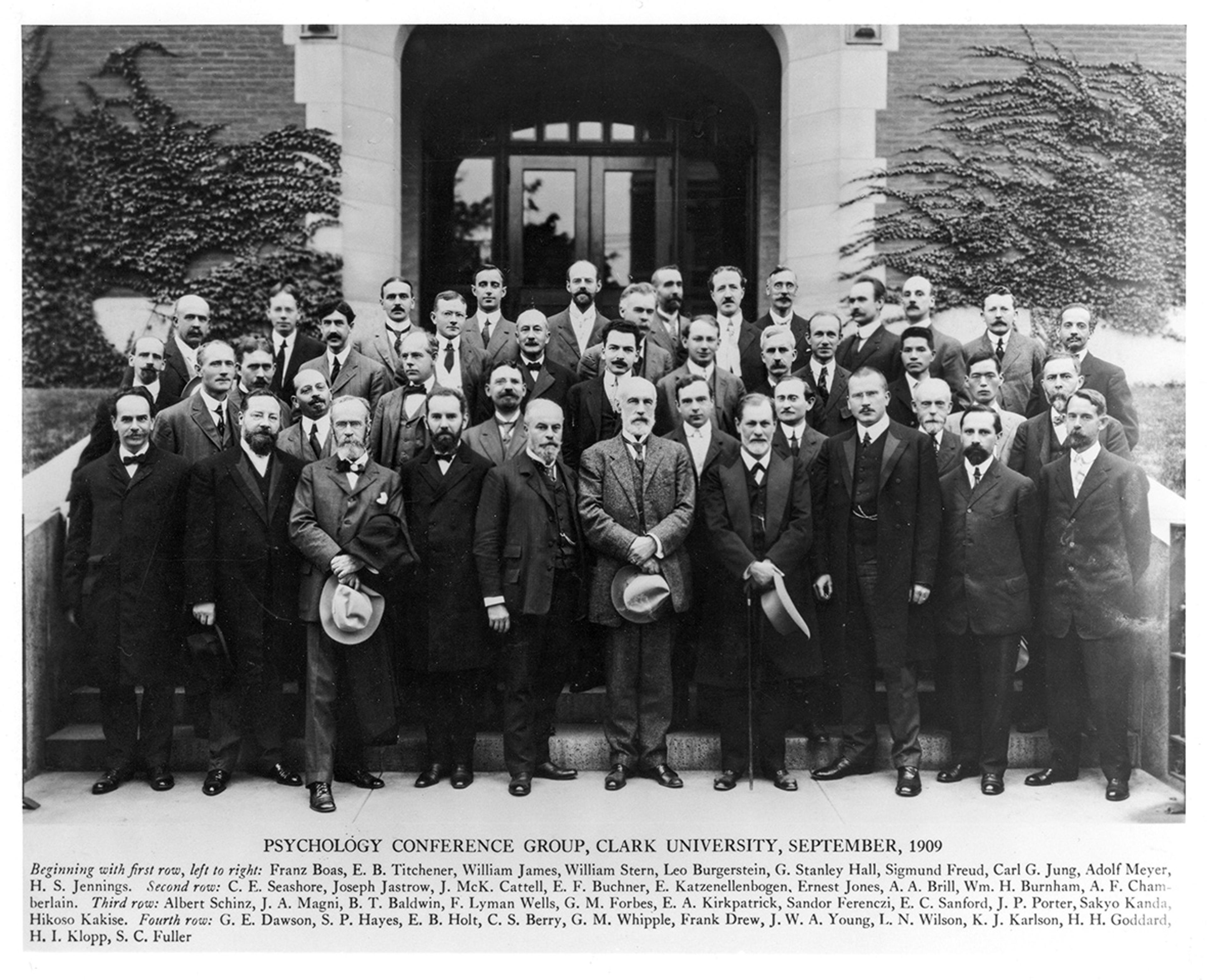
The Psychology Conference Group at the 20th anniversary of Clark University in Massachusetts in 1909. Courtesy Clark University
One can surmise that they’d heard each other, for there are traces of mutual impact: after the conference, Freud wrote Totem and Taboo (1913). Boas and his students would later deride and dismiss this attempt at ethnology, but they took on board Freud’s general theories about the psyche. In 1910, Boas gave a series of talks that eventually made their way into his best-known and most accessible book, The Mind of Primitive Man (1911). Here he integrated Freud’s insight that:
in the study of the behaviour of members of foreign races educated in European society, we should also bear in mind the influence of habits of thought, feeling and action acquired in early childhood, and of which no recollection is retained … It is largely due to Sigmund Freud that we understand the importance of these forgotten incidents which remain a living force throughout life – the more potent, the more thoroughly they are forgotten. Owing to their lasting influences many of the habits of thought and traits of personality which we are all too ready to interpret as due to heredity are acquired under the influence of the environment in which the child spends the first few years of its life. All observations on the force of habit and the intensity of resistance to changes of habit are in favour of this theory.
We become attached to psychological and cultural habits, which are physiologically and neurologically engrained from our earliest age, and hence difficult, albeit not impossible, to break in our individual lives, and by extension in societies.
Language itself is one such instance of a patterned practice. What I hear is culturally conditioned
The environmentally determined habits of individuals were a long-running interest of Boas’s. In Germany, he had begun as a student of geography before turning to physics. After a doctorate on water’s absorption of light, he turned to the mechanisms of ‘apperception’, shifting from physical geography to the study of how humans interact with their environment. He took this originally Kantian notion of apperception in the meaning developed by Wilhelm Wundt, a pioneer of scientific psychology, to denote attentive perception and the integration of sensory inputs into existing mental structures and experience. It was the relation of senses, mind and world that concerned Boas. In the article ‘On Alternating Sounds’ (1899), he demonstrated that what had seemed, to him and other anthropologists and linguists, shifting phonemes in Arctic languages, were actually the hearers’ own sensations: the sounds ‘are not recognised in their individuality, but they are classified according to their similarity, and the classification is made according to known sensations.’ Previous exposure to the complex local language affected what one heard. As the anthropologist and neuroscientist Andreas Roepstorff and colleagues commented in 2010, referring to this early study by Boas, ‘the process of classifying sounds in particular ways is a result of having been exposed previously to that particular classification pattern’.
This is an example of how cultural givens become cognitive and emotive ‘habits’ that underlie shared emotions but also produce categories, prejudices and ideologies. They are built into our mental makeup and thus may seem inherent in the self. But they are in fact dynamic, cultural ‘patterned practices’. Language itself is one such instance of a patterned practice. What I hear is culturally conditioned. This is the process involved in how I internalise and then voice what seem to be collectively and normatively acceptable, authentic emotional responses to the voices of the world, such as outrage, pride or disgust. They may feel authentic, but they are precisely what can blind me to the complexity of felt experience, and to the lenses through which I inevitably look at others, or even in the mirror – because top-down goes all the way down.
Our eyes wouldn’t adjust to seeing without the lenses. But we have the metacognitive ability to become aware of their shape and understand the conditions of our own apperception, as Boas did and entreated us to do too. ‘I’ can, to an extent, stand beside the ‘we’ of which each of us is such an intricate part. In this way, we may retrieve its hidden or forgotten elements, perhaps overcome prejudices and neuroses, as Freud helped us do, and so help cultivate a healthy, plural, attentive and democratic collectivity.