Listen to this essay
25 minute listen
To think clearly, sometimes you must forget you have a body. Pain, sleep deprivation, or even a single look can be intellectually paralysing: that feeling of the body swelling while your ideas shrivel. Analytical reasoning is suddenly out of reach. There’s nothing you can say, no opinions or comments. All that is left is the body.
Such a situation can be enough to make you long for a more abstract world. I know I have. I’ve often experienced my own body as a burden. It gets tired, hungry and dirty, it ages, and it gives others an idea of who I am that is seldom correct. I was drawn to physics as a teenager because physics transcends the bodily world, by turning objects into numbers, and motion into equations.
Some of these equations are more cherished than others. When my teacher in a mechanics class introduced ‘the most beautiful rule of physics’, I was immediately intrigued. This rule seemed to promise that there was a world beyond the temporal decay and spatial confinement of everyday life. An abstract universe. I was startled when I learned that the maker of this universe, like myself, belonged to a gender whose duties historically and primarily have been bodily ones: nursing, cleaning, feeding, keeping yourself presentable, giving birth to children.
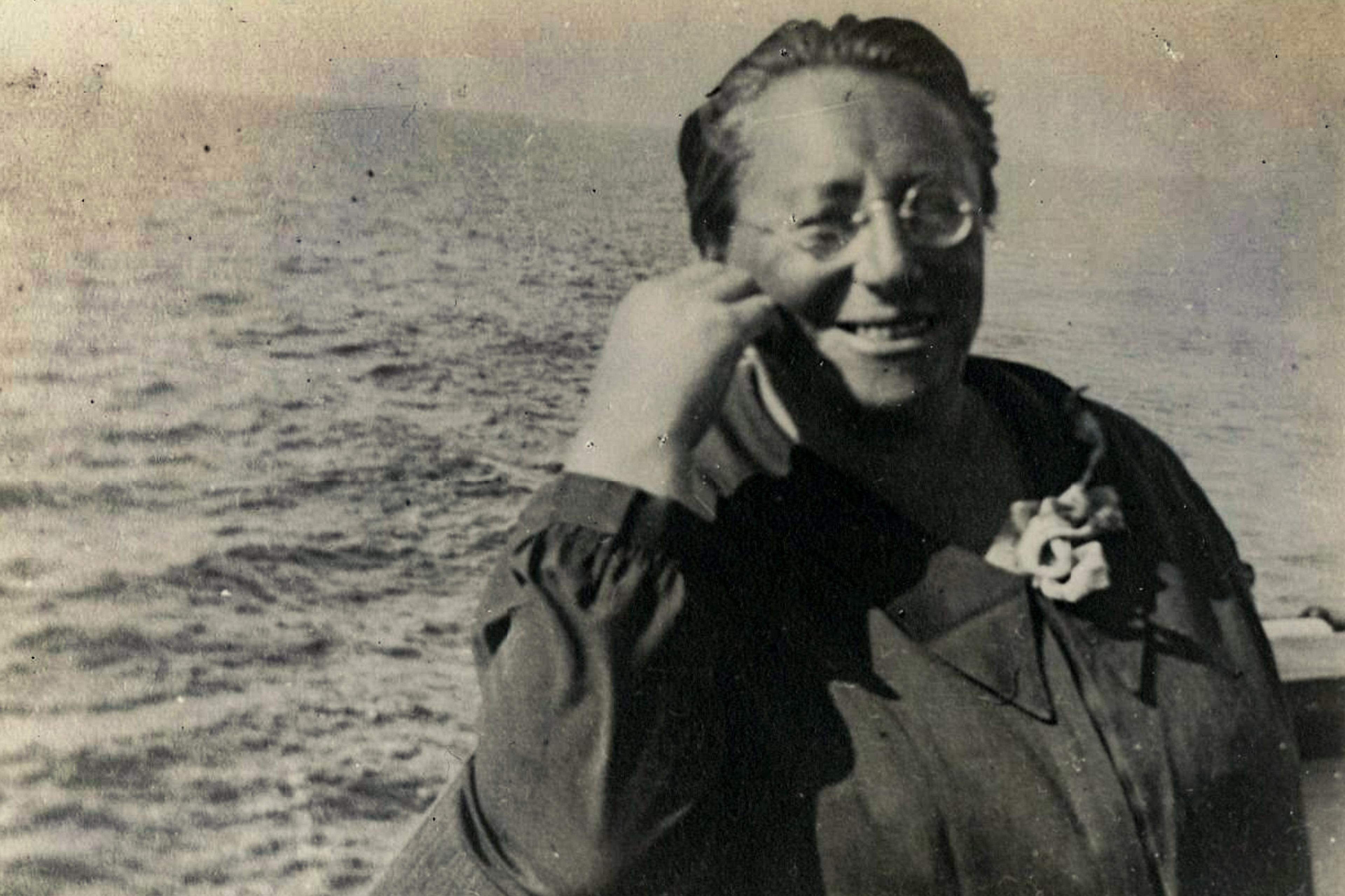
Her name was Emmy Noether, a German mathematician in the early 20th century. Noether’s theorems deal with the mathematical conditions of reality: most notably, the timelessness of the laws of physics. This indifference to the passage of time is what makes it possible to replicate an experiment and thereby establish a scientific truth. Science builds on the reproduction of experiments, and Noether showed that nature’s ability to reproduce events is mathematical.
Her theorems are called beautiful because they are so fundamental and yet so far reaching. They are like the roots of a giant mathematical forest. What the theorems showed is that the unembodied symbols of mathematics don’t need to be mere representations of an already existing reality; they could in fact be the starting point for everything.
And yet, Noether herself never got to see the implications – or the recognition – of her theorems. She died in 1935 a quite famous mathematician, with people like Albert Einstein (who played a crucial role in the development of Noether’s theorems) praising her in obituaries, but what her theorems meant for physics was yet unknown, and many aspects of her scientific work were still unrecognised. She did not even hold a professor’s title.
While she developed the theorems she is now famous for, she had neither a formal research position nor a salary, and she could teach students only unofficially, under someone else’s name. Excluded from the formal community of her workplace, left to fend for herself in a world where her female body represented an almost insurmountable limitation, she worked furiously to explain what unites all sorts of physical experiments on a purely abstract level. Was there a connection? Perhaps it was the body – slower and clumsier than the mind, caught in time and space – that made Noether yearn for the abstract and the unbound.
When looking into Noether’s life story, her love of mathematics is clear. She could talk about proofs and derivations for hours – very fast, and often in a completely improvised manner, so that some students would ask the same question three times to improve their chances of understanding her answer. She was strong-minded and sometimes stubborn; it was her way or no way. One time, while giving a lecture in mathematics at the University of Göttingen in Germany, she was in the middle of a mathematical proof when she suddenly realised that it wasn’t going to turn out the way she had hoped. It wasn’t a complete disaster – she knew other ways of proving the statement, but they were less elegant than her original idea. To her students’ great astonishment, she threw her piece of chalk to the floor in anger and disgust at having to abandon the beautiful derivation.
Despite her temper, Noether was kind and generous to her students. She helped them publish articles, connected them to other mathematicians, and organised social gatherings in her small attic apartment in Göttingen. As a teacher, she formed her own school of thought and helped establish a new branch of mathematics: modern algebra.
Modern algebra was about the procedures of mathematical proofs, the ways of doing mathematics, rather than just mathematics itself. Noether’s legacy is above all else a viewpoint and a method: don’t indulge in severe calculations to solve a problem; instead, take a step back and analyse the problem itself, decompose it, compare it with other problems, and hunt its core. This will tell you how to solve it. Hermann Weyl, a fellow mathematician, compared Noether’s method to constructing a key to unlock the doors that other mathematicians kicked open.
This was the method she used to come up with her two famous theorems in 1917 and 1918, while she was applying for a formal research position at the University of Göttingen. The talk of the town at the time was Einstein’s relativity theory, stating that time and space are interwoven, and that gravity is just the effect of spacetime bending round a heavy object like a planet or a star. But there was a problem with it, and it would fall upon Noether to solve it.
In 1900, as an 18-year-old, she was forbidden to enroll in university courses because of her gender
Energy seemed to leak whenever relativity theory was applied. And energy does not leak. This is the first law of thermodynamics, a rule proven empirically over and over again: the total amount of energy in a bounded system is always constant. Energy comes in many forms – heat, speed, light, potential to move, etc – and it shifts between them when we turn on a lightbulb or drive a car. In the case of the car, if we measure the fuel energy and then add up all the resulting motion, heat transmitted to the vehicle’s surroundings, and leftover fuel after a journey, that sum will match the initial amount. No energy gets lost or created in any process. So, why did energy leak in Einstein’s otherwise beautiful theory?
Einstein’s colleagues Felix Klein and David Hilbert brought in Noether to help. While many others would have delved into long, relativistic energy calculations when presented with this problem, Noether searched for its key. It turned out to be the boundaries. All systems on Earth can be bound: we need to account for friction and engine heat dissipation if we want to conclude that the car’s energy is conserved, but this is theoretically doable. In a relativistic spacetime, not all systems can be bound. A star does not just move through spacetime, it affects it by stretching and bending its surroundings. According to relativity theory, heavenly bodies are not possible to separate from their background. This means we can’t control what is included in the system and what’s left out, unless we zoom out long enough, so that we can watch the spacetime deformations made by the star from a safe distance. Then we can draw boundaries, count energy, and it will be conserved. But if we take a closer look, energy will leak, just like it does if we don’t include the car engine’s heat (among stars, this is what causes gravitational waves, they are energy oozing out from cosmic events).
Setting up two concise theorems, Noether presented concrete terms for when energy is conserved in every conceivable type of system. These terms weren’t limited to energy, either, but valid for all kinds of conserved quantities, like momentum or charge.
The first theorem shows the conditions for the conservation of energy, momentum and so forth in events described by, for instance, classical mechanics, like the car journey. This is the theorem that’s now world famous, the one people intend when they simply say ‘Noether’s theorem’. The second theorem explains conservation of energy and other quantities conserved in unbound situations, like the ones in relativity theory.
‘It would have done no harm to the troops returning to Göttingen from the field if they had been sent to school under Fräulein Noether,’ Einstein commented enthusiastically in May 1918, when the First World War was nearing its end and the theorems had just been published.
She was seen as an exception in every way: a male mind trapped inside a female body
But Fräulein Noether was still not allowed to teach anyone at all. She was 36 years old and had spent her entire adulthood struggling to attain a formal position in German academia. In 1900, as an 18-year-old, she was forbidden to enroll in university courses because of her gender. She instead decided to be one of a total of two female ‘auditors’ in a sea of 984 men at the University of Erlangen in Bavaria. Seven years later, she received a PhD in mathematics, despite the fact that women weren’t eligible for the following habilitation, required to proceed with paid academic work. After defending her thesis, Noether spent eight years without a salary teaching the students of her father (Max Noether, also a mathematician), and then four more unpaid years at the University of Göttingen. In 1918, as Einstein was lauding her abilities, she was in the middle of a bureaucratic process to change her situation.
The academics in favour of Noether’s inclusion at the university noted the shortage of talented mathematicians in Göttingen, especially during the war. Those who were not in favour claimed that gender segregation was a necessity that superseded all other concerns, in particular during wartime. What would happen to Germany if women chose academic careers instead of making families and bringing up the next generation of soldiers?
In 1919, Noether and her advocates won this battle and she was able to habilitate. However, no one argued for the inclusion of women as a rule in German academia. It was never a feminist struggle. This became very clear when Noether herself, later on, worried that her female students wouldn’t be able to follow her courses. According to her, women in general were intellectually inferior to men, and too concerned with their own appearances and relationships to make it in academia. Her time was better spent helping male students, since the female ones tended to get married and leave mathematics behind anyway. Herself unmarried, she was seen as an exception in every way: a male mind trapped inside a female body. Her friends and colleagues gave her the nickname ‘Der Noether’, using the German masculine article ‘der’ and thereby characterising her as neither Mr nor Miss (Herr and Fräulein in German), but something in between, something of her own.
Similar arguments arose once again when the Nazis took power in Germany in 1933 and prohibited all Jews from academic work. Like many other scholars in Göttingen, Noether was Jewish, although she never practised the religion. Now people argued that she should be viewed as a Jewish exception as well. They emphasised her ‘Aryan way of thinking’ while stressing that her intellect didn’t transcend only her gender, but her ethnicity, too. As if she had no body; as if she was her mind only.
For her body was her problem: female and Jewish, in a country and era that did not allow such bodies to exist. In the autumn of 1933, she fled Germany for the United States. Reluctantly, she ended up at the women’s college Bryn Mawr outside Philadelphia. The female students there did actually disprove her prejudices, and quite soon she embraced them as her new friends and protégées. But she continued to fret over the refusal she got from the more prestigious Princeton University (Princeton appointed their first female full professor in mathematics in 1994). And she grieved her old life. In 1933, she was left wholly at the mercy of the contingent forces surrounding her.
Her first theorem – the one not dealing with relativity – explores the exact opposite situation. Namely, what it means to be completely independent of contingencies in your surroundings. It links conservation of energy and other quantities to independence of variables like time, space and direction.
To truly keep something intact, you must isolate it from its context
In physics, equations that describe how things move are central. This type of equation usually includes variables that represent time or position, meaning that when and where an event takes place are ingredients in the equation; its mathematical terms. Noether’s theorem tells us that if the mathematical terms can change in an equation of motion without affecting the description of the motion, there’s something in that motion that’s been conserved. If it doesn’t matter what time an object is set in motion, then the object’s energy is conserved, and if it doesn’t matter where the object is moving, then its momentum is conserved.
That the start time and location for physical events don’t affect them is a somewhat trivial statement. We all know that a marble won’t roll differently across a table depending on what day we push it or where the table stands, right? So long as we push it in the same way and that all other conditions, like the floor’s inclination or the ventilation in the room are similar. But this actually points to a fundamental feature of nature: physics is timeless. Today’s high-school kids perform the same experiments as the ones Galileo Galilei did in the 17th century and, if they’re diligent, they’ll achieve the same results. This exact replicability of events is the foundation of the scientific method, and it is what sets the natural sciences apart from subjects like history or economics, where experiments are inescapably singular, characterised by their own unique circumstances. The equations of physics connect our time to the entirety of world history. Noether’s theorem shows that these essential conditions – independence of time and space – are the requirements for conserving a quantity like energy or momentum. To truly keep something intact, you must isolate it from its context.
It’s both alluring and unrealistic, this independence of context that undergirds conservation in physics. Every day, people fight to save their skin, principles and relationships but, no matter what, our lives are inevitably shaped by place and timing, and our bodies suffer from the inevitable breakdown of all that is rooted in matter. No wonder people long for an ending of the endless dissolution of matter, the incessant demand for care that is a precondition of life, the wear and tear of clothes, one’s own ageing and all the ailments that come with it.
Noether certainly longed for it. The stories of her ignorance of worldly things are numerous. One of her students once asked her why she walked around with a broken umbrella – shouldn’t she have it fixed? Well, Noether replied, when it doesn’t rain, the thought of my umbrella never crosses my mind, and when it does rain, I must use it, so when am I supposed to have it fixed?
She went for long walks no matter how much it rained; she sometimes had stains on her clothes that she didn’t bother to wash. Her students remember how she used to climb tall fences without even changing her tone of voice in the mathematical argument she was midway through. They were often baffled by her blunt ways and apparent disregard for her own looks, wearing the same black dresses every day and always allowing her hair to slip out of her coiffure. There are no records of romantic partners. Noether did not behave like a woman; she lived a life of the mind.
What better, then, than dedicating her life to mathematics? The most unworldly of all sciences. Mathematics comes out of nature’s shapes and numbers, from things like the relationship between a circle’s radius and circumference, but it doesn’t let itself be limited by physical matter. Numbers never end; the simple plus sign holds the promise of an infinite continuation to the number sequences. When something is mathematically proven, it holds forever. Scientific truths, on the other hand, are true only as long as they’re not refuted by new experiments or different theories.
Mathematics, as well as experiments, has had a central place in the natural sciences ever since the scientific revolution in the 16th and 17th centuries. Galileo and Isaac Newton repeatedly dropped objects from different heights, pushed marbles across different slopes, measured and analysed their results. They used mathematics to make sense of their experiments and generalise their conclusions. Once a law of nature like Newton’s gravity equation was found, it could be used to predict experimental results and guide the development of new theories. The 17th-century scientists started out with experiments; mathematics came second. Today, the relationship between experiments and mathematics in physics has changed, and Noether’s theorems played an important role in that transition.
With the development of 20th-century astronomy and particle physics, performing experiments has become increasingly complicated. Gigantic telescopes are required for distant stellar observations, and supercomputers or entire data-processing centres for analysing experimental data. Particle experiments performed at places like CERN in Geneva, Switzerland, are so advanced and expensive that dozens of countries must unite to make them possible. The experimental set-ups must be meticulously planned, because you can’t just throw particles on a table and see what happens. Neither stars nor electrons are anything like marbles.
It’s not easy to calculate, but when it comes to interstellar objects and super-small particles, it’s often easier than measuring. And calculations tell you where to look; how to set up your experiments. The Standard Model, the current model for the smallest constituents of matter, was to a large degree mathematically formulated before it was experimentally proven. The most famous example is perhaps the Higgs particle, theoretically predicted in 1964 and discovered in 2012 after a series of measurements at the Large Hadron Collider at CERN. The discovery yielded the Nobel Prize in physics a year later.
Above all else, Noether showed that mathematical properties yield conclusions about physical measures
Calculating before experimenting is a new order of physics. It was motivated by the increasing complexity of experiments in astronomy and particle physics. But the idea that mathematics is a valid point of departure in the first place was an insight from Noether’s theorems.
Noether connected empirical laws of nature to mathematical conditions. We no longer have to measure all the energy in a system to prove that the total amount stays the same (this is how the law of energy conservation was found). Thanks to Noether, we can just study the equations describing the system and see if the initial time affects the motion or not. If it doesn’t, then energy must be conserved. In physics, this is called time symmetry. Since Noether’s theorems are so universal, there are a lot of other symmetries with corresponding conservation laws to be explored, besides time and energy. Symmetries – that is, independencies of mathematical variables like time – have proved to be crucial tools in areas ranging from classical mechanics to quantum field theory. Above all else, Noether showed that mathematical properties yield conclusions about physical measures.
Noether’s first theorem tells us that when a mathematical model is constructed, we may look at the equations themselves to learn, from their structures and symbols, the consequences for the physical matter that could be governed by the model. If those consequences fit with everything we know so far, the mathematical model is likely to be real. Otherwise, it needs modifications. The next step is to carefully design experiments to prove that the assumptions are true – and hopefully win a Nobel Prize.
The enormous potential of mathematical prediction is mesmerising. The mathematician becomes a fortuneteller, a spokesperson for a silent, mysterious nature. To some, the recent developments in physics are evidence that mathematics is in fact the true language of nature. That nature is mathematical, deep down. If even the fundamental conditions for reproducibility of events are mathematical – then why wouldn’t everything be?
Yet I’m not sure Noether would have believed that the entire world is mathematical. For her, I think it was enough that there was a parallel, mathematical world that she could enter – or escape to when things got hard; when she was reduced from person to woman, or kicked out of her own country.
Not long after Noether’s move to the US, she was informed she had a tumour in the organ her friends jokingly implied that she lacked: her uterus. The surgeries would eventually kill her but, until the very end, her notes and letters were void of bodily complaints, and vibrant with mathematics.