Listen to this essay
27 minute listen
On a summer day in 1924, a young Indian physicist named Satyendra Nath Bose sent a paper and a letter to Albert Einstein. It would shape the nascent field of quantum mechanics and secure Bose a place in the annals of scientific history.
At the time, Bose was teaching in colonial India, thousands of miles from the centres of European science. In his letter, the 30-year-old Bose explained that he had found a more elegant way to derive one of the pivotal laws of physics (Planck’s law of radiation) and asked for Einstein’s help in publishing it. To Bose’s astonishment, Einstein replied enthusiastically. He translated Bose’s manuscript into German and arranged for it to be published in Zeitschrift für Physik, a leading physics journal of the time. Thus was born Bose-Einstein statistics, a cornerstone of quantum physics.
What made it so significant? In plain terms, Bose devised a new way to count and describe the behaviour of identical quantum particles, most famously, particles of light called photons. Unlike marbles or other distinguishable objects, these particles don’t insist on personal space: they can crowd into the same state rather than each occupying a unique state. Bose showed that treating particles as indistinguishable leads to a new statistical law that correctly produces Planck’s formula without taking recourse to classical physics.
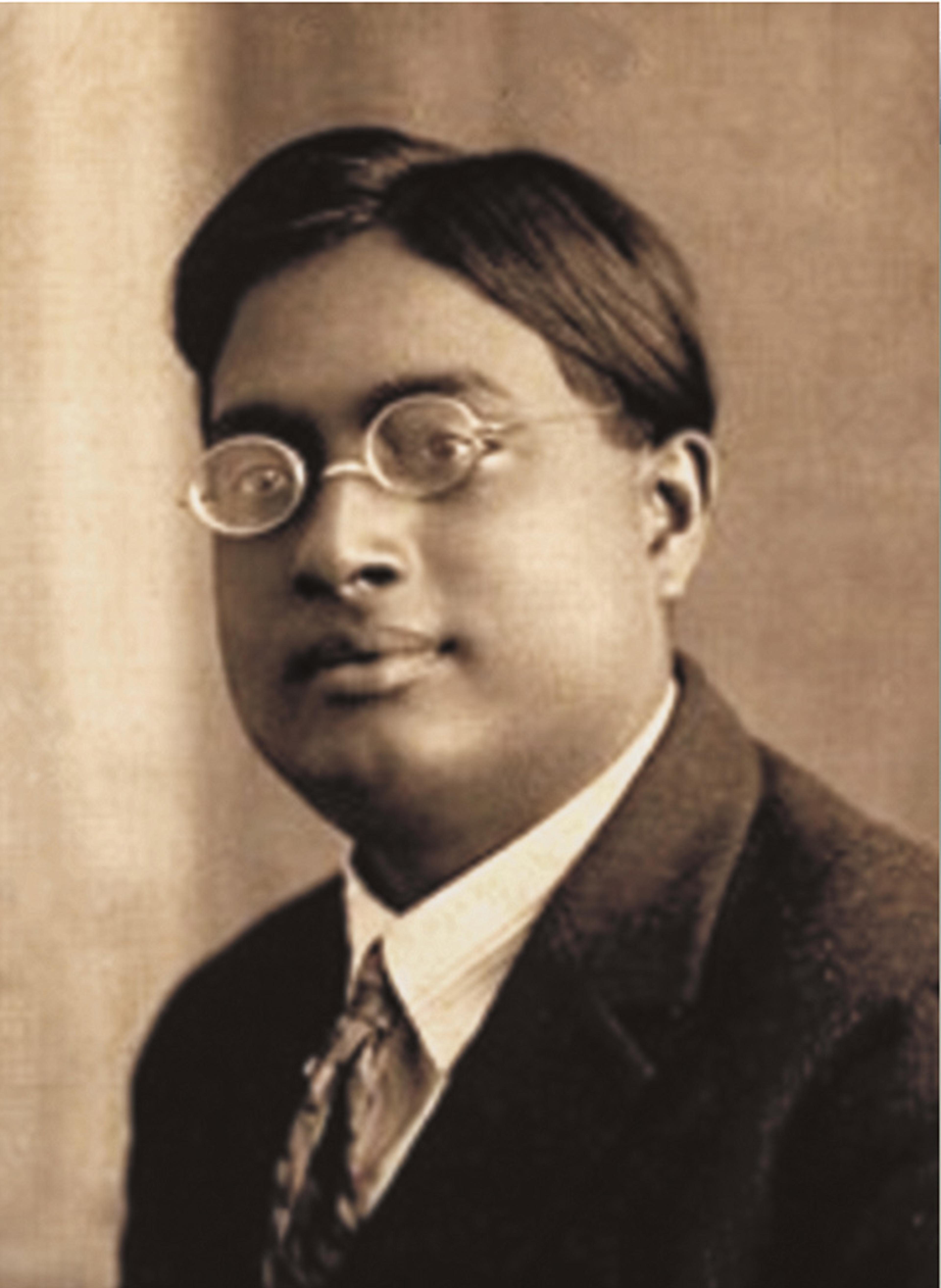
Satyendra Nath Bose in Paris, France, in 1925. Courtesy the AIP Emilio Segrè Visual Archives
Einstein was so impressed with this idea that he applied it to atoms, predicting a strange new state of matter – what we now call a Bose-Einstein condensate (BEC), where particles clump into the same state at low temperatures. BECs are important because they enable direct study of the quantum world, the creation of new states of matter and testing of fundamental theories, and have real-world implications for quantum computing, atomic clocks and other emerging quantum technologies. And today, Bose-Einstein statistics still describe one of the two fundamental classes of subatomic particles, which the physicist Paul Dirac later called ‘bosons’ in honour of Bose’s contribution. Photons are bosons, as is, of course, the Higgs boson, the so-called ‘God particle’ detected in 2012. Hence, bosons are far more important than many non-physicists might realise.
The popular telling of this episode often casts Bose as a lucky outsider whose discovery was a fluke elevated by Einstein’s patronage. But Bose’s real story is actually far richer. His life and career reveal a complex, deeply human scientist who navigated intellectual passions and colonial-era challenges to make his historical mark. The narrow focus on his ‘accidental’ discovery overlooks the breadth of Bose’s pursuits and the context that shaped him. Bose was a true polymath, fluent in multiple languages and immersed in literature and philosophy, and a dedicated teacher who believed science should be accessible to everyone, not just an elite few. Crucially, he achieved all this while working under the British Empire, facing the hurdles of a colonised scientist: limited resources, isolation from international peers, and the pressures of life under foreign rule. Acknowledging Bose’s context doesn’t diminish his achievements; instead, it casts them in a more illuminating light. His groundbreaking work was not the result of mythical serendipity alone, but rather the culmination of perseverance, intellect and a willingness to think differently from the heart of a colonial world.
Bose was born on 1 January 1894 in Calcutta (now Kolkata), then the capital of British-ruled India. He was the only, eldest son (among seven children) of a lower-middle-class Bengali family. His father, Surendra Nath Bose, was an accountant with the East Indian Railways who had a knack for mathematics and science. His mother, Amodini Devi, although barely formally educated, managed the large household. Surendra Nath harboured nationalist sympathies; in 1901, he left his secure railway job, a position with the colonial government, to start a small chemical and pharmaceutical venture with a friend. Hence, Surendra Nath’s quiet defiance of colonial structures, and his turn towards Indian scientific enterprise, likely created a family world where a nascent nationalist milieu could thrive. This, I believe, left an enduring mark on his son.
The Bose family belonged to the Bengali Kayastha caste, which was traditionally excluded from the highest echelons of scholarship. By the late 19th century, however, social reforms of the Bengal Renaissance were loosening such barriers and opening up higher education to non-Brahmins. In this milieu of rising opportunities, young Bose demonstrated exceptional talent in mathematics and science, coming top in his classes at university.
Working from the ‘periphery’ helped him think independently; the prevailing orthodoxies didn’t bind him
Bose launched his academic career just as a new era in physics was dawning, but also during the tumult of the First World War, which cut off direct intellectual contact between British India and the German scientific centres pioneering quantum theory. Bose, however, was determined to keep up with the latest developments. He taught himself German and, with the help of mentors and colleagues, obtained copies of cutting-edge European research. He devoured papers by the physicists Max Planck and Arnold Sommerfeld, and studied advanced texts, such as James Clerk Maxwell’s and J W Gibbs’s treatises on statistical mechanics. Immersing himself in these resources, Bose stayed abreast of the new quantum ideas, even as some Western scientists remained sceptical of concepts such as the light quantum (the photon). Later in life, Bose reflected that working from the ‘periphery’ helped him think independently; the prevailing orthodoxies of the European establishment didn’t bind him.
Bose’s early research efforts bore fruit despite the challenges. In 1918, he and Meghnad Saha, a friend from college, co-authored a paper on thermodynamics that appeared in the prestigious Philosophical Magazine, marking Bose’s first international publication. (Bose’s surname appears as Basu, reflecting contemporary transliteration practices rather than a different identity.) Around the same time, the pair undertook another ambitious project: translating several of Einstein’s groundbreaking papers on special and general relativity from German into English. This work was published as a book titled The Principle of Relativity (1920); notably, it was the first English translation of Einstein’s seminal papers. By bringing Einstein’s work to a broader audience, Bose and his colleague signalled that colonial India was fully engaged with the frontiers of modern physics, despite being far from its European epicentres. These early accomplishments gave Bose the confidence to venture beyond classical physics and delve deeper into the mysteries of the quantum world.
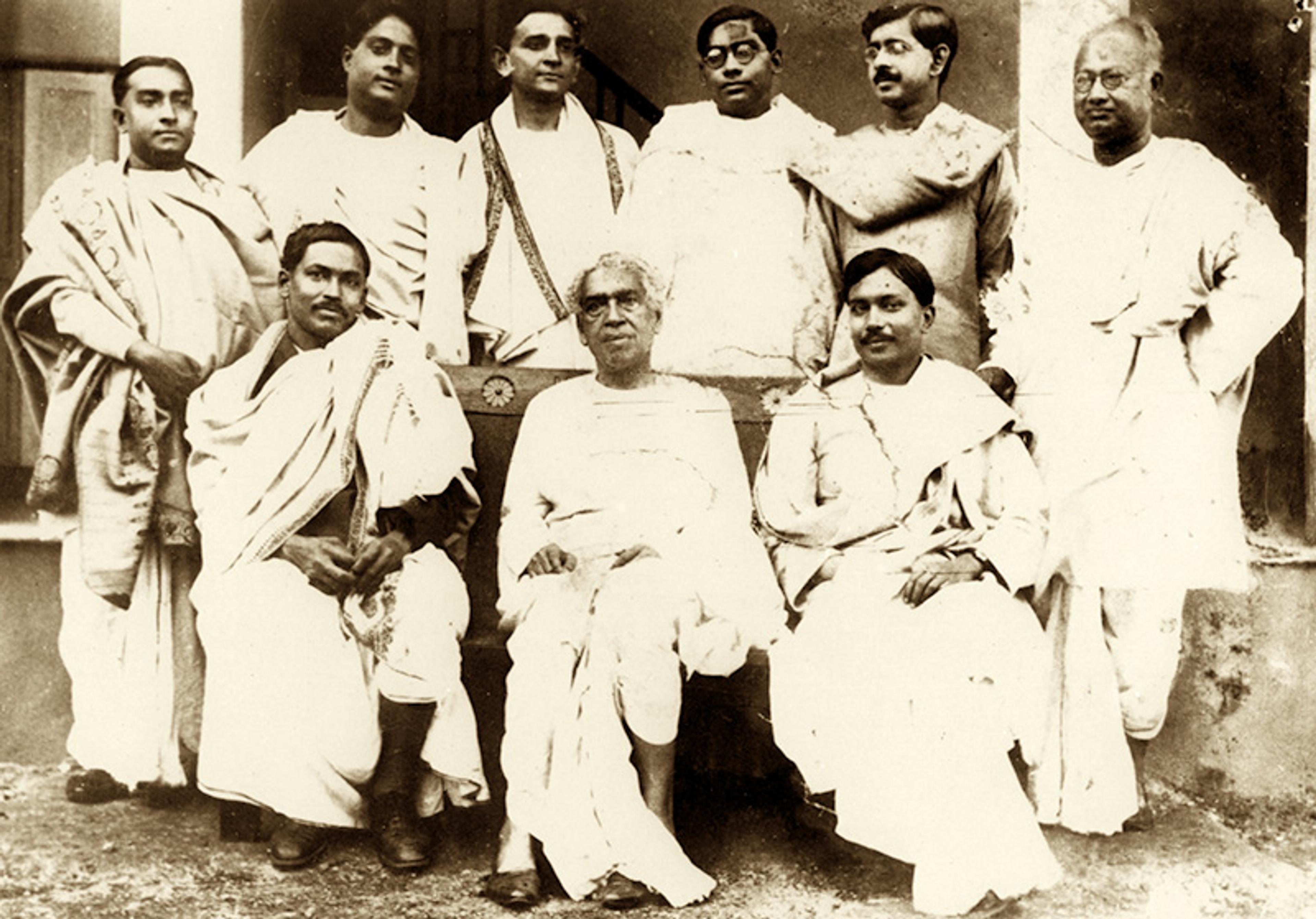
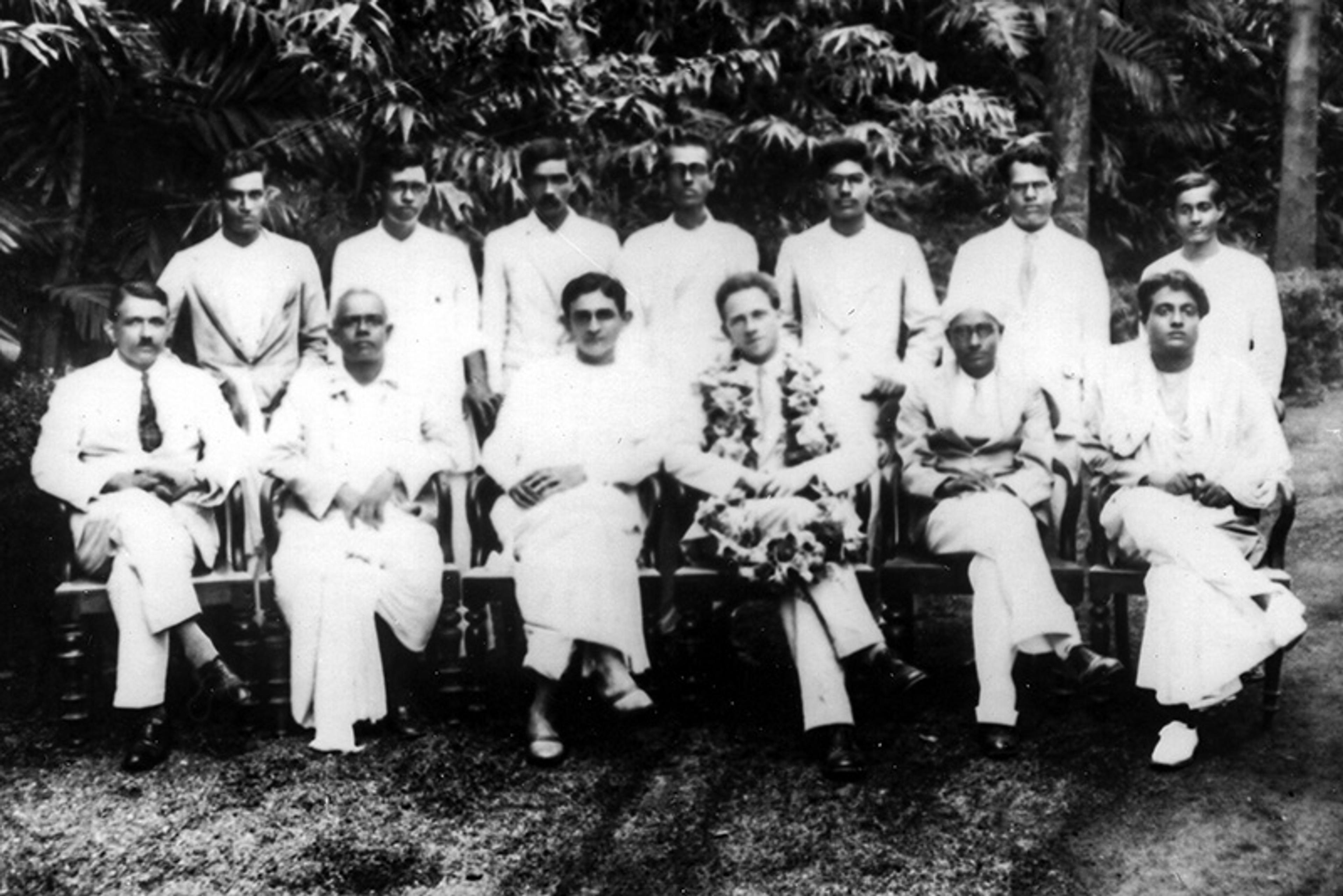
Undated group portrait featuring: seated (from left), Meghnad Saha, Jagadish Chandra Bose, Jnan Chandra Ghosh; standing (from left), Snehamoy Datta, Satyendra Nath Bose, Debendra Mohan Bose, Nikhil Ranjan Sen, Jnanendra Nath Mukherjee, N C Nag. Courtesy the AiP Emilio Segrè Visual Archives
By the early 1920s, quantum physics had emerged as a radical new field, offering Bose intellectual freedom from colonial strictures. As I argued in my book The Making of Modern Physics in Colonial India (2020), embracing the quantum provided ‘a great intellectual escape from the hegemony of scientific colonialism’ that defined the British-dominated scientific establishment in India, which focused on teaching classical physics in universities and exploring applied science that benefited colonial interests.
In 1921, a few years after the First World War, Bose left Calcutta to join the physics department at the newly founded University of Dacca (present-day Dhaka in Bangladesh). The move was strategic. Dacca University, established by the British in 1921, offered state-of-the-art laboratories and better access to international journals than crowded Calcutta could provide. Bose’s reputation as a top student had preceded him: Dacca’s vice-chancellor, Philip Joseph Hartog, personally invited him to take up the post. In his new role, the 27-year-old Bose taught advanced physics courses. While preparing lectures on cutting-edge topics, he grappled with a nagging problem: the existing derivations of Planck’s law of blackbody radiation were not entirely satisfactory. Planck’s formula, foundational to quantum theory, had been derived using ad hoc assumptions that mixed quantum ideas with classical physics, which troubled Bose. He sought a more elegant, logically consistent derivation that would be purely quantum.
Perhaps the editors in London did not know what to make of this audacious paper from distant Dacca
By 1923, Bose had his solution. Drawing on his deep knowledge of statistical mechanics and Einstein’s light-quantum hypothesis, he realised that the key was to treat light quanta as indistinguishable particles. All previous derivations (including those by Planck, Einstein, and others) had implicitly treated photons as if they were distinguishable somehow, importing classical reasoning through the back door. In a paper completed that year, Bose derived Planck’s law anew by counting the number of ways indistinguishable photons could distribute their energy among available states, a counting approach that would later bear his name. Notably, Bose was aware that many European physicists at the time were still uneasy about light quanta; several had tried to avoid or sidestep Einstein’s 1905 photon concept. But Bose’s approach showed that embracing the light quantum, rather than shying away from it, led directly to the correct radiation law. His work – alongside experimental evidence from the time – helped reconfigure physics by validating Einstein’s once-controversial ideas through insights gained from the scientific periphery.
Confident in his result, Bose shared it with the broader world. He first submitted his manuscript, ‘Planck’s Law and the Light Quantum Hypothesis’, to the British journal Philosophical Magazine. It was met with silence. Perhaps the editors in London did not know what to make of this audacious paper from distant Dacca, or maybe it was an example of the biases that colonial scientists often faced. Undeterred, Bose took a remarkable step. In June 1924, he wrote directly to Einstein, enclosing the paper and requesting his opinion and assistance in publishing it. In his cover letter, Bose modestly explained that he had derived Planck’s law in a novel fashion and hoped it would be deemed worthy of attention.
Einstein responded with genuine enthusiasm. To Bose’s delight, the renowned physicist sent him a postcard praising the work as ‘a beautiful step forward’. He forwarded the paper to Zeitschrift für Physik on Bose’s behalf, and remarked that it resolved a problem that had occupied him for nearly two decades. Bose’s statistical insight was not a fortunate accident but a natural extension of Einstein’s own 1905 light-quantum theory – an extension that, despite years of reflection, Einstein himself had not managed to formulate. By the end of 1924, Einstein had applied Bose’s statistical approach to ordinary atoms, predicting the phenomenon now known as the Bose-Einstein condensate, a low-temperature state of matter that was not detected in experiments until the 1990s. For his part, Bose followed up by sending Einstein a second paper extending his ideas to gas molecules in equilibrium with radiation. Einstein also found this second installment interesting, though their correspondence shows he offered Bose some constructive criticisms.
With Einstein’s prestige as a recent Nobel laureate, Bose secured a two-year research sabbatical to visit Europe. (Einstein’s supportive postcard helped expedite the bureaucratic approval for his travel.) Bose arrived in Paris in October 1924 and plunged eagerly into the European scientific scene. In Paris, his priority was to observe modern laboratories in action, especially in fields such as radioactivity and X-ray crystallography, which were not well-developed back home. He met the great physicist Marie Curie and expressed interest in working in her lab. Curie was welcoming but firm: she told Bose that anyone joining her research group must be proficient in French, advising him to spend a few months improving his language skills before attempting serious laboratory work. (Bose, who had been studying French for years, was too polite and shy to insist that he already knew the language quite well.) Instead, he shifted his focus and accepted an offer from the physicist Paul Langevin to work with Maurice de Broglie. In de Broglie’s laboratory in Paris, Bose learned the latest techniques in X-ray spectroscopy and crystallography, expertise he would later carry back to India.
Bose had stood at the centre of the scientific world and held his own
After about a year in France, Bose moved to Berlin, which was then the heart of theoretical physics, home to Einstein and other luminaries. There, Bose finally met Einstein face to face and interacted with scientists such as Fritz Haber, Otto Hahn, Lise Meitner, Peter Debye, Max von Laue, Wolfgang Pauli, and Werner Heisenberg. He even travelled to Austria to give a seminar at the University of Vienna, where he met Erwin Schrödinger, Hans Thirring, and other leading physicists. In Berlin, Bose spent time at the Kaiser Wilhelm Institute, working with physicists such as Michael Polanyi and Karl Weissenberg on X-ray diffraction studies of crystals and polymers. Colleagues from this period recalled Bose as being ‘quite happy’ in the European scientific community; he was sociable, full of humour, and even known to burst into German songs occasionally.
Indian Association for the Cultivation of Science in Calcutta, India, 8 October 1929. Seated (from left): S S Rao, Abhijit Dey, Debendra Mohan Bose, Werner Heisenberg, Krishnan Kariamanikkam, Satyendra Nath Bose. Others in the photo are not identified. Courtesy Max-Planck Institute, AIP Emilio Segrè Visual Archives
Despite the warm personal reception, Bose’s scientific discussions with Einstein in Berlin proved somewhat disappointing. Bose drafted a third paper expanding on his statistical ideas (incorporating some of Einstein’s earlier feedback) and eagerly awaited his approval. However, Einstein remained unconvinced by Bose’s new arguments and did not support publishing the work. No manuscript of this ‘third paper’ survives but, by all accounts, Bose abandoned it after seeing Einstein’s reaction. He was reportedly saddened by Einstein’s lack of enthusiasm, a sting that stayed with him long after. In 1926, Bose left Europe and returned to Dacca. Though his hoped-for extended collaboration with Einstein did not materialise, he came home with broadened horizons, newfound experimental skills, and an invigorated sense of purpose. He had stood at the centre of the scientific world and held his own.
The tale of Bose’s 1924 breakthrough is often told with Einstein as the hero who ‘rescued’ an obscure Indian physicist. While it’s true that Einstein’s support was invaluable, the reality is more nuanced. Einstein engaged deeply with Bose’s work not out of charity but because Bose had solved a problem Einstein genuinely cared about. Their exchange was a meeting of minds across continents, a collaboration that demonstrated how science could bridge the divide between empires, races and cultures. Einstein, an outsider in European society (a Jew in 1920s Germany), perhaps felt a kinship with Bose, who hailed from the colonial ‘periphery’. And Bose, for his part, was no supplicant; he approached Einstein confidently, as an equal in enquiry. I describe Bose’s stance as a form of ‘local cosmopolitanism’, rooted in his Indian context yet fully capable of engaging with the global scientific community as a peer. The Bose-Einstein partnership exemplified how knowledge can flow in multiple directions. A discovery in colonial Asia could revolutionise physics in Europe, just as ideas from Europe could inspire breakthroughs in Asia. Their story is a powerful rebuttal to the old notion in the history of science that science moves only from a civilised centre to a passive periphery.
Yet, despite Bose’s global connections, he could not totally transcend politics at home. Throughout his career, the backdrop of colonial India’s struggle for independence was ever present. Like many Indian intellectuals of his generation, Bose had to navigate a complex relationship with British rule. On the one hand, the colonial government had established the institutions that educated him, and he benefited from the laboratories, libraries and funding that came with that system. On the other hand, he was keenly aware of living in a nation that was subjugated. Bose was determined to contribute to India’s intellectual self-reliance and disprove the notion that Indians were incapable of high scientific achievement under their own steam.
Bose’s personal choices reflected this delicate balancing act. Early in life, he consciously decided not to join the elite Indian Civil Service, the prestigious administrative cadre of the Raj. The British partition of Bengal in 1905, a divide-and-rule policy that sparked widespread protests in Bose’s youth, left a deep impression on him. It steeled his resolve to avoid serving the colonial regime. Instead, Bose chose the path of science and education, where he could excel and uplift his fellow citizens without directly bolstering imperial rule. (In this, he mirrored his father, who had left a government job decades earlier.) During the 1920s, Bose quietly kept company with nationalist and even revolutionary circles. He was associated with the Anushilan Samiti, a revolutionary organisation in Bengal, and maintained contacts with Indian activists abroad, such as Abani Mukherjee. Unsurprisingly, these connections drew the suspicion of colonial authorities.
In 1924, as Bose was preparing to travel to Europe, the British Indian police feared his trip might be a cover for political activity rather than scientific research. They pressed Dacca University to cancel his sabbatical. Bose’s burgeoning scientific renown, however, came to his rescue. The French author Sylvain Lévi wrote to vouch for Bose’s bona fide scholarly intentions. Likewise, Dacca’s vice-chancellor Hartog defended him. Largely thanks to Lévi’s intervention (and Einstein’s postcard, which underscored Bose’s standing in the scientific community), the authorities backed down.
He mentored many students who would later play prominent roles in Indian science
Upon returning to India in 1926, Bose continued advancing science while contributing to his country’s intellectual emancipation. He firmly believed that science should be accessible to the masses in their own languages. Unlike many of his contemporaries who published exclusively in English, Bose frequently gave public lectures in his native Bengali and wrote essays about science for general readers in Bengal. He believed that educating people in their mother tongue was crucial for fostering a scientific culture in India, particularly in a nation striving to shed its foreign dominance. This commitment to science in the vernacular was a subtle yet powerful form of resistance to colonial cultural hegemony, as well as aligning with the broader Swadeshi ethos of self-reliance.
The 1930s and ’40s were turbulent times in India, as the independence movement reached its zenith. During these decades, Bose remained at Dacca University, focusing on teaching and nurturing the next generation of scientists. He mentored many students who would later play prominent roles in Indian science. As the Second World War drew near and India’s freedom loomed on the horizon (independence came in 1947), Bose’s stature grew. In 1944, with the colonial government still in power, Indian scientists honoured Bose by electing him general president of the Indian Science Congress, a significant recognition by his peers of his leadership in science. The following year, he was made president of the Indian Physical Society (serving 1945-48), firmly establishing him as one of the leading figures in Indian science on the eve of independence.
Notably, Bose was not a traditional firebrand political agitator; he did not lead rallies or write polemics against British rule. His form of nationalism was expressed through intellectual sovereignty. He showed by example that Indians could innovate at the highest levels of physics, even under the constraints of colonial rule. Moreover, by choosing to develop his career in India and by communicating science in an Indian language, he undercut the notion that one must go abroad or use English to be a successful scientist.
Beyond his famous work in quantum statistics, Bose led a rich and varied scientific life. Upon returning to Dacca after his European sojourn, he threw himself into new projects. One of his significant contributions was in the field of X-ray crystallography. With the know-how he gained in de Broglie’s lab in Paris, Bose established one of India’s first X-ray crystallography laboratories at Dacca University in 1926. Under his guidance, the lab’s students and technicians constructed advanced instruments. By the 1930s, they had built a Weissenberg X-ray camera, a sophisticated device for crystal structure analysis, in the department’s workshop. This was cutting-edge equipment for an Indian institution at the time, and it turned Bose’s Dacca lab into a regional hub of research activity. Not only his students used it, but students from other universities (including some from Calcutta) would travel to Dacca to conduct experiments. In an era when Indian scientists often struggled for resources, Bose’s initiative created rare opportunities for hands-on training within his home country.
Bose also remained a lifelong educator at heart. He inspired generations of students through his formal teaching and wider efforts to popularise science. His lectures were famously engaging and challenging, and he encouraged students to think independently, a style perhaps influenced by his own unconventional, largely self-driven scientific training outside the European mainstream. Over the decades, Bose mentored many young scientists, imparting not just knowledge of physics, but also a confidence in Indian science. Many of his protégés became prominent figures in the scientific community of independent India.
In the late 1940s, the geopolitical landscape around Bose underwent a dramatic shift. The partition of India in 1947 split Bengal into two parts, with Dacca falling in the newly created East Pakistan, and Calcutta remaining in India. Bose, a Bengali with deep roots in Calcutta, decided to return to his hometown. Even before partition, he had accepted an offer in 1945 to become a professor of physics at the University of Calcutta. Returning to a free India, he helped rebuild and develop the country’s scientific infrastructure after the end of colonial rule and division.
He achieved his 1924 breakthrough not in a Cambridge or Göttingen, but in a modest laboratory in colonial India
True to the label ‘polymath’, Bose’s interests were never confined to physics alone. His lifelong love of literature, music and philosophy complemented his scientific pursuits. Bose was fluent in several languages, including Bengali and English, as well as French, and had a working knowledge of German from his student days. He enjoyed reading the original works of Western philosophers and actively engaged in the cultural and intellectual debates of his time. Friends and colleagues recall that he could discuss the poetry of Rabindranath Tagore or the essays of Bertrand Russell with equal ease, as he could the latest findings in quantum mechanics.
In the history of physics, Bose stands as a reminder that great science can emerge from unexpected quarters. His work on quantum statistics was pivotal; it underpins much of modern physics, from the behaviour of electrons in solids to the properties of stars and the expanding Universe. And yet, remembering how Bose made those contributions is just as important. He achieved his 1924 breakthrough not in a Cambridge or Göttingen, but in a modest laboratory in colonial India, with no large research team or sophisticated equipment at his disposal, and initially without the validation of the Western scientific establishment. His success was a triumph of intellect and determination over circumstance, a testament to creativity flourishing in an out-of-the-way locale through sheer force of will.
However, Bose’s life demonstrates that he was no one-hit wonder, but a multifaceted thinker and institution-builder. Bose was not a mythologised figure of serendipity, nor merely Einstein’s sidekick; he was a complex individual who combined curiosity, creativity and a strong sense of identity. He helped lay the groundwork for scientific research in a country that, during his prime years, was fighting for its independence. He proved that being at the periphery of political power did not mean being at the periphery of knowledge. In the years following independence, Bose became a symbol of his nation’s scientific potential. His forward-looking emphasis on education and science outreach in the local language was decades ahead of its time, and it remains a model for scientists in developing countries today.
Celebrating Bose now is not to indulge in hagiography but to recognise his life’s larger lesson. In a world where science is increasingly global yet still shaped by inequalities, Bose’s life speaks to the possibility of creativity under constraint. He was not just ‘Einstein’s Indian collaborator’, but a thinker who saw science as a universal human endeavour. Whenever we speak of bosons or marvel at a quantum technology, we are invoking his intellect, context, and enduring place in the story of modern physics.