Listen to this essay
30 minute listen
Hug a tree! Save the whales! Plant a pollinator garden! The message we often hear from ecology and conservation science is that we should love and care for nature. But contemporary biology also tells us that our love for nature should be conditional and restricted: not everything should be treated with the same care. Trees may be huggable, but what about the five-metre-long Burmese pythons plaguing the Everglades? Florida is now encouraging its residents to hunt them down. Likewise, whales may be protected internationally, but what about the rats and stoats murdering beautiful birds in Aotearoa (New Zealand)? The island nation has begun a programme called Predator Free 2050 with the goal of eliminating introduced mammals that are endangering native species. And yes, pollinator-friendly plants are great, but what about out-of-control weeds? Visit your local waterway in the United States and you’re likely to find the banks choked by thickets of non-native Tamarix shrubs or Arundo donax reeds. Local environmental agencies declare war on these plants, employing fire, herbicide and chainsaws in a perpetual battle.
Even seemingly benign organisms, like fungi, get blacklisted. Scientists in North America have encouraged the public to help ‘track and contain’ the threat of golden oyster mushrooms by reporting them to the proper authorities or even setting their habitats on fire. That may sound like a drastic response to a mushroom. But for biologists, this is an invasive species and for that reason should be counted ‘among the greatest threats to local ecosystems’.
You don’t need a degree in biology to see that invasive species occupy a peculiar moral position: they are the one part of nature we are told not to love. As a philosopher of science, my ears prick up whenever I notice moral complexities emerging among scientists. It makes me wonder: when it comes to invasive species, is the science shaping our moral attitudes or are those attitudes shaping the work of ecologists and conservationists?
The casting of ‘invasives’ as ecological villains has long been backed by scientific and political consensus. Yet as species increasingly move into unfamiliar regions, a favouritism towards natives is growing harder to defend. The traditional approach of trying to stop invasions and eradicate successful invaders isn’t just costly and often ineffective. It may be entirely the wrong approach, if we’re concerned about the environment. While some invasive species are truly harmful and need to be fought, others are a healthy ecological response – they’re part of how the biosphere is adapting to humanity’s environmental impact.
If we want a science that responds honestly to planetary change, we need to address the deep biases against Burmese pythons, out-of-control weeds and other species on the move. We desperately need a new way of coexisting with the forms of life that are being rapidly redistributed on our changing planet.
Scientists have been worried about the impact of relocated organisms for centuries. In the 1800s, British botanists grappled with the way their nation’s imperialism had facilitated the introduction of species to new environments across the world. As a result, they began developing different systems to classify plants based on their geographic origins. The classification system that caught on borrowed legal terminology used for human migrants: ‘native’ and ‘alien’. According to the system, a species is native when it lives in the geographic territory it occupied prior to modern human-driven transformations, especially European colonialism. Outside that ancestral territory, it’s an alien. For example, eucalyptus trees are native in their homeland of Australia, and count as aliens in California, India and the Andes, where they were introduced as a source of fast-growing timber. Technically, the word ‘alien’ isn’t supposed to be pejorative. It’s just a fact about whether a species originated here or there. But, in practice, just as with people, if you get labelled an alien you’re probably being treated with suspicion.
In The Ecology of Invasions by Animals and Plants (1958), Charles Elton argued that some aliens aren’t just harmless immigrants. Instead, they’re dangerous threats that cause damage and spread rapidly whether we want them to or not. Elton’s ideas eventually seeded the scientific field of invasion biology, which emerged in the 1980s as a response to an increased consciousness about the effects of globalisation on ecosystems. Invasion biologists study biological invasions: how they occur, their impacts, and how to prevent and manage them. They may study seaweed blobs – giant clumps of sargassum – which have gone from being an infrequent phenomenon affecting Caribbean coastlines to a perennial occurrence. They may study the raccoons imported from North America to Germany in the 20th century, which have now become a popular game animal – tens of thousands are hunted every year. According to the typical approach in invasion biology, if a species is fast-spreading, alien and harmful, it’s an invasive species.
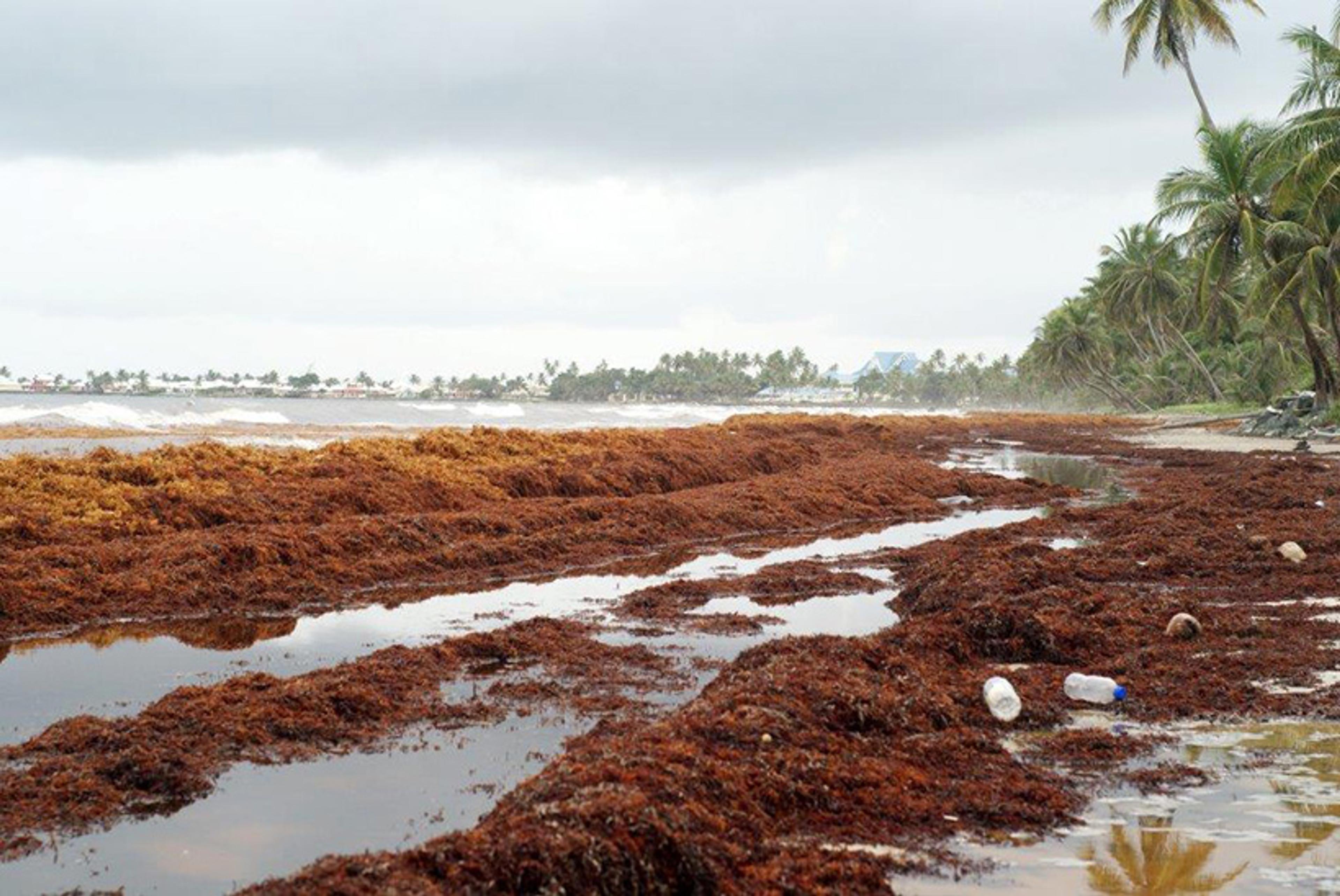
Sargassum seaweed covers the beach at Little Rockly Bay, Tobago. Photo courtesy rjsinenomine/Flickr
That’s not just how scientists use the term. It’s established in law. In the US, Executive Order 13112 (1999) defines ‘invasive species’ as ‘an alien species whose introduction does or is likely to cause economic or environmental harm or harm to human health.’ India’s Wild Life Protection Act (1972) says invasive species are ‘alien species which pose a threat to the wildlife or habitat in India.’ Biodiversity Act 10 (2004) in South Africa also defines ‘invasive’ as a species ‘outside of its natural distribution range’ that could ‘result in economic or environmental harm or harm to human health.’
Biological invasions are, like climate change, an ecological crisis that our species is responsible for
These species can cause all sorts of problems. Some have already spread disease to humans and wildlife. Consider how mosquitoes from the Aedes genus, such as the Asian tiger mosquito, have recently carried the dengue virus to Europe and yellow fever across the Americas and Africa. Other species have driven native animals to extinction, as occurred in the case of the brown tree snake (Boiga irregularis), which is believed to have hitchhiked to Guam on US Navy ships and within a couple of decades had wiped out most of the island’s native bird populations. Invasive species can even change the character of entire ecosystems for the worse. For example, the increasing number and intensity of wildfires around the world is a particularly detrimental effect of climate change, but it’s not just due to increased temperatures and shifting weather patterns. Invasive plants have made some ecosystems more prone to intense fires.
Whole economies can feel the impact of invasive species. The largest comprehensive scientific study on alien species, published by the Intergovernmental Science-Policy Platform on Biodiversity and Ecosystem Services in 2023, identifies 3,500 established harmful invasive species, and estimates that they cost the globe a staggering amount each year: nearly half a trillion dollars. The report also claims that such species have become one of the top five drivers of biodiversity loss. Take a second to imagine 3,500 cases of invasive species, each with the kinds of detrimental effects described above, and you understand the scope of the problem. You also start to understand why it is our problem: these species often invade because we humans provide them with the means. In some cases, we’ve intentionally introduced them to new lands and waters. In others, we’ve unintentionally provided them with new means of dispersal on planes, trains, ships and trucks. That means biological invasions are, like climate change or plastics pollution, an ecological crisis that our species is responsible for and should thus take charge in addressing. But what are we to do?
Scientists and governments clearly take the threat of invasive species seriously and, when it comes to combating them, environmental science and policy have managed to work hand in hand surprisingly well. It’s often a tough battle to get governments to regulate greenhouse gas emissions, plastics pollution, and other serious drivers of environmental harm. By contrast, states have tended to be very willing to fight back against invasive species. I already mentioned New Zealand’s ambitious Predator Free 2050 programme, which parallels Australia’s drive to eradicate feral cats, as well as hundreds of invasive predator-eradication projects on other islands around the world.
A different front of the war is biosecurity. Travellers will be familiar with measures meant to prevent the transit of invasive species, such as when the interiors of passenger planes get sprayed with pesticide to kill invasive insects just before landing. Similarly, at many borders, cargo is inspected for hitchhiking invaders. At the local level, municipalities often fight their own battles through invasive plant-removal programmes, and many have codes and ordinances that encourage the use of native plants while discouraging the spread of alien species.
Many of the fundamental assumptions behind the idea of invasive species are not always supported by science
These kinds of actions are widespread in part because invasive species management isn’t just a conservation issue. Many of these policy measures are carried out by public health agencies and agriculture ministries, for instance. Some governments even consider invasive species as threats to national security. In the US, for instance, the Department of Homeland Security is one of the major actors in invasive species management and a key member of the National Invasive Species Council.
Governments have been very willing to take significant action to eradicate, manage and prevent the spread of invasives. It’s no surprise then that the field of invasion biology has experienced exponential growth in its four-decade history. Whether we’re counting the number of researchers, the number of scientific publications, or the number of research questions and hypotheses, it’s been an explosive adolescence for the relatively young science.
This is good news, because invasion biologists have produced a lot of excellent research to help us understand our rapidly changing planet. But invasion biologists are not the only ones studying the changing movements of species. In the past decade, a range of experts have begun to look closely at the data and they are finding that many of the fundamental assumptions behind the idea of invasive species – some of which go back to the early 19th century – are not always supported by science. In fact, determining whether a species is ‘harmful’ seems to rely on a troubling double standard: why do we judge alien species according to one set of rules, and native species according to another?
We have rigged the game against alien species. Why do we treat their normal, healthy contributions to ecosystems as evidence of misbehaviour, even though we celebrate the same behaviour in native species? And in cases where an alien species really is harmful, why do we sentence them to eradication, when similar cases of harm caused by native species call for damage to be mitigated in less violent ways? These double standards are part of a scientific bias against alien species that some researchers and philosophers have taken to calling ‘ecological nativism’: a dogmatic presumption that native species should be favoured over alien species.
I had a striking encounter with ecological nativism a few years ago when I was part of a group working to restore a riverside landscape in Utah. During a planning meeting, the team descended into an unexpectedly heated debate about shrubbery. At issue was which species we should plant to filter pollutants. To many of us, the obvious answer would emerge from experimentation: test different groupings of plant species, take measurements, and see which worked best. But the conservation biologist on our team was certain that all this was unnecessary because the right answer was obvious: if we planted native plant species everything would work out. This is textbook ecological nativism – the idea that a species’ geographic origin tells us pretty much everything we need to know. It’s a view that is now ubiquitous.
In a systematic review of the scientific literature, the biologist Patricio Pereyra and colleagues found that 66 per cent of scientific articles frame alien species negatively, 33 per cent neutrally, and only 1 per cent positively. That’s not necessarily problematic, since it is possible that those alien species may have deserved the negative framing if they really were harmful. But Pereyra and co found that how a species is framed in the scientific literature is independent of evidence of harm. An alien species we know little about is just as likely to be framed negatively as one that has been implicated in driving extinction. Species on the World’s Worst Invasive Alien Species list, which the International Union for Conservation of Nature compiles based on evidence of harm, have the same probability of being negatively, neutrally or positively framed as species that are not remotely contenders for such a blacklist. In other words, even in the peer-reviewed scientific literature, the presentation of alien species as dangerous is a function of a widespread nativist bias, not data-driven analysis.
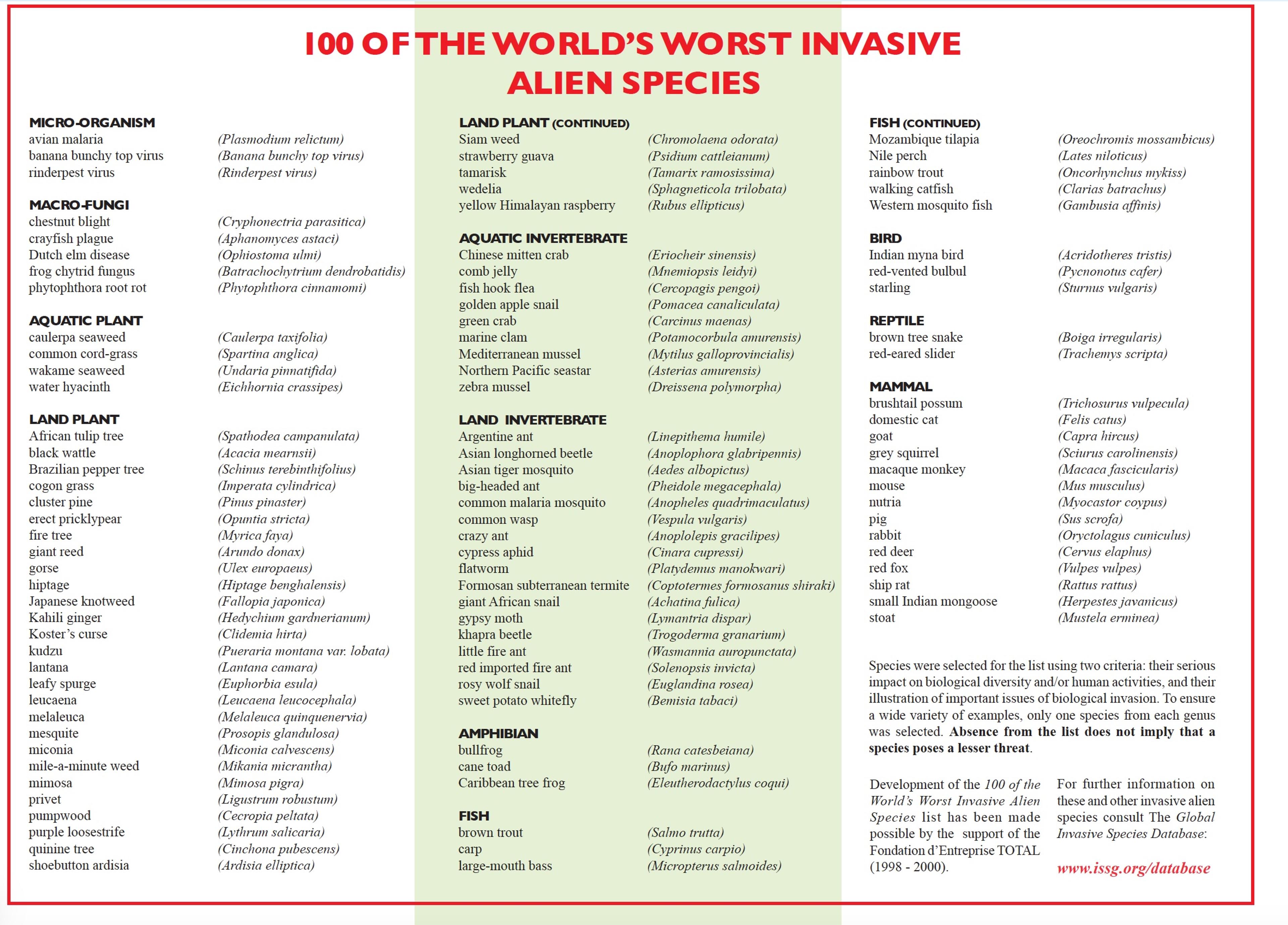
Courtesy IUCN
If we revisited the scientific data without the bias of nativism, we’d probably end up with a very different account of the harms of alien species: no thousands of invasive species, no hundreds of billions of dollars in damages each year, no ‘top driver of biodiversity loss’ status. That’s not to say that there aren’t plenty of cases of problematic invasive species, just that the overall scientific picture that’s informing policy is heavily skewed by nativist dogma.
Most threatened or extinct mammal species have been attributed to cats or foxes without evidence
A handful of scientists and philosophers have been raising concerns about this dogma for years. In a 2011 letter to Nature, for instance, a group of ecologists led by Mark Davis asked that we ‘don’t judge species on their origins.’ Similarly, the philosopher of economics Mark Sagoff argued that the scope of the damages caused by alien species is wildly overstated, which is why ecological nativists tend to justify their claims by appealing to consensus among themselves rather than to empirical evidence. That gets to the heart of the issue. Is nativist suspicion of alien species driven by prejudice or supported by the data?
It would take a monumental effort to revisit all the research, but when we’ve examined studies about particular cases, the results are revisionary. For instance, the majority of Australia’s modern mammal extinctions are usually blamed on invasive cats and foxes. The biologists Arian Wallach and Erick Lundgren recently went looking for the data that supports this view, and found that, for 70 to 80 per cent of purported cases, no such data exists. Worse, once we look at the available data, it seems that most threatened or extinct mammal species have been attributed to cats or foxes without evidence. It’s unlikely, or even impossible, that these alien predators are the real drivers of extinction. If expert opinion isn’t accountable to basic reality checks, it’s probably driven by nativist bias, not scientific evidence.
It can be risky to question ecological nativism. When Wallach and Lundgren presented some of their data at an international meeting of conservation biologists in the summer of 2025, they were labelled ‘invasive species denialists,’ and accused of being ideologically motivated. Those of us who question ecological nativism are used to this sort of response. It’s how we’re dismissed in the scientific literature. Ironically, however, it’s those of us accused of scientific denial who are asking for better science. Accusations of ecological danger need to be based on empirical evidence rather than just expert opinion. This isn’t to deny that some alien species can be harmful and need to be managed. It just means requesting a fair trial for an organism before the eradication programmes begin.
At present, invasive species are not assessed in the same way as native ones. Placed side by side, these treatments reveal a set of double standards. First, native species are presumed innocent, while alien species are presumed dangerous. Second, we are told to learn to live with the former, while eradication is treated as the default response to the latter. But these assumptions don’t seem to be grounded in data. They function instead as prior judgments that shape how evidence is gathered, interpreted and presented. In this sense, ecological nativism is not a scientific discovery, it’s a rigged result we arrive at because we look only for data that will confirm our prejudices.
A healthy ecosystem is healthy because of the complex web of interactions between its participants. These interactions are called ecological ‘functions’. Bees and butterflies pollinate; pollination is an ecological function. Fungi decompose dead wood; decomposition is a function. Plants produce organic compounds through photosynthesis; biologists call this function ‘primary production’. Ecosystems thrive when these functions are performed by the diversity of organisms and processes within them. The first nativist double standard involves calling a function harmful when an alien species performs it, even though the same function would be seen as beneficial when performed by a native species.
Consider the invasive Burmese pythons in Florida. They’re widely regarded as an ecological disaster, primarily because they’re such effective predators of small mammals. One study on the effects of pythons in the Everglades attributes a 99 per cent decrease in observed raccoons and opossums to the snakes, a fact that has been used to justify issuing bounties on pythons and paying hunters to eradicate them.
The idea that pythons are harmful because they prey on native species might be intuitive, but it’s not necessarily good ecological science. Predators, you can learn in any introductory ecology class, are often keystone species that keep an ecosystem healthy. They keep their prey from overexploiting an environment and thus serve as the ‘keystone’ holding the whole food web together. Predation is violent, but it’s often essential to ecosystem health.
Are pythons keeping their prey species in check in ways that lead to healthier ecosystems?
Conservation scientists are quick to recognise this fact when it comes to native species. They celebrate, for instance, the reintroduction of wolves to places like Yellowstone and Isle Royale in the US, pointing to how those predators keep herbivores like deer and elk from stripping the vegetation bare. This has become a well-established conservation success story.
Rather than asking whether pythons prey on native species, we should consider a different question: are pythons keeping their prey species in check in ways that lead to healthier ecosystems? The available data we have on python predation doesn’t provide a full answer, but the herpetologist-philosopher Derek Halm has argued that pythons are likely a keystone species on any fair assessment. Biologists familiar with the python case have told me that, even in the absence of systematic data, anecdotal evidence suggests the pythons are preying on healthy populations to the benefit of vulnerable species. For instance, the pythons do eat a lot of raccoons but, as anyone in proximity to a garbage bin in North America can tell you, raccoons are anything but endangered. The raccoons in Florida, however, have a taste for the eggs laid by vulnerable sea turtles. By keeping native raccoons in check through predation, the alien pythons might be helping protect endangered turtle species.
I’ve focused on the function of predation, but the double standard applies to any ecological function. Remember those golden oyster mushrooms that have been blacklisted? They’ve been granted the ‘invasive’ label based on evidence that they compete with native fungi. But competition is a normal, functional part of ecosystems. It is the foundation of biological evolution. You can bet those native fungi also compete with each other. I’ll panic about the golden oyster mushrooms when I see evidence that they are dangerously outcompeting native fungi with demonstrable harms to ecosystem processes. Unless you are evaluating the mushrooms according to a nativist double standard, there’s no reason for panic.
I’m not denying that wildlife can cause serious harms to ecosystems as well as to human health and livelihoods. For example, in conservation circles recently, I’ve been hearing a lot about a species running rampant in parts of Africa, destroying the crops that subsistence farmers depend on, turning healthy forests into expanses of dust, and threatening to attack people, forcing villagers to hide in their homes when they could otherwise be working and socialising. You might not know about all these harms, but I’m certain you’re familiar with this highly destructive animal: the African elephant.
What are we to do about this menace, which threatens so many people, crops and ecosystems over much of the continent? If I suggested a solution that involved killing off elephants in large numbers, you’d probably be appalled, as you should be. Current thinking in conservation science is that human-wildlife conflict should preferably be solved not through eradicating organisms that come into conflict with humans, but by finding means of coexistence.
A group called Elephants Alive, for instance, sends out daring conservationists on motorbikes to steer elephant herds away from villages by – I promise this is real – throwing eggs injected with hot sauce at the animals. Elephants hate the capsaicin in spicy food. Farmers in South Africa are planting rows of chillies, which the pachyderms refuse to walk through, to keep herds out of their crops. Rural Gabonese are planting decoy trees well outside their villages, so that herds will choose the literal low-hanging fruit in the orchards rather than coming into town for a snack and putting people in danger.
Perhaps it’s the fact that those parrots are in little danger of extinction that justifies using lethal methods
When a harmful species is a native species, like African elephants in Africa, people will go to great lengths to peacefully coexist. When a harmful species is an alien, however, the standard response is to eradicate with prejudice. Consider the spread of parrots across Europe. Like elephants in Africa, parrots in Europe eat human crops and otherwise disrupt human activities. Also like elephants, parrots are social, highly intelligent animals who likely have rich inner lives and form meaningful relationships. But, unlike elephants in Africa, parrots in Europe are considered alien, and mass parrot kills have been pursued or proposed in places like England and Spain.
If it were merely a question of mitigating harm, the approach we’d take to parrots would thus be similar to the approach we take towards elephants. We’d pursue creative solutions to coexist in ways that don’t require eliminating animals from our shared spaces.
However, there’s a relevant difference between parrots and elephants. Many elephant populations and species are a flagship endangered species, and we want to avoid eradicating herds because we want to preserve them. While some alien parrot species are on the cusp of being threatened in their native ranges, and at least one is classified as endangered, other species such as the green monk parakeets (Myiopsitta monachus) in Spain are not, and perhaps it’s the fact that those parrots are in little danger of extinction that justifies using lethal methods.
Regardless of whether a species is vulnerable or not, we should be concerned about employing unnecessarily destructive methods of control. Culls cause immense suffering to sentient animals. Poisoned bait used to kill off aliens can harm innocent bystander species. And the herbicides used to control riparian invasive plants often end up in our water supply. Lethal measures are costly measures, which is a good reason to take the same attitude towards alien ‘invaders’ that we take towards native species: pursue coexistence, and take destructive measures only if all else fails.
Ecological nativism has become the dominant view in the environmental sciences. For this reason, asking questions about established research can lead to accusations of anti-environmentalism – especially when invasive species are seen as major drivers of biodiversity loss. But that couldn’t be further from the truth. Disagreements with ecological nativists are almost entirely about what the scientific evidence supports. They’re not about values. In fact, I share with nativists a commitment to environmental values, including conserving healthy species and ecosystems, finding sustainable futures for humans and non-human organisms alike, and ensuring that spaces are retained for wildness on our increasingly human-dominated planet.
That last value is particularly important. ‘Wildness’, as I’m using the term, is nature acting independently of human management and control. A carefully tended garden might be lovely, but it isn’t wild like a grassland that develops without human intervention. A wave formed by ocean winds is wild, unlike one generated by a machine in a wavepool. Conserving wildness is a core environmental value. If conservation just meant preventing species extinctions, we could preserve endangered species in zoos and call it a day. But we’d much rather preserve wild populations that can operate free from captivity and human micromanagement. If environmentalism just meant preserving resources, we’d plant tree farms rather than saving forests in their wonderful, diverse, messy states. Doing conservation right means letting some of nature operate outside our control.
Ironically, by doubling down on ecological nativism, environmentalists risk undermining wildness. Fighting against so-called invasive species is a heavy-handed way of micromanaging ecosystems. By being more open to alien newcomers, we allow ecosystems to respond to change in their own unpredictable way. The war against invasive species tends to fail because the very ‘wild’ features that make those species invasive also make them effective at resisting human management and control.
Determining whether an alien species crosses the line is a question we should approach on a case-by-case basis
Wildness everywhere has been reduced through habitat destruction, pollution and climate change. But allowing species to fight for a space in this new world – a space we humans didn’t reserve for them – is one way that wildness can be preserved. It is also one way of becoming a better environmentalist.
Embracing wildness doesn’t entail that we should never try to control or eradicate alien species, since wildness isn’t the only thing we value. Consider the tiger mosquito referenced at the start of this essay, which has spread dengue and yellow fever. Whatever wildness it represents is clearly outweighed by the serious harms it presents to human health. The threat that alien rats pose to vulnerable bird populations on islands in the Pacific might be another case where wildness is outweighed by serious and well-demonstrated harms to native species. But determining whether an alien species crosses the line is a question we should approach on a case-by-case basis. The standard of evidence should be higher than the nativist’s guilty-until-proven-innocent approach. Moreover, going to war requires weighing the broad social and ecological values involved, as has been done in the case of the Predator Free 2050 eradication programme.
Labelling a species as an ‘invasive’ – one that needs to be fought and defeated – is a complicated political decision, too. Managing these animals requires substantial evidence-gathering and broad social conversations. There’s not always a clear answer. How should Colombia, for example, think about its introduced hippopotamus population?
In one of the stranger cases of animal ‘invasion’, the Colombian drug lord Pablo Escobar in 1981 imported four hippos to a massive estate far outside Medellín. After his death in 1993, they escaped and bred. What should happen to the estimated 200 or so hippos now thriving in Colombia? That’s a controversial question, and it should be. Whether the hippos are allowed to thrive or are eradicated will be a consequential decision requiring scientific evidence and democratic input. The point is that we shouldn’t jump to the conclusion that they must be removed from Colombia just because they’re a high-impact alien species. Instead, we might learn to see them, and other introduced species, as representations of wildness, refugees and not invaders, and good ecological citizens that we might even learn to live alongside.
Though coexistence won’t always be possible or desirable, it should be an option worth considering. But as long as the double standards of ecological nativism endure, it’s not something that will be given serious thought. Instead, Burmese pythons, monk parakeets, golden oyster mushrooms or other ‘invasives’ will continue to be judged on their origins, not their ecological merits.